 India's No.1 PU & Degree With Integrated IAS & IPS(UPSC/PSC) Training College.


Ethanol Blending in India: Promise and Challenges
Ethanol Blending in India: Promise, Pitfalls and the Road Ahead
Syllabus:
GS Paper – 3
Environmental Pollution & Degradation ,Renewable Energy 2nd ARC
Why in the News ?
- India has achieved 20% ethanol blending (E20) five years ahead of the National Policy on Biofuels target.
- From 5% in 2014 to 20% in 2025, ethanol blending has grown rapidly, backed by government support.
- While projected as a win for farmers, environment, and import reduction, the policy faces serious challenges in agriculture, consumer acceptance, and environmental sustainability.
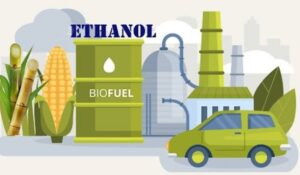
Ethanol Blending: Progress and Policy Push
- E20 Petrol: Petrol mixed with 20% ethanol, rolled out by Indian refiners.
- Policy Support:
- National Policy on Biofuels (2018, revised 2022) advanced the E20 target to 2025.
- Fiscal incentives for sugarcane and ethanol industries.
- Achievements:
- Ethanol blending rose from 1.5% (2014) to 20% (2025).
- India saved ₹1.40 lakh crore foreign exchange since 2014-15.
- CO2 emissions reduced by 700 lakh tonnes, according to the Ministry of Petroleum and Natural Gas.
- Supply Growth:
- Sugarcane-based ethanol rose from 40 crore litres (2014) to 670 crore litres (FY24).
- Rice and corn also being diverted for ethanol.
About National Policy on Biofuels :● National Policy on Biofuels (2018, revised 2022) – target: 20% ethanol blending by 2025, achieved early. ● Fair and Remunerative Price (FRP) – assured price mechanism for sugarcane farmers. ● Ethanol Blending Programme (EBP, 2003) – initiated with 5% blending. ● National Electric Mobility Mission Plan (2013) – framework for EV adoption. ● FAME I & II Schemes – incentives for EVs. ● Paris Agreement (2015) – India’s NDCs: 33–35% emission intensity reduction by 2030. ● Net Zero Target – India pledged to achieve net zero by 2070 (Glasgow COP26). ● Water Context: Sugarcane needs 1,500–3,000 mm rainfall, but much of India relies on irrigation → links to Groundwater Act, 2005 (regulation). ● Articles 39(b) & 47 – Directive Principles supporting sustainable resource use and nutrition (food vs. fuel debate). |
Public and Industrial Response
- Vehicle Compatibility:
- Since 2023, new vehicles sold carry E20-compatible stickers.
- Older vehicles may face issues with rubber, elastomers, and plastic components.
- Consumer Concerns:
- LocalCircles survey: 2 in 3 petrol owners oppose E20 mandate.
- Concerns: drop in mileage, higher maintenance cost.
- Government’s Stand:
- Admits “marginal drop” in efficiency but insists it can be fixed with better engine tuning.
- Minister Hardeep Singh Puri dismissed opposition as a “vilification campaign” by vested interests.
- NITI Aayog recommended tax incentives on E10 and E20 to compensate consumers.
- Public Sector Oil Companies (PSUs):
- Despite saving on imports, PSUs passed only 2% reduction in petrol prices to consumers, despite a 65% fall in oil prices since 2022-23.
Agriculture and Environmental Concerns
- Sugarcane Dependence:
- One tonne sugarcane needs 60–70 tonnes of water.
- Most sugarcane-growing areas (e.g., Maharashtra) rely on groundwater extraction.
- Sugarcane accounts for 9% of India’s sugar output being diverted for ethanol.
- Water Stress:
- 2023 Central Groundwater Board report: sugarcane districts extract more water than non-sugarcane areas.
- 30% of India’s land degraded (Desertification and Land Degradation Atlas 2021).
- Diversification Efforts:
- Rice allocation for ethanol jumped to 5.2 million metric tonnes in 2024-25.
- Corn: 34% diverted to ethanol, forcing 7 lakh tonnes of corn imports (6x rise from last year).
- Farmer Incentives:
- ₹1.20 lakh crore paid to farmers since FY15.
- Fair and Remunerative Pricing (FRP) ensures sugarcane’s steady profitability, making diversification harder.
- OECD-FAO projection: By 2034, 22% of India’s sugarcane will go to ethanol.
Global Reactions and Trade Tensions
- S. Concerns:
- The S. Trade Estimate Report (2025) calls India’s restrictions on ethanol imports a “significant trade barrier.”
- The Trump administration pushing India to relax restrictions.
- The S. Trade Estimate Report (2025) calls India’s restrictions on ethanol imports a “significant trade barrier.”
- Indian Sugar Mills Association (ISMA): Strongly opposes import relaxation → would undermine domestic ethanol industry built over a decade.
- Geopolitical Angle: India’s ethanol boom is seen as strategic autonomy in energy but may face WTO disputes if protection continues.
5. Ethanol vs. EV Transition
- Emission Savings:
- Ethanol blending reduced 700 lakh tonnes CO2.
- But EV adoption offers greater long-term emission cuts.
- Slow EV Adoption in India:
- EVs = 6% of sales in 2024, target is 30% by 2030.
- Needs 22% annual growth in next 5 years.
- Barriers:
- Rare Earth Element (REE) dependency – crucial for batteries and motors.
- China dominates REE supply → India vulnerable.
- Example: Maruti Suzuki cut EV targets due to REE shortages.
- Global Comparison:
- S., EU, China → EV adoption far ahead.
- Beijing’s air quality improved largely due to rapid EV shift.
- Policy Dilemma:
- Push ethanol blending beyond 20% OR accelerate EV adoption?
- Government signals mixed; no final decision yet.
Challenges :
- Consumer Resistance: E20 adoption unpopular due to lower mileage and higher costs.
- Environmental Sustainability:
- Sugarcane is water-intensive.
- Causes groundwater depletion and land degradation.
- Food vs. Fuel Dilemma: Diversion of rice and corn risks food security and raises import bills.
- Unequal Benefits: Farmers benefit from assured FRP payments, but consumers see little petrol price relief.
- Energy Policy Confusion: Lack of clarity on whether to expand ethanol blending beyond 20% or shift focus to EVs.
- EV Barriers: REE shortage, high costs, weak charging infrastructure.
- Global Pressure: U.S. pushing for ethanol import liberalisation, risking domestic producers.
- Long-term Climate Goals: Ethanol alone cannot deliver net-zero targets; must integrate with EVs + renewables.
Way Forward :
- Balanced Approach: Ethanol blending should complement, not substitute, EV transition.
- Diversify Feedstock: Move beyond sugarcane → encourage maize, sorghum, cellulosic ethanol.
- Water-Smart Policies: Incentivise farmers for drip irrigation, crop diversification, water-efficient crops.
- Consumer Relief:
- Introduce tax incentives for E20 use.
- Ensure PSUs pass fuel savings to the public.
- Strengthen EV Ecosystem:
- Invest in charging infra, battery R&D, and REE exploration in India.
- Secure rare earth supply chains via diplomacy and FTA agreements.
- Global Strategy: Maintain ethanol import restrictions to protect domestic industry.
- Policy Clarity: Government must signal if the future strategy is high-blend ethanol (E85) or EV dominance.
- Integrated Climate Action: Combine ethanol blending, EV adoption, and renewable energy growth for sustainable decarbonisation.
Conclusion :
Ethanol blending has given India foreign exchange savings, farmer support, and emission reductions. Yet, over-reliance on water-intensive sugarcane and consumer backlash highlight its limits. A balanced approach, integrating ethanol with EV adoption and renewable energy, is essential to ensure sustainable growth and align with India’s net-zero 2070 goal.
Source : TH
Mains Practice Question :
Critically examine the impact of ethanol blending on India’s energy security, agriculture, and environmental sustainability. Discuss whether ethanol can be a transitional solution or if the long-term strategy should prioritize electric mobility and renewable energy.

