 India's No.1 PU & Degree With Integrated IAS & IPS(UPSC/PSC) Training College.


El Niño Threatens India’s Economy and Livelihoods
El Niño Threatens India’s Economy and Livelihoods
Why in the News ?
Forecasts indicate a high probability of El Niño developing during 2026–27, raising concerns about below-normal monsoon rainfall in India. Experts warn that its impact may extend beyond weather, affecting agriculture, employment, inflation, and overall economic stability, necessitating comprehensive environmental impact assessment of adaptation measures.
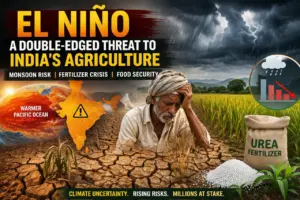
El Niño as an Economic and Development Challenge
- According to forecasts, El Niño is likely to emerge during 2026 and persist into 2027, increasing the risk of weaker monsoon conditions.
- The India Meteorological Department (IMD) has projected monsoon rainfall at 92% of the Long Period Average (LPA), categorised as below normal.
- Climate-related shocks in India quickly translate into economic challenges due to the country’s dependence on climate-sensitive sectors.
- A weak monsoon can reduce rural incomes, affect agricultural productivity, and increase economic uncertainty.
- The impact is particularly severe on the informal sector, where a large proportion of workers depend directly on weather-sensitive activities.
- El Niño is therefore increasingly viewed as a development and economic risk, rather than merely a meteorological phenomenon.
Impact on Labour, Agriculture and Inflation
- Rising temperatures and prolonged heatwaves reduce the productivity of outdoor workers such as construction labourers, agricultural workers, street vendors, and delivery personnel.
- Heat stress lowers working hours, reduces earnings, and increases health risks for vulnerable populations.
- Agriculture remains highly dependent on monsoon rainfall, which provides nearly 70% of the water required for crops and groundwater recharge.
- Uncertain rainfall can increase irrigation costs, intensify groundwater extraction, and disrupt sowing decisions.
- Climate-induced crop stress often leads to higher prices of vegetables, pulses, and essential food items.
- Food inflation can create policy challenges by simultaneously slowing economic growth and increasing price pressures.
- Urban areas are also becoming more vulnerable due to rising temperatures, shrinking green spaces, and growing water scarcity.
About El Niño and ENSO :● El Niño is the warm phase of the El Niño-Southern Oscillation (ENSO) phenomenon. ● It is characterized by abnormal warming of surface waters in the central and eastern equatorial Pacific Ocean. ● El Niño often weakens the Indian Southwest Monsoon, leading to below-normal rainfall. ● The opposite phase, known as La Niña, is associated with cooler Pacific waters and often stronger monsoon conditions in India. ● ENSO significantly influences global weather patterns, including droughts, floods, cyclones, and temperature anomalies. ● Monitoring of ENSO conditions is carried out by agencies such as the National Oceanic and Atmospheric Administration (NOAA) and the India Meteorological Department (IMD). |

