 India's No.1 PU & Degree With Integrated IAS & IPS(UPSC/PSC) Training College.


THE MECCA PACT AND THE RISE OF STRATEGIC HEDGING
THE MECCA PACT AND THE RISE OF STRATEGIC HEDGING
Syllabus:
GS-2:
- Centre State Fiscal relation
- Governance
- Devolution of Power
Why in the News?
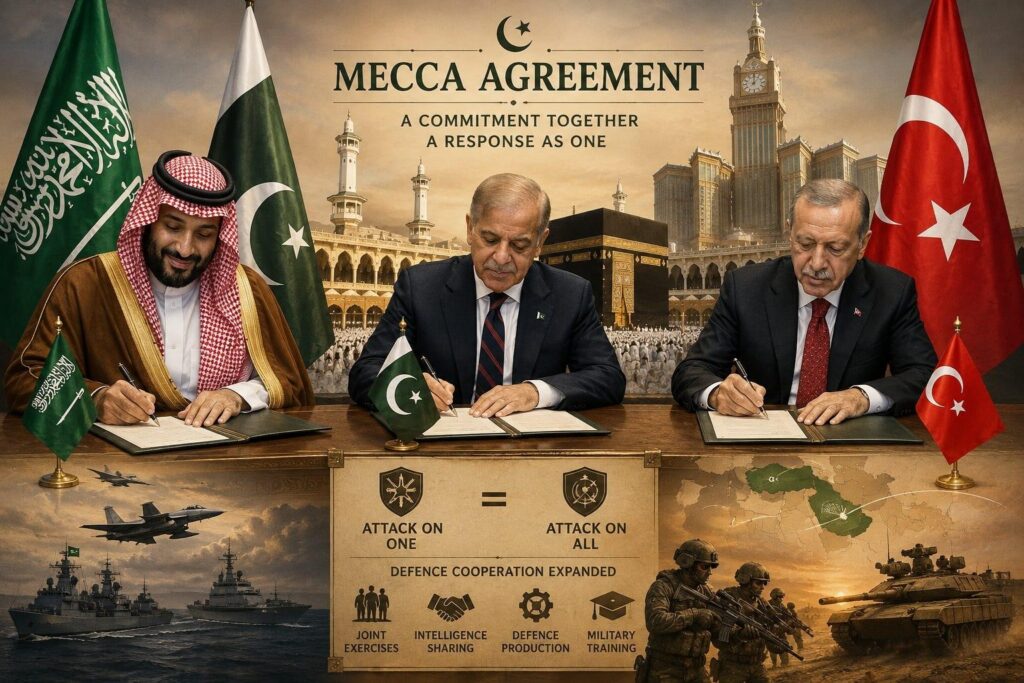
Saudi Arabia, Türkiye and Pakistan signed a mutual defence pact in Mecca on August 7, potentially altering West Asian security calculations. The agreement reflects growing efforts by regional powers to supplement external security guarantees with indigenous strategic arrangements. India must assess the pact carefully because of Pakistan’s participation, Türkiye’s position on Kashmir and its expanding strategic relationship with Saudi Arabia.
STRATEGIC HEDGING AND INDIA’S FOREIGN POLICY
- Strategic Autonomy: India’s strategic autonomy seeks independent decision-making while allowing issue-based partnerships with competing major and regional powers.
- Multi-Alignment: Contemporary Indian diplomacy increasingly follows multi-alignment, involving simultaneous engagement with the U.S., Russia, Gulf states, Iran, Israel and Indo-Pacific partners.
- SAGAR Doctrine: India’s SAGAR — Security and Growth for All in the Region — promotes maritime security, economic cooperation and capacity-building across the Indian Ocean region.
- West Asian Interests: India’s West Asian priorities include energy security, diaspora welfare, trade, investment, maritime connectivity and counter-terrorism cooperation.
- Foreign Policy Principle: The emergence of regional security arrangements reinforces India’s need for flexible partnerships without excessive dependence on any single external or regional power.
MECCA PACT AND REGIONAL SECURITY ARCHITECTURE
- Security Shift: The agreement signals movement from predominantly externally guaranteed security towards greater regional responsibility for managing strategic threats and vulnerabilities.
- Mutual Defence: The provision treating an attack against one member as an attack against all strengthens perceptions of collective deterrence among participating states.
- Regional Agency: The pact demonstrates increasing willingness among major Muslim powers to exercise greater strategic autonomy rather than depend exclusively upon Western security arrangements.
- Institutionalisation: By formalising existing bilateral military relationships into a trilateral framework, the agreement gives greater institutional depth to regional security cooperation.
- Strategic Context: The pact emerges amid conflicts involving Iran, Israel, Gulf states and external powers, increasing incentives for regional states to diversify security partnerships.
COMPLEMENTARY STRATEGIC CAPABILITIES OF THE PARTNERS
- Saudi Resources: Saudi Arabia contributes enormous financial resources, energy influence and political weight across the Arab and wider Islamic worlds.
- Turkish Strength: Türkiye brings substantial conventional military capabilities, NATO experience and an increasingly sophisticated indigenous defence-industrial base.
- Pakistani Capability: Pakistan contributes extensive military experience and, most importantly, a nuclear weapons capability that significantly influences deterrence calculations.
- Strategic Synergy: Combining financial power, conventional military strength, defence technology and nuclear capability creates considerable strategic complementarity.
- Geographical Reach: The partnership connects the Gulf, West Asia and South Asia, thereby expanding the geographical scope of strategic cooperation.
MOTIVATIONS BEHIND STRATEGIC HEDGING
- Saudi Insurance: Riyadh seeks greater strategic insurance after experiencing vulnerabilities from attacks on critical infrastructure and uncertainty surrounding external security guarantees.
- Turkish Autonomy: President Erdoğan has sought to transform Türkiye into an independent centre of power, expanding its influence beyond its traditional NATO-centric security role.
- Pakistani Expansion: Islamabad gains an opportunity to convert its military capabilities into greater geopolitical influence beyond its traditional India-focused security calculations.
- Defence Opportunities: Türkiye can expand its defence-industrial exports, while Saudi Arabia can diversify security partnerships without abandoning American military cooperation.
- Risk Management: Strategic hedging enables all three states to retain existing alliances while developing alternative security options against future geopolitical uncertainty.
STRATEGIC HEDGING AND THE U.S. ROLE
- American Presence: The pact does not displace Washington because Saudi Arabia continues to depend substantially on American military technology and security guarantees.
- Reduced Dependence: Regional states increasingly recognise that excessive reliance on one external power can create strategic vulnerabilities during unexpected geopolitical crises.
- Hedging Logic: Strategic hedging involves maintaining relationships with competing powers while developing sufficient independent capabilities to avoid overdependence on a single actor.
- Cumulative Transformation: Individual hedging decisions may appear limited, but simultaneous diversification by major states can gradually alter the regional balance of power.
- Multipolar Order: Such developments could contribute to a more multipolar West Asian security architecture, where regional powers exercise greater strategic agency.
IMPLICATIONS FOR INDIA
- Saudi Partnership: India should not automatically view the agreement as anti-Indian because Saudi Arabia has substantial economic and strategic interests in maintaining close relations with New Delhi.
- Pakistan Factor: Pakistan’s participation nevertheless requires India to assess whether the agreement could become relevant during a future India-Pakistan military confrontation.
- Turkish Challenge: Türkiye remains a significant concern because Ankara has repeatedly supported Pakistan’s position on Kashmir and strengthened defence cooperation with Islamabad.
- Diplomatic Assurance: New Delhi should seek explicit assurances from Riyadh that the pact has no application to potential India-Pakistan conflicts.
- Broader Lens: India should analyse the development within the larger West Asian geopolitical framework, rather than viewing it exclusively through the India-Pakistan prism.
IMPLICATIONS FOR IRAN AND ISRAEL
- Iranian Concerns: The pact could appear anti-Iranian because of longstanding Saudi-Iranian rivalry and recent military tensions across the region.
- Shared Interests: Türkiye and Pakistan, however, have geographical and strategic interests requiring stable relations with Iran, limiting their incentives for direct confrontation with Tehran.
- Israeli Response: Israel could view greater coordination among these three powers with concern because regional fragmentation has historically contributed to its strategic advantages.
- Nuclear Dimension: Pakistan’s nuclear capability introduces a qualitatively important factor into regional deterrence, although the agreement does not constitute a formal nuclear guarantee.
- Complex Alignment: Consequently, the pact should not be simplistically interpreted as an anti-Iranian or anti-Israeli coalition, given the divergent interests involved.
FROM EXTERNAL GUARANTEES TO REGIONAL OWNERSHIP
- Historical Dependence: West Asian security has historically relied heavily on external powers, particularly the United States and earlier European powers.
- Regional Ownership: The Mecca pact reflects an emerging preference for regional security ownership, with local states increasingly assuming responsibility for collective defence.
- Security Pluralism: Such arrangements could create overlapping security networks instead of a single dominant alliance, increasing strategic flexibility for participating countries.
- Institutional Challenge: Regional security arrangements can succeed only if members manage their divergent interests, rivalries and threat perceptions effectively.
- Long-Term Shift: If similar initiatives multiply, West Asia could gradually move towards a more pluralistic and regionally driven security order.
INDIA’S STRATEGIC RESPONSE
- Deepen Engagement: India should strengthen relations with Saudi Arabia and Gulf partners, whose economic, energy and diaspora significance remains critical for Indian interests.
- Manage Differences: New Delhi should continue diplomatic engagement with Türkiye while clearly communicating concerns regarding Kashmir and defence cooperation with Pakistan.
- Iran Balance: India must preserve functional relations with Iran because of its importance for energy security, connectivity and access to Central Asia.
- Maritime Security: Greater Indian engagement with the Arabian Sea, Gulf and western Indian Ocean can strengthen India’s ability to respond to changing regional security dynamics.
- Strategic Autonomy: India should avoid choosing between competing blocs and instead pursue flexible partnerships, diversified relationships and independent strategic capabilities.
CONCLUSION
The Mecca Pact is significant not because it immediately replaces the U.S.-led security architecture, but because it reflects the growing tendency of regional powers to hedge against strategic uncertainty. Saudi Arabia, Türkiye and Pakistan possess different interests, yet all three see value in developing additional security options. For India, the appropriate response is neither alarmism nor complacency. New Delhi should deepen its engagement with Saudi Arabia and the Gulf, manage differences with Türkiye, monitor Pakistan’s military diplomacy and retain constructive engagement with Iran. Ultimately, the changing West Asian order reinforces the importance of India’s own strategic autonomy, diversified partnerships and regional capabilities.
SOURCE:
The Hindu
MAINS PRACTICE QUESTION
The Mecca Pact represents not an immediate rejection of the U.S.-led security architecture, but the emergence of strategic hedging by regional powers.” Discuss its implications for West Asian geopolitics and India’s strategic interests.

