 India's No.1 PU & Degree With Integrated IAS & IPS(UPSC/PSC) Training College.


E20 Ethanol Blending: Impact on Older Vehicles & Food
E20 Ethanol Blending: Older Vehicles, Food Security and the Way Forward
Syllabus:
GS – 3 –Ethanol blending , Sustainable Energy
Focus :
The article examines India’s ethanol-blending policy, particularly the transition to E20 petrol, highlighting genuine concerns for older vehicles and the broader food-versus-fuel trade-off. It assesses the implications of higher ethanol blending for agricultural land, maize and oilseed cultivation, water resources, energy security and environmental sustainability, while advocating E10 for older vehicles and caution before moving beyond E20.
Introduction
- India’s ethanol blending programme has become an important component of its energy, agricultural and environmental policy.
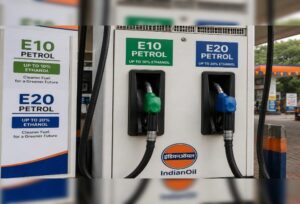
- The move towards E20 petrol, containing 20% ethanol, aims to reduce crude oil imports, support farmers, utilise surplus agricultural produce and reduce certain vehicular emissions.
- However, the transition to E20 has generated concerns about vehicle compatibility, fuel efficiency, water consumption and the growing use of food crops such as maize for ethanol production.
- The article argues that the debate should move beyond the question of whether E20 damages engines and focus on the more fundamental food-versus-fuel trade-off.
- It recommends bringing back E10 petrol for older vehicles, correcting distortions in crop pricing and water use, and carefully assessing the costs and benefits of moving beyond E20.
The Debate Around E20 Petrol
- E20 refers to petrol blended with approximately 20% ethanol.
- Ethanol contains considerably less energy per litre than petrol.
- Therefore, E20 can result in somewhat lower mileage compared with conventional petrol.
- However, the article argues that claims that E20 causes widespread engine damage or reduces mileage by around 30% are not supported by available evidence.
- The actual energy penalty is estimated at around 6–7%, rather than 30%.
Does E20 Damage Vehicle Engines?
Evidence from International Studies
- The United States has extensive experience with ethanol blending.
- Oak Ridge National Laboratory tested 86 vehicles over a cumulative distance of nearly 10 million kilometres using ethanol blends up to E20.
- The study reportedly found no significant increase in vehicle wear in vehicles not specifically rated for E20.
Evidence from India
- These studies have broadly indicated that E20 does not cause widespread mechanical damage in compatible vehicles.
- Therefore, generalised claims that E20 petrol inevitably damages modern engines are not supported by the available evidence.
The Genuine Problem: India’s Older Two-Wheelers
- Although the general concern regarding engine damage is exaggerated, there is a genuine compatibility problem involving India’s older vehicle fleet.
- India has approximately 75–80 million older two-wheelers, particularly vehicles manufactured before the BS-IV era.
- Many of these vehicles use carburettors rather than modern electronic fuel-injection systems.
Problem of Older Rubber Components
- The compatibility issue is not limited to the engine itself.
- Older vehicles may contain rubber seals and other components that were not designed to withstand higher ethanol concentrations.
- Ethanol can accelerate the deterioration of certain older materials.
- Replacing such components with ethanol-compatible alternatives is technically feasible and relatively inexpensive.
- However, replacing components across 75–80 million vehicles would take considerable time and require a large-scale retrofit programme.
Why E10 Should Be Reintroduced
- India’s original ethanol-blending roadmap recognised that older vehicles could face compatibility challenges.
- It envisaged the availability of lower-blend fuel for vehicles that were not compatible with higher ethanol concentrations.
- The article therefore recommends bringing E10 petrol back to fuel stations alongside E20.
Advantages of E10
- It would provide a safer option for older vehicles.
- It would reduce anxiety among vehicle owners.
- It would allow the existing vehicle fleet to transition gradually.
- It would give manufacturers and workshops time to undertake retrofitting.
- It could reduce the immediate demand for ethanol.
- Importantly, providing E10 does not necessarily undermine the ethanol programme; instead, it could make the transition more inclusive and technologically practical.
India’s Oil Import Dependence
- One of the primary objectives of ethanol blending is to reduce India’s dependence on imported crude oil.
- India has a very large crude oil import bill, estimated in the article at approximately ₹11–12 lakh crore annually.
- Ethanol blending can reduce the quantity of petrol derived from crude oil.
- However, the article argues that E20 reduces the crude oil import bill by only around 3–4%.
- Therefore, policymakers must evaluate whether increasing ethanol blending beyond E20 would generate sufficiently large energy-security benefits to justify its agricultural and environmental costs.
India’s Edible Oil Import Challenge
- India also has a substantial edible oil import dependence.
- The country’s edible oil import bill is estimated at approximately ₹1.6–1.75 lakh crore annually.
- India currently produces only around 40% of its domestic cooking oil requirement.
- The government aims to increase domestic production substantially, with a target of approximately 72% self-sufficiency by 2030–31.
- The article argues that reducing edible oil dependence may be a more achievable form of import substitution than significantly reducing crude oil dependence through increasingly high ethanol blending.
Food Versus Fuel: The Emerging Trade-Off
- The feedstock used for ethanol production has increasingly shifted from sugarcane towards grains.
- Maize now accounts for around half of India’s ethanol feedstock, while grains collectively account for nearly 67%.
- This creates a direct competition between fuel production and food and feed production.
- Therefore, expanding grain-based ethanol production can influence agricultural prices and cropping patterns.
Distillers’ Grain as Animal Feed
- Ethanol production from maize generates by-products that can be used as animal feed.
- These by-products can compete with soybean meal in the animal-feed market.
- If prices of alternative feed products decline, soybean prices can also come under pressure.
Impact on Oilseed Farmers
- India’s objective of reducing edible oil imports requires stronger domestic production of oilseeds.
- However, if agricultural land becomes increasingly attractive for maize production because of ethanol procurement incentives, farmers may shift away from oilseed cultivation.
- This can undermine India’s edible oil self-sufficiency goals.
- Therefore, ethanol policy cannot be designed independently of agricultural policy.
- Energy security, food security and farmers’ incomes must be considered together.
Water Consumption: The Need for a Better Assessment
- Ethanol production also raises concerns about water consumption.
- However, the article argues that commonly quoted estimates of water use can be misleading because they combine different categories of water.
Regional Water Stress
- Sugarcane-based ethanol can be particularly problematic in water-stressed regions.
- States such as Maharashtra and Karnataka have areas where groundwater and other freshwater resources are already under considerable pressure.
- Therefore, ethanol policy should not simply focus on the volume of water used.
- Water-intensive feedstocks should be discouraged in severely water-stressed regions.
Is Ethanol Always Environmentally Beneficial?
- Ethanol blending is often justified on environmental grounds because it can reduce certain vehicular emissions.
- However, the climate benefits of increasing ethanol blending beyond E20 are less certain.
- Higher blending levels may increasingly depend on grain-based ethanol.
- Life-cycle assessments of grain ethanol do not always produce uniform conclusions regarding its climate benefits.
Costs of Remaining at E20
- The article also recognises that stopping at E20 has its own costs.
- Some distilleries may have borrowed money based on expectations of continued ethanol demand.
- The sugar industry also uses ethanol as an important mechanism for managing sugar surpluses.
- Therefore, any change in ethanol policy must consider the financial implications for farmers, sugar mills, distilleries and investors.
Way Forward
- Bring Back E10 for Older Vehicles-E10 should be made available alongside E20 to protect older vehicles and ensure a smooth transition.
- Continue Retrofitting-Older vehicles should gradually be upgraded with ethanol-compatible components.
- Rationalise Feedstock Incentives-Procurement policies should avoid creating excessive incentives for maize at the expense of oilseeds and other crops.
- Focus on Blue Water-Water policy should focus particularly on freshwater withdrawals and groundwater stress rather than merely calculating total water consumption.
- Strengthen Edible Oil Self-Sufficiency-India should carefully assess the impact of ethanol policy on soybean, mustard, groundnut and other oilseed crops.
- Pause Before Moving Beyond E20-India should avoid automatically moving towards E27 or E30 until the food-versus-fuel trade-off has been comprehensively assessed.
Conclusion
- India’s ethanol programme has delivered significant benefits in terms of energy security, rural incomes, sugar-sector viability and reduction of petroleum dependence. However, the next phase of ethanol policy requires greater caution.
- The immediate concern about widespread engine damage from E20 is not supported by available evidence, but older vehicles genuinely require a lower-blend option such as E10. Top of Form
Mains UPSC Question GS 3
“India’s ethanol-blending programme must balance energy security with food security and environmental sustainability.” In this context, critically examine the implications of moving beyond E20 blending, with particular reference to older vehicles, agricultural land use, water stress and the food-versus-fuel trade-off.
(15 Marks, 250 Words)

