 India's No.1 PU & Degree With Integrated IAS & IPS(UPSC/PSC) Training College.


UN Reform: India’s Push for a Permanent Seat
Reforming the United Nations
Syllabus
GS 2: India and its Neighbourhood
Why in the News?
Recently, world leaders gathered in New York for the 81st United Nations General Assembly high-level week. They debated trust, reform, and the UN’s ability to deliver results for all, together
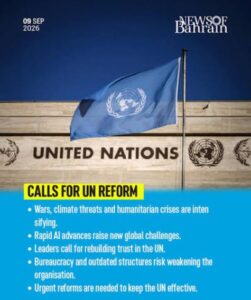
Introduction
- The United Nations was created after the Second World War to make relations among countries more predictable.
- It offered dialogue, international law, and common rules.
- Today, declining trust threatens this achievement.
- Deadlocks, weak accountability, unequal representation, financial influence, and limited peace efforts raise concerns.
- Restoring trust requires deep institutional reform.
UN and the Idea of Trust
Historical Role of the United Nations
- The world has traditionally been a low-trust environment, where suspicion between states often produced conflict.
- The United Nations created a shared forum where countries could discuss disputes before they developed into wider conflicts.
- Its system of international law also made state behaviour more predictable, although power politics never disappeared.
- The UN therefore became one of humanity’s major achievements by creating channels for dialogue and international cooperation.
- Its purpose was never to end geopolitical competition completely, but to place that competition within accepted rules.
81st General Assembly Theme
- The 81st General Assembly adopted the theme “Restoring Trust, Managing Transformation: a UN that delivers for all.”
- The word “restoring” itself indicates that confidence in the organisation has weakened considerably over recent decades.
- The theme therefore connects institutional reform with the larger need to rebuild public and international confidence.
- The UN now needs to apply the trust-building methods it once promoted among conflicting parties.
Evidence of Declining Trust
Survey Findings
- Surveys indicate that confidence in the United Nations has weakened across several countries during recent years.
- Edelman Trust and Pew surveys conducted last year recorded declining trust and favourability towards the organisation.
- A UN Foundation poll found that 52% of respondents believed the UN struggled to deliver results.
- The same poll showed strong demand for deep structural reforms within the organisation.
- More than half of respondents felt the UN struggled to enforce international law and protect human rights.
- Many respondents also believed that a small group of powerful countries dominated important UN decisions.
- Another Rockefeller Foundation and Focal data poll found that only 58% believed the UN could lead global problem-solving.
- This figure may represent one of the organisation’s lowest levels of public confidence.
Security Council Deadlock
- Persistent deadlock in the United Nations Security Council has weakened confidence in the wider UN system.
- The problem has also created frustration within the General Assembly over the influence of permanent members.
- Resolution A/76/262 requires permanent Security Council members to explain every new use of their veto.
- This requirement reflects growing concern about accountability surrounding the most powerful UN decision-making body.
- Veto politics can prevent collective action even when major humanitarian or security concerns receive broad international attention.
Accountability and Internal Governance
Institutional Integrity Concerns
- Trust also depends on whether the UN manages recruitment, procurement, and resources transparently and fairly.
- Several controversies have raised questions about whether individual punishment alone can solve deeper institutional weaknesses.
- A procurement controversy in Afghanistan during 2013 exposed concerns surrounding financial and administrative oversight.
- Cases involving sexual exploitation and abuse by peacekeepers in 2017 further damaged the organisation’s credibility.
- Contracts involving non-existent housing projects in Ghana and India during 2021 created additional concerns.
- Such controversies were often treated as individual failures rather than evidence of broader systemic weaknesses.
- Limited consequences for wrongdoing can create perceptions that internal accountability remains insufficient.
Financial Influence
- Financial contributions from powerful countries can also shape influence within different parts of the UN system.
- Some governments advocate for their nationals during recruitment or provide extra-budgetary funding for selected programmes.
- A 2024 ACABQ report found that eight of nine technical experts in one UN agency were sponsored by one government.
- Such concentration can raise legitimate questions about whether policy advice remains fully independent and neutral.
- Transparency regarding development spending is also increasingly directed towards donors rather than beneficiary populations.
- Fear of losing funding or damaging careers can make UN officials more cautious about addressing conflicts.
- Excessive dependence on major donors can therefore weaken both institutional independence and public confidence.
Representation and the Global South
Unequal Decision-Making
- The UN delivers much of its programme work in the Global South, yet decision-making power remains unevenly distributed.
- Trust in the organisation is reportedly higher in the Global South according to the UN Foundation poll.
- Developing countries represent around 84% of the global population but hold only 44% of UN civil service leadership positions.
- Only about one-third of UN leadership positions in Africa are held by Africans.
- Just two-fifths of cities hosting UN headquarters are located in the Global South.
- In 2025, thousands of positions were shifted away from New York and Geneva during cost-cutting measures.
- Despite lower operating costs, most additional destinations in the Global South were not selected.
- These patterns create a gap between where the UN works and where institutional authority is concentrated.
Humanitarian Assistance
- The UN provided humanitarian assistance and protection to around 98 million people during 2025-26.
- This represented roughly 1.1% of the world’s population and demonstrated the continuing value of UN operations.
- However, questions remain about aid effectiveness and the proportion of funding reaching local actors.
- Greater local participation could improve ownership, accountability, and understanding of community-level needs.
Peacebuilding and Conflict Prevention
Limited Political Results
- The UN has sometimes achieved useful tactical results without converting them into wider peace processes.
- During the Ukraine conflict, UN action helped maintain grain exports through the Black Sea.
- In the Red Sea, UN intervention helped prevent a potentially serious oil spill and its wider consequences.
- Similar efforts in conflicts involving Gaza and Iran showed the value of limited humanitarian interventions.
- Yet these interventions did not consistently create mechanisms for opposing parties to begin sustained political dialogue.
- Peacemaking has increasingly become concentrated among the organisation’s highest bureaucratic levels.
- This centralisation can reduce flexibility and weaken early conflict prevention at regional and local levels.
Reforms Needed to Restore Trust
Greater Transparency
- The UN should publish clearer information about recruitment, procurement, funding, programme spending, and institutional decision-making.
- Transparency should reach citizens and communities receiving UN assistance, rather than remaining mainly accessible to donor governments.
- Stronger independent oversight can help identify systemic failures before they become major public controversies.
More Inclusive Representation
- Developing countries need greater representation in senior positions, decision-making structures, and locations hosting UN institutions.
- Leadership should better reflect the population and regions where the organisation performs substantial development and humanitarian work.
- Moving selected institutions towards capable Global South cities could reduce costs while improving geographical balance.
Stronger Local Partnerships
- UN programmes should increase the share of resources reaching capable local organisations and community-level institutions.
- Local actors often understand social conditions better and can improve the relevance of humanitarian interventions.
- Stronger partnerships can also make international assistance more accountable to people rather than only governments.
Reviving Preventive Diplomacy
- The UN should strengthen regional and field-level mechanisms that identify tensions before they become major conflicts.
- Peacemaking should not depend entirely on decisions made at the organisation’s highest bureaucratic levels.
- Earlier engagement can create space for dialogue when political positions remain less rigid and violence remains limited.
- Tactical humanitarian successes should become entry points for longer-term negotiations wherever conditions permit.
Reconnecting with People
- The UN must build relationships with ordinary people instead of communicating mainly through national governments.
- Public communication should explain achievements, failures, spending, and reform efforts in simple and accessible language.
- Independent evaluation should show whether programmes actually improve lives and reach intended communities.
- Such openness can gradually rebuild confidence among citizens who currently view the organisation as distant.
Way Forward
- The UN should combine institutional accountability with wider representation to restore confidence among both states and citizens.
- Its reform process should address Security Council deadlock while improving transparency throughout administrative and financial systems.
- Greater representation of developing countries can make decision-making more consistent with the UN’s global membership.
- The organisation should also decentralise suitable functions towards regions where humanitarian and development activities are concentrated.
- Stronger local partnerships can ensure that resources reach communities efficiently and reflect their actual needs.
- Finally, preventive diplomacy should become more decentralised, allowing regional teams to respond before conflicts become difficult to manage.
Conclusion
The UN remains essential, but its legitimacy depends on trust. Restoring confidence requires transparency, fair representation, stronger accountability, local partnerships, and effective diplomacy. Transformation must reconnect the organisation with people worldwide and strengthen its role.
Source: The Hindu
Mains Practice Question
Reforming multilateral institutions requires greater representation of the Global South. Examine the need for reforms within the United Nations system.

