 India's No.1 PU & Degree With Integrated IAS & IPS(UPSC/PSC) Training College.


Daily Current Affairs Digest | 18th May 2026
Daily Current Affairs Digest | 18th May 2026
1. Transboundary Water Diplomacy: Indus Waters Treaty Impasse
India has rejected the Court of Arbitration’s ruling on the Indus Waters Treaty dispute, asserting that the Court was illegally constituted and its award has no legal effect. The dispute centers on India’s run-of-the-river hydroelectric projects on the western rivers, notably the Kishanganga project (a Jhelum tributary) and the Ratle project on the Chenab. India argues that parallel proceedings before a Neutral Expert and the Court undermine the Treaty’s graded dispute-resolution mechanism.
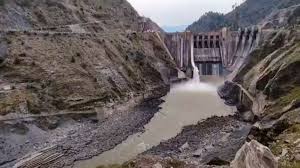 Background: Signed in 1960 with World Bank facilitation, the Treaty allocates the eastern rivers—Ravi, Beas, Sutlej—to India and the western rivers—Indus, Jhelum, Chenab—to Pakistan, while allowing India limited rights over western rivers for non-consumptive uses and run-of-the-river hydropower.
Significance: The current dispute highlights the challenges of applying a mid-20th century water-sharing treaty to modern energy demands, climate variability, and technological changes in hydropower.
2. West Asian Geopolitics: Barakah Nuclear Plant and Critical Infrastructure
A drone strike reportedly caused a fire at the Barakah nuclear power plant in the UAE, although no radiological release occurred. The plant, located in Abu Dhabi’s Al Dhafrah region, is the Arab world’s first operational commercial nuclear facility and central to the UAE’s energy diversification strategy.
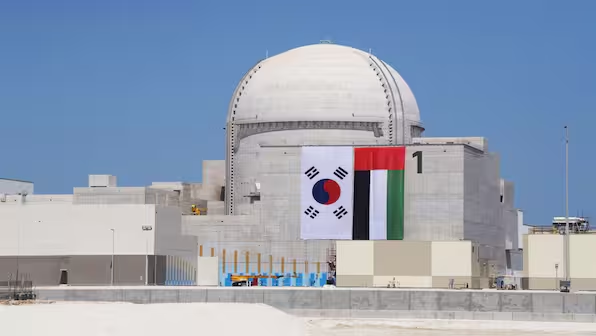 Implications for India: The attack underscores the vulnerability of critical infrastructure in West Asia, affecting energy security, diaspora safety, and maritime trade. It also highlights the evolving nature of threats, including drones, missiles, and proxy conflicts.
3. Constitutional Architecture: Supreme Court Judge Strength Ordinance
President Droupadi Murmu promulgated the Supreme Court (Number of Judges) Amendment Ordinance, 2026, raising the sanctioned strength of judges from 33 to 37, excluding the Chief Justice. The total strength now stands at 38, including the Chief Justice.
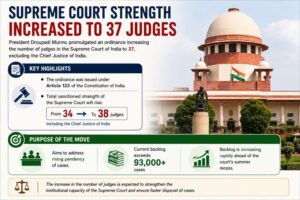 Purpose: This move aims to address rising pendency in constitutional, civil, criminal, and appellate cases. While increasing judge strength improves hearing capacity, structural reforms in case management, technology use, and regional accessibility are essential to tackle systemic delays.
4. Global Health Governance: Ebola PHEIC Declaration
The World Health Organization has declared the Ebola outbreak in the Democratic Republic of Congo and Uganda a Public Health Emergency of International Concern (PHEIC) under the International Health Regulations, 2005. The outbreak involves the Bundibugyo virus, a variant of Ebola.
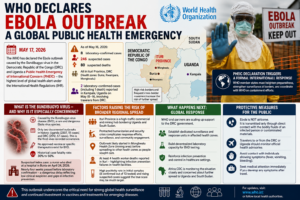 Significance: The declaration emphasizes the importance of early warning systems, cross-border coordination, vaccine research, and health infrastructure in global disease preparedness. India can contribute through vaccine manufacturing, digital health platforms, and training in epidemic response.
5. Indo-Dutch Strategic Matrix: Kalpasar, Semiconductors and Chola Copper Plates
 Prime Minister Narendra Modi’s recent visit to the Netherlands resulted in significant bilateral cooperation:
- Kalpasar Project: Technical cooperation for Gujarat’s freshwater reservoir project across the Gulf of Khambhat.
- Semiconductors: Tata Electronics and ASML deepened collaboration for India’s semiconductor ecosystem, especially the Dholera fab.
- Cultural Restitution: Leiden University Library returned 11th-century Chola copper plates to India.
Takeaway: The visit demonstrates a modern, integrated diplomacy approach, linking water management, technology, renewable energy, and cultural heritage in a single strategic partnership.




