 India's No.1 PU & Degree With Integrated IAS & IPS(UPSC/PSC) Training College.


Daily Current Affairs Digest | 16th July 2026
Daily Current Affairs Digest | 16th July 2026
Cabinet Approves ₹1.275-Lakh-Crore Semicon 2.0 Programme
The Union Cabinet has approved the ambitious Semicon 2.0 programme with an estimated financial outlay of ₹1.275 lakh crore. The programme represents the next phase of India’s efforts to establish a complete and globally competitive semiconductor ecosystem.
 Semicon 2.0 is expected to support semiconductor fabrication facilities, compound semiconductor manufacturing, chip-design companies, advanced packaging, research and development, equipment manufacturing and the production of essential raw materials.
The government expects the programme to attract nearly ₹4 lakh crore in investments. By covering the entire semiconductor value chain, the initiative seeks to reduce India’s dependence on imported electronic components and strengthen the country’s technological and strategic autonomy.
It will also support India’s emergence as a major semiconductor manufacturing and design hub at a time when countries across the world are attempting to build resilient and diversified chip-supply chains.
India Announces Three Major Development Projects for Palestine
India has announced the establishment of three important development projects for the Palestinian people: a specialty hospital, an Artificial Limb Fitment Centre and a Vocational Training Institute.
 The specialty hospital and artificial-limb centre are expected to strengthen access to specialised healthcare and rehabilitation services, particularly for people affected by the continuing humanitarian crisis. The vocational institute will provide young Palestinians with skills that can support employment, community reconstruction and long-term economic recovery.
The Palestinian Embassy in New Delhi welcomed the announcement and acknowledged India’s continuing humanitarian and development partnership with Palestine.
India has also reiterated its long-standing support for a negotiated two-State solution, under which an independent Palestinian State and Israel can live side by side in peace and security.
India Launches First Trial Index of Services Production
The Government of India has introduced the country’s first Index of Services Production, or ISP, to measure short-term changes in the output of the formal services sector.
 The first trial release covers 19 service sub-sectors, representing approximately 60% of India’s services economy. It uses 2024–25 as the base year and has initially released data for April 2026.
The ISP will function as a high-frequency economic indicator for services, similar to the role played by the Index of Industrial Production for industrial activity. Regular monthly trial indices are expected to be released with a time lag of approximately 60 days.
The new index will assist policymakers, researchers and economic ministries in monitoring changes in areas such as retail trade, telecommunications, real estate, transportation, accommodation, food services and professional services. It is expected to strengthen economic forecasting, national income estimation and evidence-based policymaking.
NAMASTE Scheme Strengthens the Safety of Sanitation Workers
The National Action for Mechanised Sanitation Ecosystem, popularly known as the NAMASTE Scheme, has made measurable progress in improving the safety and dignity of sanitation workers.
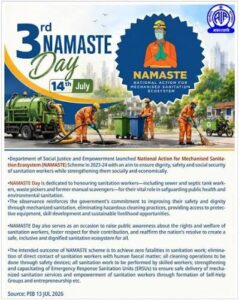 Under the programme, 87,037 sewer and septic-tank workers have received personal protective equipment kits, while 76,247 workers have been covered under different health insurance schemes.
More than 90,000 sewer and septic-tank workers have been profiled, and thousands have received support for training, safety equipment, mechanised cleaning vehicles and alternative livelihood opportunities.
The programme seeks to eliminate hazardous manual cleaning by promoting mechanised sewer and septic-tank maintenance. It combines occupational safety measures with healthcare coverage, skill development, entrepreneurship assistance and social protection.
NAMASTE therefore represents an important transition from hazardous manual sanitation practices towards a mechanised, rights-based and dignified sanitation ecosystem.
NIPU-2026 to Strengthen India’s Urea Self-Reliance
The Union Cabinet has approved the National Investment Policy for Urea-2026 for Atmanirbhar Bharat, known as NIPU-2026.
The policy aims to encourage investments in approximately eight to nine new natural-gas-based urea manufacturing plants. These plants are expected to add nearly one crore tonnes of annual domestic production capacity.
 India consumes approximately four crore tonnes of urea annually but produces only about three crore tonnes domestically. The remaining requirement is met through imports, exposing the agricultural sector to international price volatility and supply disruptions.
By expanding indigenous production, NIPU-2026 seeks to reduce fertiliser imports, ensure a stable supply of urea to farmers, promote modern production technologies and strengthen national food security.
The policy is also expected to attract both public and private investment into new greenfield projects and the expansion of existing manufacturing units.
Draft National Health Research Policy Sets 2047 Funding Target
The Draft National Health Research Policy 2026 proposes a major increase in government investment in health research.
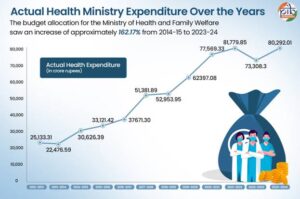 The policy seeks to raise public expenditure on health research from the present level of approximately 0.024% of GDP to 0.072% by 2037 and ultimately to 0.15% of GDP by 2047.
It proposes the creation of a coordinated national framework covering biomedical research, clinical research, epidemiology, public health, health systems, behavioural sciences, digital health, artificial intelligence and emerging medical technologies.
The draft also recommends a three-tier governance structure involving a national stewardship committee, the Department of Health Research as the nodal implementing authority and the Indian Council of Medical Research as the scientific and technical lead.
The policy seeks to shift the evaluation of research beyond publications and citations towards measurable improvements in public health, indigenous medical technologies, policy relevance and societal impact.
Indian Railways Introduces Eight New “Reform Express” Measures
Indian Railways has announced eight additional structural reforms under its “Reform Express” initiative. With the latest announcements, the number of reforms implemented has reached 17 out of the targeted 52 reforms in 52 weeks.
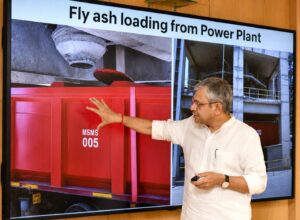 The measures focus on modernising freight operations, encouraging containerisation, simplifying regulatory procedures, introducing unified operator licences, improving wagon design and accelerating project execution.
One important measure promotes the transportation of fly ash through specially designed containers, reducing dust pollution during loading, transportation and unloading.
The reforms are intended to shift a larger share of freight transportation from roads to railways. This could reduce logistics costs, improve supply-chain efficiency, lower carbon emissions and encourage greater private-sector participation in the railway ecosystem.
India Leads Adoption of Seven Global Codex Standards
India played an important role in the adoption of seven international food standards and guidelines at the 49th session of the Codex Alimentarius Commission.
 The adopted standards include provisions relating to dried coriander seeds, fresh curry leaves, vanilla and large cardamom. Other texts address safe water use in food processing, the control of Campylobacter and Salmonella in chicken meat and the labelling of pre-packaged foods.
Codex standards are internationally recognised benchmarks developed under the joint framework of the Food and Agriculture Organization and the World Health Organization. They protect consumer health and facilitate fair international food trade.
India’s leadership in developing these standards could benefit farmers, spice producers and food exporters by improving quality consistency, reducing technical trade barriers and strengthening access to global markets.
India Hosts Fifth BIMSTEC National Security Advisers’ Meeting
India hosted the fifth meeting of the BIMSTEC National Security Advisers and Security Chiefs in New Delhi on 16 July 2026.
The meeting brought together representatives from the seven BIMSTEC members: Bangladesh, Bhutan, India, Myanmar, Nepal, Sri Lanka and Thailand.
 Discussions focused on terrorism, cybersecurity, maritime security, transnational organised crime and other emerging security threats affecting the Bay of Bengal region.
The meeting emphasised practical cooperation, intelligence sharing and coordinated regional responses to cross-border security challenges. The discussions are significant because the Bay of Bengal is a strategically important region connecting South Asia and Southeast Asia.
Strengthened security cooperation under BIMSTEC can complement the organisation’s broader objectives relating to connectivity, trade, economic development, disaster management and regional stability.




