India's No.1 PU & Degree With Integrated IAS & IPS(UPSC/PSC) Training College.



Current Affairs -20 January 2026
Current Affairs | 20 January 2026
1. India–UAE Target $200 Billion Trade by 2032
India and the United Arab Emirates have agreed to double their bilateral trade to $200 billion by 2032, marking a major expansion of strategic and economic ties.
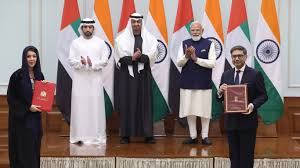 Key agreements were signed in the areas of:
- Defence cooperation
- Space and advanced technologies
- Energy and food security
- Supercomputing and digital infrastructure
- Investment promotion in Gujarat
The move builds on the Comprehensive Economic Partnership Agreement (CEPA) and reflects growing trust in India–UAE relations, especially in trade diversification, strategic industries, and long-term investment partnerships.
Exam relevance: International Relations, Economy, Trade Diplomacy.
2. Nitin Nabin Elected BJP National President Unopposed
BJP Working President Nitin Nabin has been elected National President of the Bharatiya Janata Party (BJP) unopposed.
 Key highlights:
- He was the sole nominee
- Supported by 37 valid nominations
- Endorsed by senior leaders including JP Nadda, Amit Shah, and Rajnath Singh
- He formally succeeds JP Nadda today
This leadership transition is expected to shape the party’s organisational strategy ahead of upcoming electoral cycles.
Exam relevance: Polity, Political Parties, Contemporary Governance.
3. India Achieves Record $47 Billion Electronics Exports in 2025
India recorded $47 billion in electronics exports in 2025, marking a historic milestone in manufacturing and export growth.
 Key facts:
- $30 billion contributed by smartphones
- Growth driven by the PLI (Production Linked Incentive) Scheme
- Electronics now the third-largest export sector
- Exports increased 11 times since 2015
- Generated nearly 25 lakh jobs
This success strengthens India’s ambition to become a global electronics manufacturing hub.
Exam relevance: Economy, Industrial Policy, Make in India, PLI Scheme.
4. India on Path to Upper Middle-Income Status by 2030
According to an SBI analysis, India’s GNI per capita is projected to reach $4,000 by 2030, qualifying it as an upper middle-income country under World Bank criteria.
Key points:
- Current World Bank threshold: ~$4,465
- India would join peers like China and Indonesia
- Reflects rising incomes, economic growth, and structural transformation
This transition highlights progress but also raises challenges related to inequality, job creation, and social mobility.
Exam relevance: Development Economics, World Bank classifications.
5. India–China Universities Develop Green Corrosion Protection Technology
Researchers from Nagaland University and Chinese universities have developed an eco-friendly corrosion inhibitor using carbon quantum dots derived from waste apple leaves.
 Key features:
- Provides 96% protection for copper
- Non-toxic and environmentally safe
- Sustainable alternative to chemical corrosion inhibitors
- Uses agricultural waste for high-value applications
This innovation supports green chemistry and sustainable materials science.
Exam relevance: Science & Technology, Green Technology, Sustainability.
6. China’s Population Declines by 3 Million in 2025
China’s population declined for the fourth consecutive year, falling by 3 million in 2025 to 1.404 billion.
 Key statistics:
- Births dropped 17% to 7.92 million
- Decline persists despite pro-family policies
- China now trails India as the world’s most populous nation
The trend poses long-term challenges for economic growth, labour supply, and social security systems.
Exam relevance: World Demography, Population Trends, Global Affairs.
7. WEF 2026 Davos Summit Begins Under ‘Spirit of Dialogue’
The 56th Annual World Economic Forum (WEF) meeting has begun in Davos, Switzerland, under the theme “Spirit of Dialogue.”
 Key details:
- Over 3,000 global leaders participating
- Focus areas include:
- Slowing global growth
- Geopolitical tensions
- Technological disruption
- Declining trust in institutions
- Emphasis on cooperation and multilateral dialogue
The summit aims to rebuild global consensus in a fragmented world.
Exam relevance: International Organisations, Global Governance.
Conclusion
The 20 January 2026 current affairs highlight:
- India’s growing global economic and diplomatic footprint
- Political leadership changes at home
- Technological innovation and sustainability efforts
- Major global demographic and economic shifts
These developments are highly relevant for competitive exams, academic discussions, and policy understanding.