 India's No.1 PU & Degree With Integrated IAS & IPS(UPSC/PSC) Training College.


Balanced Delimitation and Women’s Quota Safeguard Federalism
Balanced Delimitation and Women’s Quota Safeguard Federalism
Syllabus:
GS-2: Indian Constitution, Elections, Statutory Bodies
Why in the News ?
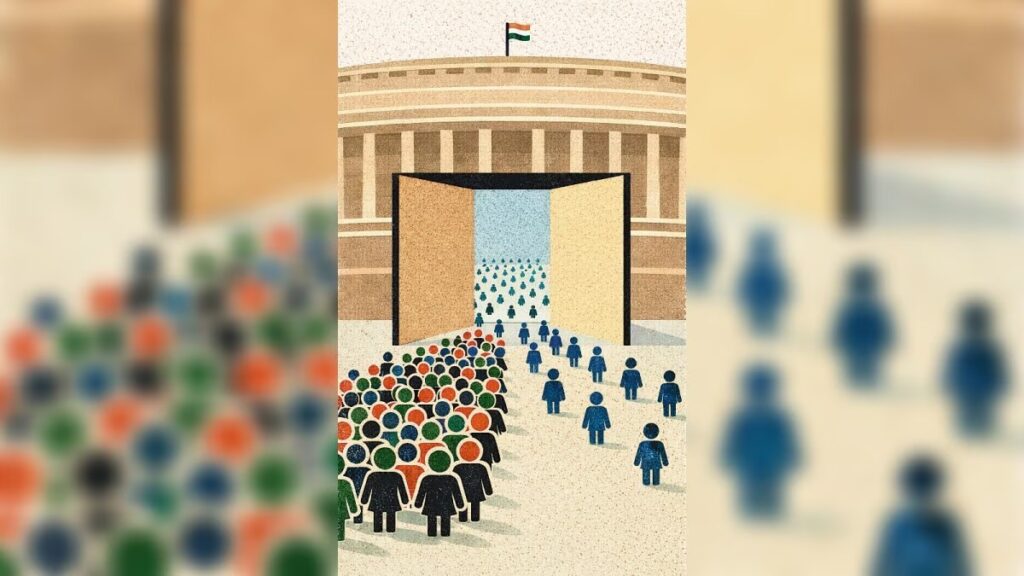
The debate over delimitation post-2026 Census and implementation of the Nari Shakti Vandan Adhiniyam (Women’s Reservation Act) has intensified. Concerns from southern states about potential loss of parliamentary representation have been countered by proposals to expand the Lok Sabha, ensuring equitable representation without penalising population control efforts.
Historical Context of Delimitation Freeze:
- Constitutional Basis: Articles 81, 82, and 330A mandate periodic delimitation based on population to ensure equal representation.
- 1971 Freeze: Seat redistribution was frozen after the 1971 Census to avoid penalising states that successfully controlled population growth.
- Policy Rationale: Southern states like Tamil Nadu, Kerala, Karnataka invested in education, healthcare, and family planning, leading to lower fertility rates.
- Extension of Freeze: The freeze was extended until the first Census after 2026, maintaining inter-state seat distribution unchanged.
- Distortion in Representation: Today, each MP represents nearly 26 lakh citizens, leading to a democratic imbalance.
- Population Explosion vs Representation: India’s population increased from 55 crore (1971) to over 140 crore, but Lok Sabha seats remained at 543.
- Democratic Imperative: Expanding Parliament is necessary to restore representational equity and accountability.
Key Provisions: Delimitation, Representation and Women’s ReservationConstitutional Provisions● Article 81: Composition of Lok Sabha ● Article 82: Readjustment after Census ● Article 330A: Reservation provisions Key Acts● Delimitation Commission Acts (1952, 1962, 1972, 2002) ● Nari Shakti Vandan Adhiniyam, 2023 (Women’s Reservation Act) Key Concepts● Delimitation: Redrawing constituency boundaries ● Population-Based Representation: Seats allocated based on population ● Federalism: Balance of power between Centre and States ● Digressive Proportionality: Unequal representation model Important Facts● Lok Sabha strength: 543 (current) ● Proposed expansion: ~850 seats ● Freeze period: 1971–2026 ● Census basis currently used: 2001 (for boundaries), not seat distribution |
Delimitation After 2026: Core Concerns
- Inevitable Redrawing: With the 2027 Census, delimitation will automatically follow constitutional provisions.
- Population-Based Redistribution: Seats would be reallocated strictly based on population, benefitting northern states.
- Southern States’ Fear: States with controlled population growth risk losing parliamentary share and influence.
- Example – Kerala: Could reduce from 20 seats to nearly 12, significantly weakening representation.
- North-South Divide: States like Uttar Pradesh, Bihar, Madhya Pradesh would gain disproportionately.
- Political Consequences: Reduced bargaining power for southern states in national policymaking.
- Federal Tensions: Risk of increasing regional imbalance and political alienation.
Intersection with Women’s Reservation (Nari Shakti Vandan Adhiniyam)
- Key Provision: Mandates one-third reservation for women in Lok Sabha and State Assemblies.
- Conditional Implementation: Reservation comes into effect after delimitation.
- Impact on Reduced Seats: If total seats shrink for a state, women’s quota reduces available general seats further.
- Kerala Case: From 12 seats, 4 reserved for women, leaving only 8 general seats.
- Displacement Effect: Existing MPs, especially male MPs, lose constituencies.
- Political Instability: Sudden restructuring may disrupt party dynamics and representation continuity.
- Equity Concern: Women’s empowerment should not come at the cost of regional representation imbalance.
Government’s Proposed Solution: Expanding Lok Sabha
- Seat Expansion Plan: Increase Lok Sabha strength to around 850 seats.
- Uniform Growth Formula: Apply an 80% increase in seats across all states.
- No Reduction Principle: Ensures no state loses its current share.
- Examples of Gains:
○ Karnataka: 28 → 42 seats
○ Tamil Nadu: 39 → 59 seats
○ Kerala: 20 → 30 seats
○ Andhra Pradesh: 25 → 38 seats
○ Telangana: 17 → 26 seats
- Southern Collective Gain: Gains 66 additional seats while maintaining 23.7% share.
- Avoiding Redistribution Conflict: Prevents zero-sum competition between states.
- Balanced Representation: Combines population logic with federal fairness.
Governance and Democratic Efficiency Gains
- Reduced MP Burden:
○ Karnataka: 25 lakh → 16 lakh per MP
○ Tamil Nadu: 19 lakh → 13 lakh per MP
- Better Accessibility: Smaller constituencies improve citizen-representative interaction.
- Enhanced Accountability: MPs can better address local issues and grievances.
- Improved Policy Delivery: Governance becomes more responsive and decentralised.
- Strengthened Democracy: Moves closer to the principle of “one person, one vote, one value”.
- Administrative Efficiency: More MPs allow better committee functioning and oversight.
- Inclusive Representation: Facilitates smoother integration of women’s reservation.
Critique of Alternative Proposals
- GSDP-Based Allocation:
- Would favour economically strong states like Maharashtra, Gujarat.
- Makes representation dependent on economic fluctuations, not population.
- Digressive Proportionality (suggested by some leaders):
- Gives unequal weight to votes across states.
- Violates democratic principle of equal representation.
- Partial Redistribution Models:
- Still result in loss of seats for southern states.
- Fail to address federal concerns comprehensively.
- Status Quo Approach:
- Ignoring delimitation would worsen representation imbalance.
- Political Motivations: Some alternatives seen as politically driven rather than constitutionally sound.
- Lack of Practicality: Do not provide a clear, scalable framework.
- Conclusion on Alternatives: Expansion model remains the most balanced and feasible solution.
Broader Implications for Federalism and Democracy
- Preserving Federal Balance: Ensures no region is penalised for good governance.
- Encouraging Population Control: Rewards states that invested in human development.
- Strengthening National Unity: Reduces potential North-South political divide.
- Gender Inclusion: Smooth integration of women’s political participation.
- Future-Proofing Democracy: Prepares India for continued population growth.
- Institutional Stability: Avoids abrupt changes in political representation structures.
- Democratic Legitimacy: Enhances trust in Parliament as a representative body.
Challenges:
- Political Consensus: Achieving agreement among states with divergent interests is difficult.
- Infrastructure Constraints: Expanding Parliament to 850 seats requires logistical and infrastructural upgrades.
- Delimitation Complexity: Redrawing boundaries involves administrative, legal, and political challenges.
- Regional Distrust: Southern states remain sceptical about fair implementation.
- Legal Hurdles: Constitutional amendments may face judicial scrutiny.
- Implementation Delay: Linking women’s reservation to delimitation could delay gender justice.
- Political Resistance: Incumbent MPs may resist due to loss of safe constituencies.
- Data Accuracy Issues: Census reliability and delays can affect fair seat allocation.
- Coordination Challenges: Requires coordination between Election Commission, Parliament, and States.
- Public Perception: Misinterpretation may fuel regional or political narratives.
Way Forward :
- Inclusive Dialogue: Conduct all-party consultations to build consensus.
- Transparent Framework: Clearly communicate the formula and benefits of expansion.
- Phased Implementation: Gradually increase seats to manage administrative transition.
- Strengthen Institutions: Empower the Delimitation Commission with autonomy and credibility.
- Synchronise Census and Delimitation: Ensure timely and accurate Census data.
- Infrastructure Development: Upgrade Parliament Bhavan and digital systems for larger representation.
- Safeguard Federalism: Legally ensure no state loses proportional share.
- Decouple Women’s Reservation (if needed): Avoid delays in gender representation reforms.
- Public Awareness Campaigns: Educate citizens about benefits of delimitation reform.
- Periodic Review Mechanism: Introduce a system to review representation every decade.
Conclusion:
The proposed expansion of the Lok Sabha offers a balanced, forward-looking solution to delimitation challenges. It safeguards southern states’ interests, strengthens democratic representation, and enables smooth implementation of women’s reservation. By combining equity with efficiency, it reinforces India’s federal structure and democratic legitimacy.
Source: IE
Mains Practice Question:
Discuss the implications of post-2026 delimitation on India’s federal structure. Evaluate the proposal to expand the Lok Sabha as a solution to regional imbalances and its role in facilitating women’s reservation.

