 India's No.1 PU & Degree With Integrated IAS & IPS(UPSC/PSC) Training College.


AN ALTERNATIVE TO VIKSIT BHARAT SHIKSHA ADHISTHAN BILL
AN ALTERNATIVE TO VIKSIT BHARAT SHIKSHA ADHISTHAN BILL
Why in the News?
- The proposed Viksit Bharat Shiksha Adhisthan (VBSA) Bill seeks to give statutory backing to the National Education Policy 2020, replacing earlier attempts like the HECI Bill.
- The Bill is currently being examined by a Joint Parliamentary Committee (JPC), inviting suggestions from stakeholders such as teachers, students, State governments, and civil society, ensuring parliamentary oversight.
- Concerns have been raised that the Bill was based on a policy adopted during the COVID-19 period without adequate consultation with States, raising constitutional concerns.
- Critics argue that the Bill may lead to constitutional overreach, exceeding Parliament’s mandate under Entry 66 of the Union List (limited to coordination and standards in higher education).
- The Bill proposes to vest extensive discretionary powers in Union-controlled statutory bodies for standard-setting, inspections, and regulation of Higher Education Institutions (HEIs).
- It also centralises financial control, with the Union Education Ministry assuming authority over grant allocation to HEIs, raising concerns about federal imbalance and local autonomy.

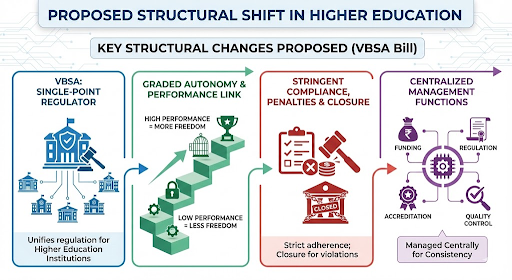
Concerns with the VBSA Bill
- Lack of Institutional Participation: The Bill does not provide for meaningful democratic participation of Higher Education Institutions (HEIs) in decision-making processes.
- Executive Overreach: It embeds excessive control of bureaucrats in governance, assigning them a central role in transforming higher education and creating a significant compliance burden.
-
Dilution of University Grants Commission (UGC) Norms:
○ Weakens the consultative mechanism mandated under the UGC Act.
○ Undermines provisions like Section 13, which require prior consultation with universities before inspections, affecting quality assurance processes.
- Erosion of Institutional Autonomy:
○ Curtails academic freedom and autonomy of premier institutions such as Indian Institutes of Technology (IITs), Indian Institutes of Management (IIMs), and Inter-University Centres.
○ Extends centralised control over Central, State, and private institutions alike, undermining academic independence.
- Centralisation of Regulatory Powers: Enables top-down, prescriptive regulation in areas like standard-setting, inspections, and accreditation through a rigid regulatory framework, reducing federal balance.
- Ideological Concerns:
○ Promotes a narrow interpretation of “Bhartiya Knowledge” systems.
○ Allegedly undermines India’s pluralistic and multicultural knowledge systems and linguistic traditions.
-
Overemphasis on Global Rankings:
○ Encourages hyper-globalisation by focusing on output-based global rankings and international credibility.
○ Neglects goals like national innovation, self-reliance, and social inclusion through performance metrics alone.
- Shift Away from Public Funding:
○ Indicates a move towards reduced public investment in education.
○ May increase reliance on loans for higher education, affecting public universities disproportionately.
- Weak Commitment to Social Justice:
○ Does not ensure enforcement of reservation policies for SCs, STs, and OBCs, or protect minority institutions.
○ Lacks provisions for inter-institutional, inter-State, and inter-regional equity and social inclusion.
Justice to States & Federal Concerns
- Weak Support for State Universities (SUs):
○ The proposed National Research Foundation lacks provisions for block grants to public universities and State Universities.
○ Fails to promote integrated scholarship combining teaching, research, and outreach, or support capacity building initiatives.
- Inadequate Role of State Higher Education Councils (SHECs):
○ SHECs are not adequately represented in decision-making bodies under the Bill, undermining academic federalism.
○ Need formal inclusion in councils to ensure cooperative federalism and consensus-based governance with democratic accountability.
○ Should have a clear mandate to influence the future direction of Higher Education Institutions (HEIs) including technical education and teacher education.
- Exclusion of Academic Stakeholders:
○ The Bill does not explicitly recognise the role of students, teachers, and non-teaching staff associations in democratic participation.
○ Senates and academic councils of HEIs should be involved in planning, feedback, and monitoring processes to ensure public disclosure and transparency.
- Excessive Central Control in Regulation:
○ The proposed Regulatory Council (Viniyaman Parishad) centralises enforcement powers related to governance and regulatory compliance.
○ The Centre is given sweeping authority over recognition, authorisation, and institutional closure of institutions.
○ Closure of institutions should require consent of the concerned State government to preserve local autonomy.
- Concerns with Accreditation Mechanism:
○ The Accreditation Council (Gunvatta Parishad) proposes outsourcing accreditation to third-party agencies, affecting quality benchmarks.
○ This may bypass deliberative processes and undermine societal goals of higher education including learning outcomes.
○ Over-reliance on technology-driven assessments may ignore qualitative aspects and student mobility considerations.
- Prescriptive vs Deliberative Regulation:
○ The Bill promotes a top-down, prescriptive regulatory model with excessive regulatory compliance requirements.
○ A more process-oriented, consultative, and deliberative approach is required for effective quality assurance.
- Limitations of Output-Based Evaluation:
○ Focus on metrics like patents and publications may not reflect real educational outcomes or learning outcomes.
○ Evaluation should be impact-oriented, including social relevance, innovation, and inclusivity through comprehensive performance metrics.
- One-Size-Fits-All Standards:
○ The Standards Council (Manak Parishad) centralised in Delhi cannot define uniform academic standards for all institutions.
○ Standards must be context-specific, varying across States, industrial sectors, and respecting Indian languages and linguistic traditions.
Federalism, Equity & Way Forward
- Violation of Federal Principles:
○ Education falls under the Concurrent List, yet the VBSA Bill applies uniformly to all States without adequate consultation, raising constitutional concerns.
○ States must have a substantive role in standard-setting, accreditation, and regulation, instead of a top-down approach that ignores academic federalism.
- Marginalisation of States’ Role:
○ Despite States being primary funders of higher education, their role in governance remains limited.
○ The Bill overlooks States’ priorities such as school education linkages, environment, climate action, and local economic development.
- Equity Concerns:
○ Fails to ensure social justice and inter-regional equity through effective social inclusion mechanisms.
○ Private institutions under the Bill are not obligated to promote equity and inclusion or protect minority institutions.
Way Forward / Suggested Reforms
- Balanced Centre-State Participation:
○ Ensure 50:50 representation between State Higher Education Councils (SHECs) and Union statutory bodies in regulation, accreditation, and standard-setting.
○ Promote goals like linguistic and cultural autonomy, social justice, innovation, and global excellence through a multidisciplinary approach.
- Creation of Regional Councils:
○ Establish regional bodies to address ecological, socio-technical, and region-specific educational needs while ensuring quality benchmarks.
- Shared Governance Framework:
○ Reimagine higher education governance as a joint responsibility of Centre and States with enabling institutional mechanisms and democratic accountability.
- Establishment of Higher Education Grants Council (HEGC):
○ Create a dedicated funding body for disbursing grants to institutions with transparent grant allocation mechanisms.
○ Ensure balanced funding for both Central institutions and public universities, especially to address historical and structural gaps through capacity building.
- Strengthening SHECs:
○ Provide adequate funding and institutional space to SHECs through HEGC with clear enforcement powers.
○ Enable them to play a central role in governance and policy implementation within the regulatory framework.
- Autonomous Functional Councils:
○ Regulatory, accreditation, and standards councils should:
■ Be run by academics and professionals, not bureaucrats, ensuring academic independence.
■ Have independent budgets and operational autonomy with public disclosure requirements.
- Clear Division of Powers:
○ The amended Bill must clearly define “who regulates what” to avoid overlap and central overreach while respecting local autonomy.
- Focus on Public Purpose of Education:
○ Explicitly recognise higher education as a public good accessible to all.
○ Align funding and policy with outcomes such as equity, innovation, research, and societal impact while maintaining international credibility and academic standards.
Source: https://www.thehindu.com/opinion/lead/an-alternativeproposal-onviksit-bharat-shikshaadhisthanbill/article70847787.ece
Mains question
“The VBSA Bill raises concerns of centralisation, federal imbalance, and erosion of institutional autonomy in higher education governance.” Critically examine in light of cooperative federalism and social justice. (250 words)

