 India's No.1 PU & Degree With Integrated IAS & IPS(UPSC/PSC) Training College.


Census 2027: Digital Count & Caste Data
CENSUS 2027: DIGITAL ENUMERATION AND CASTE DATA COLLECTION
WHY IN THE NEWS ?
- Preparatory Exercise: Field trainers are preparing enumerators for the second phase of Census 2027, known as Population Enumeration, beginning December 1 in four States.
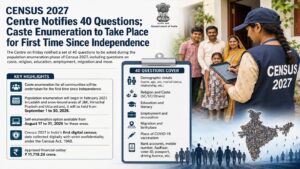
- Key Features: The exercise will involve 40 questions, digital data collection and sensitive information concerning caste, religion, Aadhaar, migration and fertility.
CENSUS 2027: TRAINING AND IMPLEMENTATION FRAMEWORK
- Large Workforce: Around 34 lakh enumerators, primarily government school teachers, will conduct door-to-door enumeration. Private school teachers and members of institutions, societies and trusts can also be appointed.
- Training Structure: A five-level training pyramid involves National Trainers, Master Trainers, Field Trainers, enumerators and supervisors. Training batches ideally comprise 35–50 participants.
- Digital Census: For the first time, enumerators will record information through a mobile application, making practical training with the Population Enumeration app mandatory.
- PRAMAN Framework: It includes Pehchaan (Identity), Rishta (Rapport), Anurodh (Request), Madad (Assistance), Aankada Shuddhata (Data Accuracy) and Nishtha (Commitment).
- Sensitive Engagement: Enumerators are being trained to handle questions concerning religion, language, caste, disability, migration, fertility and economic activities with sensitivity and neutrality.
NEW QUESTIONS AND SENSITIVE DATA COLLECTION
- Additional Questions: The Population Enumeration questionnaire contains 40 questions, including 13 new data fields compared with Census 2011.
- Identity Details: New questions include parental particulars, religion, place of birth and details relating to Aadhaar, mobile numbers, voter ID and driving licences.
- Aadhaar Collection: Question 37 seeks the respondent’s Aadhaar number, if available. Census officials clarified that providing it is optional and there is no instruction linking Aadhaar with citizenship verification.
- Caste Enumeration: Question 10(C) collects caste details. SC/ST respondents can select predetermined options, while others must manually enter their caste names.
- Declaration Options: Respondents can also select ‘Does not want to declare Caste’ or ‘No Caste’. Enumerators are instructed to remain neutral and avoid influencing responses.
KEY POINTS: CENSUS IN INDIA● Definition: Census is the systematic process of collecting, compiling and analysing demographic, social and economic information about a population. ● Legal Framework: Census in India is conducted under the Census Act, 1948, and Census Rules, 1990. ● Constitutional Provision: Census is included in the Union List (Entry 69) of the Seventh Schedule. ● Nodal Authority: The Office of the Registrar General and Census Commissioner, India, under the Ministry of Home Affairs, conducts the Census. ● Significance: Census data supports policy formulation, welfare delivery, resource allocation, constituency delimitation and evidence-based governance. |

