 India's No.1 PU & Degree With Integrated IAS & IPS(UPSC/PSC) Training College.


Supreme Court Quashes Karnataka Recruitment Law
SUPREME COURT STRIKES DOWN KARNATAKA RECRUITMENT VALIDATION LAW
WHY IN THE NEWS ?
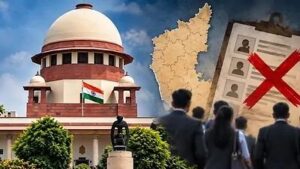
- Judicial Intervention: The Supreme Court struck down the Karnataka Civil Services (Validation of Selection and Appointment of 2011 Batch Gazetted Probationers) Act, 2022, which sought to validate appointments of 362 gazetted probationers despite serious recruitment irregularities.
- Key Observation: The Court held that legislation cannot be used to overturn or nullify judicial decisions.
BACKGROUND OF KARNATAKA RECRUITMENT SCANDAL AND SUPREME COURT RULING:
- Recruitment Controversy: The case concerns the recruitment of 362 gazetted probationers belonging to the 2011 batch in Karnataka Civil Services.
- Corruption Allegations: A Criminal Investigation Department (CID) investigation exposed widespread irregularities, including allegations of rampant corruption and blatant nepotism in the selection process.
- Earlier Judicial Decisions: In 2018, the Karnataka High Court and subsequently the Supreme Court upheld the cancellation of the entire selection process due to serious irregularities.
- Legislative Intervention: In 2022, the then Karnataka government enacted the Karnataka Civil Services (Validation of Selection and Appointment of 2011 Batch Gazetted Probationers) Act to revive and validate the disputed appointments.
- Supreme Court Verdict: A Bench comprising Justices J.B. Pardiwala and K. Vinod Chandran struck down the 2022 legislation, observing that the legislature cannot sit in appeal over judicial decisions or nullify them through a subsequent law.
- Political Inconsistency: The Court criticised successive Karnataka governments for changing their positions according to political circumstances, thereby leaving the aspirations of thousands of jobseekers uncertain.
CONSTITUTIONAL IMPLICATIONS AND SIGNIFICANCE OF THE JUDGMENT
- Separation of Powers: The judgment reinforces the constitutional distinction between the Legislature, Executive and Judiciary, preventing one organ from improperly exercising the functions of another.
- Judicial Independence: The legislature cannot simply overturn a judicial verdict by declaring it invalid through legislation.
- Rule of Law: Government recruitment must follow fairness, transparency, merit and established legal procedures rather than political considerations.
- Public Accountability: The ruling emphasises that governments must maintain consistency in administrative decisions and cannot selectively defend questionable appointments.
- Meritocracy: Protecting transparent recruitment procedures safeguards equal opportunities for deserving candidates and strengthens public confidence in government institutions.
KEY POINTS: SEPARATION OF POWERS AND JUDICIAL REVIEW● Constitutional Principle: The doctrine of Separation of Powers distributes governmental authority among the Legislature, Executive and Judiciary to prevent concentration of power. ● Constitutional Framework: Although the Indian Constitution does not establish a strict separation of powers, it provides for functional separation with institutional checks and balances. ● Article 13: Laws inconsistent with Fundamental Rights can be declared void to the extent of their inconsistency. ● Article 32 and 226: The Supreme Court and High Courts have powers to issue constitutional writs for enforcement of Fundamental Rights and other legal purposes, respectively. ● Basic Structure Doctrine: In Kesavananda Bharati v. State of Kerala (1973), the Supreme Court established that Parliament cannot alter the Constitution’s basic structure, which includes principles such as judicial review and constitutional supremacy. |

