 India's No.1 PU & Degree With Integrated IAS & IPS(UPSC/PSC) Training College.


Milky Way Evolved Through Ancient Collisions
MILKY WAY EVOLVED THROUGH ANCIENT GALACTIC COLLISIONS
WHY IN THE NEWS (40 Words)
- Scientific Discovery: Astronomers are reconstructing the Milky Way’s nearly 12-billion-year history by studying the age, chemical composition and movement of stars.
- Major Findings: Recent research has identified ancient galactic mergers, including the Gaia-Enceladus collision and the older Low-energy-Kraken-Heracles merger.
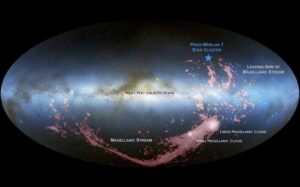
GALACTIC ARCHAEOLOGY AND MILKY WAY FORMATION:
- Galactic Archaeology: It is the study of the Milky Way’s formation and evolution through stellar ages, chemical compositions and orbital movements.
- Galactic Cannibalism: Galaxies grow by absorbing smaller galaxies through gravitational interactions, leaving behind streams and clusters of stars known as merger remnants.
- Sagittarius Dwarf: Astronomer Rodrigo Ibata identified unusual stellar movements that revealed the Sagittarius dwarf galaxy was being absorbed by the Milky Way.
- Gaia-Enceladus Merger: In 2018, Amina Helmi and her team used ESA’s Gaia data to identify stars moving differently from most Milky Way stars, indicating an ancient galactic merger around 10 billion years ago.
- Ancient Collision: Research published in August 2026 identified the Low-energy-Kraken-Heracles (LKH) galaxy merger, which occurred approximately 12 billion years ago and may represent the Milky Way’s earliest major merger.
SCIENTIFIC METHODS AND FUTURE RESEARCH
- Stellar Analysis: Scientists combine stellar age, chemical composition and three-dimensional motion to identify stars originating from different galaxies.
- Gaia Mission: The European Space Agency’s Gaia mission provides precise measurements of stellar positions, distances and movements, helping reconstruct the Milky Way’s history.
- Globular Clusters: Researchers studied 39 globular clusters, identifying 12 as remnants of an external galaxy absorbed approximately 12 billion years ago.
- Advanced Instruments: The upcoming 4MOST survey in Chile and MOONS telescope will examine stellar populations, including regions hidden by dust near the galactic centre.
- Research Challenges: Distinguishing ancient merger remnants remains difficult because gravitational interactions alter stellar orbits, while different age-estimation models can produce variations of up to two billion years.
ABOUT MILKY WAY AND GALAXIES:● Milky Way: It is a barred spiral galaxy containing our Solar System and billions of stars. ● Galactic Structure: Its major components include the central bulge, disc, spiral arms and extended stellar halo. ● Globular Clusters: These are densely packed, approximately spherical groups of old stars held together by gravity. ● Magellanic Clouds: The Large and Small Magellanic Clouds are satellite galaxies of the Milky Way. ● ESA Gaia Mission: Launched in 2013, Gaia maps the positions, distances and motions of stars to create a detailed three-dimensional map of our galaxy. |

