India's No.1 PU & Degree With Integrated IAS & IPS(UPSC/PSC) Training College.


GST Collections Rise 23% on Strong Demand
GST COLLECTIONS RISE 23% AMID STRONG ECONOMIC ACTIVITY
WHY IN THJE NEWS ?
- Strong Growth: India’s gross GST collections increased by nearly 23% year-on-year, crossing ₹2.31 lakh crore in October.
- Economic Momentum: Robust domestic economic activity and higher import-related tax revenues contributed to the significant rise.
- Revenue Performance: The increase reflects improved tax mobilisation and continued strength in indirect tax collections.
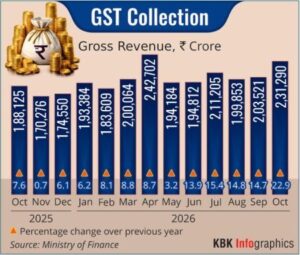
GST COLLECTIONS: KEY HIGHLIGHTS:
- Record Performance: Gross GST collections reached over ₹2.31 lakh crore in October, registering nearly 23% growth compared to the corresponding month last year.
- Domestic Revenue: GST revenue from domestic sales increased by 15.8% year-on-year, crossing ₹1.59 lakh crore.
- Import Revenue: Revenue from imports witnessed a sharp rise of 42.2%, reflecting higher tax collections from imported goods.
- Revenue Composition: The total gross GST collection comprised:
- Central GST (CGST): ₹42,935 crore.
- State GST (SGST): ₹51,340 crore.
- Integrated GST (IGST): ₹1,37,015 crore.
- Growth Drivers: Strong consumption demand, economic activity and increased import-related revenue supported the overall improvement in GST collections.
- Fiscal Significance: Higher GST revenue strengthens government finances and provides greater fiscal capacity for public expenditure and development programmes.
SIGNIFICANCE AND ECONOMIC IMPLICATIONS
- Revenue Mobilisation: Rising GST collections indicate improved indirect tax revenue generation and strengthen the Centre’s and States’ financial resources.
- Economic Indicator: GST collections serve as an important indicator of consumption trends, business activity and the overall performance of the formal economy.
- Fiscal Stability: Consistent growth in tax revenues can support infrastructure investment, welfare expenditure and fiscal consolidation.
- Formalisation Push: GST promotes greater transparency in business transactions and encourages enterprises to operate within the formal taxation system.
- Policy Implications: Sustained revenue growth requires simplified compliance procedures, reduced tax evasion, stable tax policies and improved coordination between the Centre and States.
ABOUT GOODS AND SERVICES TAX (GST):● Introduction: GST is a destination-based indirect tax imposed on the supply of goods and services. ● Constitutional Basis: GST was introduced through the 101st Constitutional Amendment Act, 2016 and implemented on 1 July 2017. ● CGST and SGST: CGST is collected by the Centre, while SGST is collected by the respective State Government on intra-state supplies. ● IGST: Integrated GST is levied on inter-state supplies and imports, with revenue apportioned between the Centre and States. ● GST Council: Article 279A provides for the GST Council, which recommends tax rates, exemptions and other important GST-related matters. |