 India's No.1 PU & Degree With Integrated IAS & IPS(UPSC/PSC) Training College.


Hell Chicken Fossil Reveals Fruit-Eating Dinosaur
HELL CHICKEN FOSSIL REVEALS DINOSAURS’ FRUIT-BASED DIET
WHY IN THE NEWS ?
- New Discovery: Scientists have identified a previously unknown, small, bird-like dinosaur species named Infernogallus jamesi from North America’s Hell Creek Formation.
- Research Findings: Published in Nature Communications, the study reveals unusual jaw movements suggesting that the dinosaur primarily consumed fleshy fruits and soft plant tissues.
- Evolutionary Significance: The discovery highlights how the emergence and diversification of flowering plants influenced dinosaur feeding adaptations during the Cretaceous Period.
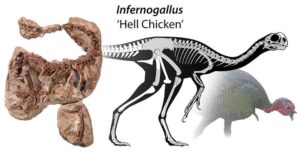
INFERNOGALLUS JAMESI: KEY SCIENTIFIC FINDINGS
- New Species: Infernogallus jamesi is a previously unknown member of the Caenagnathids, a group of toothless theropod dinosaurs belonging to the oviraptorosaur lineage.
- Fossil Evidence: The specimen was discovered in the Hell Creek Formation of North America and included a nearly complete skull.
- Physical Features: Researchers estimated that the dinosaur was an adult weighing approximately 12 kg. Its name, Infernogallus, means ‘hell chicken’.
- Unusual Jaw Structure: CT scans and jaw-muscle reconstructions revealed that its lower jaw could move forwards and backwards by approximately 1.5 cm.
- Feeding Adaptation: Unlike most non-avian theropods, which primarily moved their jaws up and down, this dinosaur possessed specialised forward-and-backward jaw movements.
- Dietary Hypothesis: Its jaw structure suggests that tough vegetation, fibrous plants and hard seeds were unlikely to form a major part of its diet.
- Fruit Consumption: Researchers identified similarities with modern Pesquet’s parrots of New Guinea, which remove fruit pulp from seeds. This suggests that Infernogallus probably consumed fleshy fruits and other soft plant tissues.
EVOLUTIONARY SIGNIFICANCE OF THE DISCOVERY
- Plant-Dinosaur Relationship: The discovery provides evidence that the evolution of flowering plants influenced dinosaur feeding behaviour and ecological adaptations.
- Dietary Diversification: The availability of different fruits may have encouraged the development of specialised feeding mechanisms among certain dinosaur groups.
- Evolutionary Timing: Caenagnathids originated shortly after flowering plants began producing fruits, while their feeding adaptations broadly coincided with increasing fruit size and diversity.
- Ecosystem Transformation: The expansion of flowering plants transformed terrestrial ecosystems by creating new food resources and ecological relationships.
- Scientific Importance: The fossil demonstrates how anatomical studies can help reconstruct the diets and ecological roles of extinct organisms.
ABOUT CRETACEOUS PERIOD AND ANGIOSPERMS:● Geological Timeline: The Cretaceous Period extended approximately from 145 million to 66 million years ago and was the final period of the Mesozoic Era. ● Mass Extinction: It ended with the Cretaceous–Paleogene (K–Pg) mass extinction, which eliminated non-avian dinosaurs. ● Angiosperms: Flowering plants, scientifically known as angiosperms, evolved and diversified significantly during the Cretaceous Period. ● Key Feature: Angiosperms produce flowers and seeds enclosed within fruits, unlike gymnosperms, whose seeds are generally not enclosed in fruits. ● Ecological Importance: Their diversification transformed terrestrial habitats and created new food resources for several animal groups. |

