India's No.1 PU & Degree With Integrated IAS & IPS(UPSC/PSC) Training College.


KUKI–NAGA BLOCKADE IN MANIPUR AND DEMAND FOR SEPARATE ADMINISTRATION
KUKI–NAGA BLOCKADE IN MANIPUR AND DEMAND FOR SEPARATE ADMINISTRATION
Why in the News?
- Fresh Tensions: The Kuki-Zo Council (KZC) has sought the Union Government’s intervention over the blockade of essential supplies to Kuki-Zo areas in Manipur’s Kangpokpi district by Naga groups, highlighting internal security challenges in India’s strategically important Northeast region within the broader Indo-Pacific strategy context.
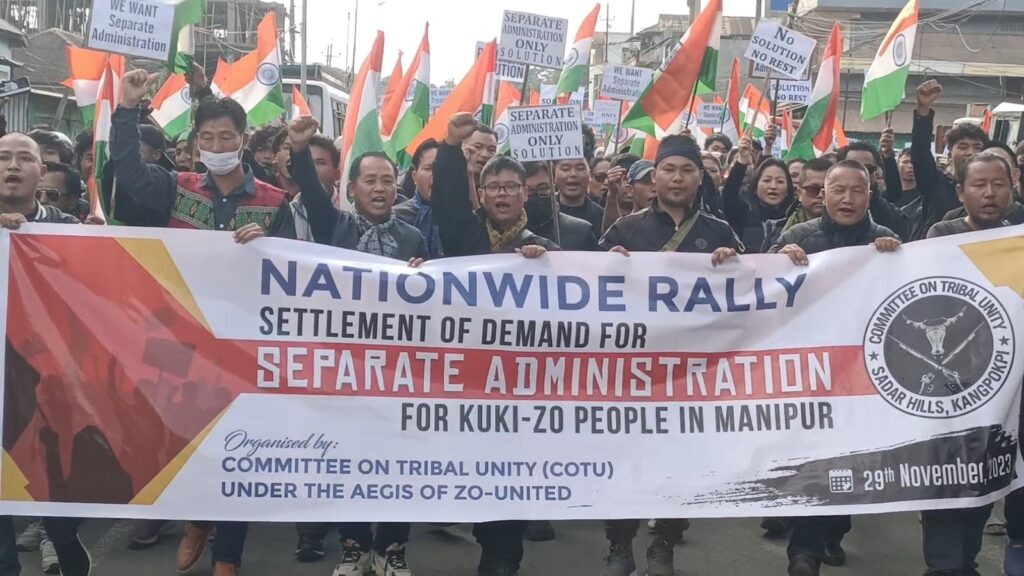
- Political Demand: The KZC has reiterated its demand for a separate Union Territory with a legislature and urged the Centre to expedite a political settlement through enhanced diplomatic engagement and inclusive dialogue mechanisms.
KUKI–NAGA TENSIONS IN MANIPUR
- Escalating Conflict: The ethnic conflict, which began between the Meitei and Kuki-Zo communities in May 2023, has now expanded to include tensions between the Kuki-Zo and Naga communities, complicating the regional security architecture in Northeast India’s sensitive border areas.
- Supply Blockade: Naga groups have allegedly blocked the movement of essential commodities to Kuki-Zo dominated areas, raising humanitarian concerns over food, medicines, and other basic necessities, requiring immediate intervention through regional security cooperation mechanisms.
- Security Concerns: The Kuki-Zo Council informed the Director of the Intelligence Bureau about vulnerable villages requiring immediate security deployment and protection from further violence, emphasizing the need for strengthened defense cooperation agreements and coordinated security responses.
- Political Dissatisfaction: Kuki-Zo leaders stated that the restoration of the elected government after President’s Rule has not addressed their security or political concerns, necessitating a comprehensive cooperative security framework for lasting peace.
- Demand for Separate Administration: The KZC continues to seek a Union Territory with a legislature, arguing that only a separate administrative arrangement can ensure lasting peace and protection of their rights, requiring careful consideration within India’s federal structure and regional engagement strategy.
CHALLENGES IN MANIPUR
- Complex Ethnic Composition: Manipur comprises three major communities—Meiteis, Nagas, and Kuki-Zo tribes—with overlapping territorial, political, and historical claims.
- Law and Order Issues: Continued violence, displacement, and blockades have disrupted governance, economic activity, and normal life across several districts.
- Humanitarian Impact: Restrictions on the movement of essential goods aggravate the hardships faced by affected populations and increase the risk of prolonged instability.
- Need for Political Dialogue: Sustainable peace requires continuous engagement among the Centre, State Government, tribal organisations, and civil society through inclusive negotiations.
- Constitutional Balance: Any long-term solution must reconcile demands for autonomy with the principles of federalism, territorial integrity, and constitutional governance.
KUKI AND NAGA TRIBES● Ethnic Identity: The Kuki and Naga are two major Scheduled Tribe groups inhabiting Manipur, Nagaland, Mizoram, Assam, and adjoining areas of Myanmar, each comprising several distinct tribes with separate languages and customs. ● Traditional Habitat: The Nagas predominantly inhabit the northern and eastern hill districts of Manipur, while the Kuki-Zo tribes are concentrated in the southern and western hill districts, with some overlapping areas leading to territorial disputes. ● Governance Structure: Both communities are governed through customary laws, village councils, and traditional institutions recognised under constitutional and statutory provisions, particularly in tribal areas. ● Sources of Conflict: Tensions between the Kuki and Naga communities have historically arisen over land ownership, territorial claims, political representation, autonomous administrative demands, and control over resources, occasionally resulting in ethnic violence. ● UPSC Relevance: The Kuki–Naga issue is important for GS Paper I (Indian Society) and GS Paper II (Polity & Governance) under topics such as tribal communities, ethnic conflicts, internal security, federalism, regional autonomy, and Northeast India. |