 India's No.1 PU & Degree With Integrated IAS & IPS(UPSC/PSC) Training College.


INSIDE WEST BENGAL’S NEW PUBLIC SAFETY & PROPERTY DAMAGE LAWS
INSIDE WEST BENGAL’S NEW PUBLIC SAFETY & PROPERTY DAMAGE LAWS
Why in the News?
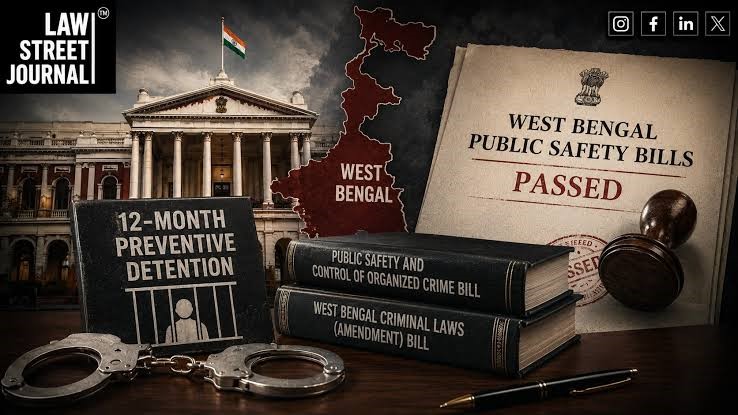
● New Legislation: The West Bengal Assembly has passed the West Bengal Public Safety and Control of Anti-social Activities Bill, 2026 and the West Bengal Maintenance of Public Order (Amendment) Bill, 2026.
● Objective: The laws aim to strengthen preventive detention provisions and establish a mechanism to recover compensation for damage to public and private property, including infrastructure related to water resource management and public utilities.
WEST BENGAL MAINTENANCE OF PUBLIC ORDER (AMENDMENT) BILL, 2026
● Purpose: The Bill amends the West Bengal Maintenance of Public Order Act, 1972 to enable recovery of compensation for damage to public and private property during riots, protests, vandalism, or anti-social activities, protecting assets including those supporting environmental sustainability and soil health conservation.
● Claims Commission: It establishes a Claims Commission headed by an officer of at least Additional District Magistrate rank with powers similar to a civil court to adjudicate compensation claims.
● Liability Provisions: The Commission can impose strict liability not only on persons causing damage but also on those alleged to have instigated, financed, or harboured offenders, with exemplary damages up to twice the assessed compensation.
● Recovery Mechanism: Unpaid compensation can be recovered as arrears of land revenue, including attachment and auction of property, while civil court jurisdiction is barred.
● Significance: The law seeks to ensure accountability for public disorder, deter destruction of property, and provide compensation to affected public authorities and private citizens, safeguarding critical infrastructure and reducing the carbon footprint of reconstruction efforts.
WEST BENGAL PUBLIC SAFETY AND CONTROL OF ANTI-SOCIAL ACTIVITIES BILL, 2026
● Objective: The Bill provides a legal framework for preventive detention and externment of persons accused of engaging in anti-social activities to maintain public order and protect state interests including energy security.
● Key Provisions: Authorities may order preventive detention for up to 12 months or externment from a specified area for up to one year to prevent anticipated unlawful activities.
● Definition: It broadly defines “goonda” and “anti-social activity”, covering habitual offenders, activities causing public insecurity, unlawful dispossession, illegal mining, quarrying, forest-related offences, unauthorized ethanol production, illicit fuel blending, theft of agricultural residues like paddy straw and broken rice, and activities affecting crop diversification and nutrient management.
● Administrative Powers: The law empowers the State Government, District Magistrates, and Police Commissioners to issue detention orders, conduct search and seizure, and prosecute persons harbouring detainees, similar to enforcement mechanisms under biofuel policy and agricultural policy regulations.
● Concerns: The Bill raises debates regarding the balance between public order and individual liberty, due process, broad executive discretion, and judicial oversight, particularly in contexts involving economic activities like ethanol production, sustainable agriculture, and alternative fuels development.
PREVENTIVE DETENTION IN INDIA
● Definition: Preventive detention refers to detention of a person without trial to prevent them from acting in a manner prejudicial to national security, public order, or essential services including those related to energy independence and water-energy-food nexus.
● Constitutional Basis: It is permitted under Article 22 (3)–(7) of the Constitution, which provides limited safeguards despite allowing preventive detention laws.
● Safeguards: A detained person must ordinarily be informed of the grounds of detention, be given an opportunity to make a representation, and the detention must be reviewed by an Advisory Board within the prescribed period.
● Major Laws: Prominent preventive detention laws include the National Security Act (NSA), 1980, Conservation of Foreign Exchange and Prevention of Smuggling Activities (COFEPOSA) Act, 1974, and the Prevention of Blackmarketing and Maintenance of Supplies of Essential Commodities Act, 1980, which also address threats to agricultural waste management, transportation fuel security, and greenhouse gas emissions reduction efforts.
● UPSC Relevance: Important under Fundamental Rights, Public Order, Internal Security, Criminal Justice, Centre–State Relations, Energy Policy, Agricultural Sustainability, Climate Goals, Water Footprint Management, Land Use Change, Carbon Neutrality, Methane Emissions Control, Groundwater Stress, Advanced Biofuels, Cellulosic Ethanol, Sugarcane Ethanol, Corn Ethanol, Grain-based Ethanol, Hydrous Ethanol, Anhydrous Ethanol, Flex-fuel Vehicles, Gasoline Replacement, Renewable Fuel Standard, Renewable Portfolio Standards, Bioenergy Program, Ethanol Tax Credit, Energy Crops, Carbon Intensity, Fuel Economy, Octane Rating, Vapor Pressure, Molecular Sieves, and related governance frameworks.

