 India's No.1 PU & Degree With Integrated IAS & IPS(UPSC/PSC) Training College.


Carbon Border Taxes: India’s Trade Challenge
CARBON BORDER TAXES AND INDIA’S TRADE CHALLENGE
Syllabus:
GS 3:
- Environment and conservation.
- Carbon Tax
Why in the News?
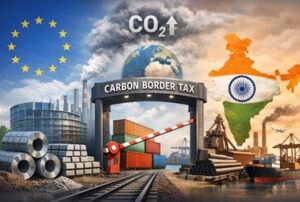
The European Union’s Carbon Border Adjustment Mechanism (CBAM) entered its definitive phase in January 2026, reshaping global trade by linking market access with carbon emissions compliance.
CLIMATE CHANGE AND INTERNATIONAL TRADE● Climate-Trade Nexus: Increasing integration of environmental standards with global trade rules reflects evolving priorities in international economic governance. ● Sustainable Development Principle: Climate policies must balance economic growth, environmental protection, and developmental equity, particularly for emerging economies. ● Common But Differentiated Responsibilities: International climate governance recognises differing responsibilities of countries based on historical emissions and developmental capacities. ● Green Industrial Policies: Nations increasingly use climate regulations to promote domestic green industries and sustainable technological transitions. ● WTO and Carbon Measures: Carbon-border taxes raise debates regarding compatibility with World Trade Organization principles of free and non-discriminatory trade. |
UNDERSTANDING THE CBAM FRAMEWORK
- Climate Policy Tool: CBAM aims to prevent carbon leakage by imposing carbon-linked charges on imports produced through emission-intensive methods outside the European Union’s environmental regulatory framework.
- Targeted Sectors: Carbon-intensive industries such as steel, cement, aluminium, fertilizers, electricity, and hydrogen will face direct compliance obligations under the EU’s carbon-border taxation mechanism.
- Price-Based Mechanism: Unlike conventional non-tariff barriers, CBAM quantitatively links market access with embedded carbon emissions, directly increasing export costs for emission-intensive goods entering European markets.
- Global Trade Shift: The mechanism signals a transition where carbon efficiency increasingly determines competitiveness, alongside traditional factors such as labour costs, productivity, and comparative production advantages.
- Policy Replication Risk: Other developed economies may adopt similar carbon-border regulations, potentially expanding compliance pressures on developing countries dependent on carbon-intensive manufacturing and exports.
IMPACT ON INDIA’S EXPORT SECTORS
- Steel Industry Exposure: India’s steel sector, heavily dependent on European markets and coal-intensive production processes, faces significant compliance costs and reduced competitiveness under CBAM regulations.
- Aluminium Sector Pressure: The aluminium industry may experience tighter contracts and declining export margins as European buyers increasingly prioritise low-carbon suppliers and environmentally sustainable manufacturing processes.
- Higher Production Costs: Indian exporters may need substantial investments in clean technologies and renewable energy adoption, increasing operational costs and reducing short-term profitability in global markets.
- Market Access Constraints: Even with ongoing India-EU Free Trade Agreement negotiations, CBAM-related compliance costs could undermine expected gains from tariff reductions and expanded trade opportunities.
- Supply Chain Adjustment: European importers are likely to enforce stricter supplier standards, compelling Indian firms to improve carbon accounting, emissions reporting, and sustainability practices
INDIRECT ECONOMIC CONSEQUENCES FOR INDIA
- Fertilizer Price Shock: India, as a major fertilizer importer, may face rising costs due to global price transmission from exporters impacted by carbon compliance expenses under CBAM.
- Agricultural Burden: Higher fertilizer prices can adversely affect farm profitability, agricultural productivity, and food inflation, especially impacting small and marginal farmers across India.
- Import Dependence Risk: Heavy reliance on imports of fertilizers, energy resources, and industrial inputs increases vulnerability to carbon-linked global price fluctuations and external shocks.
- Inflationary Impact: Rising import costs may contribute to broader inflationary pressures, complicating monetary policy management and increasing economic stress on vulnerable populations.
- Competitiveness Erosion: Carbon-related compliance costs could reduce India’s export competitiveness relative to countries with advanced green technologies and lower carbon-intensity production systems.
CBAM AND CHANGING GLOBAL TRADE RULES
- Trade Beyond Tariffs: International trade is increasingly governed by climate and sustainability standards, reducing the dominance of traditional tariff-based market access frameworks.
- Carbon Efficiency Importance: Competitive advantage now depends significantly on low-carbon production methods, alongside efficiency, pricing, and technological innovation in manufacturing sectors.
- Green Protectionism Concerns: Developing nations argue CBAM may function as disguised protectionism, disproportionately affecting countries lacking financial and technological resources for rapid green transitions.
- Developmental Inequality: Developed countries historically contributed most to global emissions, yet developing economies now bear substantial costs for transitioning toward carbon-neutral trade systems.
- Trade Architecture Shift: CBAM reflects the emergence of a carbon-conscious global economic order, where environmental policies increasingly influence international commerce and supply-chain decisions.
CHALLENGES FOR DEVELOPING COUNTRIES
- Technology Gap: Many developing countries lack access to advanced green technologies and affordable renewable infrastructure, limiting their ability to comply with stringent carbon regulations.
- Financial Constraints: Transitioning toward low-carbon production requires massive investments, which pose severe challenges for resource-constrained industries and economies.
- Policy Readiness Issues: Developing economies often face inadequate institutional capacity, carbon-accounting systems, and regulatory preparedness to adapt quickly to carbon-border mechanisms.
- Unequal Transition Burden: Carbon compliance disproportionately affects countries still pursuing industrialisation and poverty reduction, potentially restricting developmental opportunities and economic growth trajectories.
- Trade Diversion Risks: Exporters may lose access to developed markets, resulting in trade diversion and reduced integration into high-value global supply chains.
INDIA’S DOMESTIC REFORM REQUIREMENTS
- Renewable Energy Expansion: India must accelerate investments in solar, wind, green hydrogen, and clean energy infrastructure to reduce industrial carbon intensity sustainably.
- Carbon Policy Strengthening: Effective implementation of carbon markets, emissions trading systems, and sustainability regulations is essential to improve global trade competitiveness.
- Industrial Modernisation: Carbon-intensive industries require technological upgrades and adoption of energy-efficient production methods to remain competitive under evolving global standards.
- Agricultural Sustainability: Better implementation of the Soil Health Cards Scheme and balanced fertilizer use can reduce import dependence and improve agricultural resilience.
- Research and Innovation: Greater focus on green technology research and indigenous innovation can strengthen India’s long-term climate and trade adaptability.
INTERNATIONAL NEGOTIATION STRATEGIES
- Equitable Transition Demand: India must advocate for special and differential treatment for developing countries in global climate-related trade negotiations and frameworks.
- Technology Transfer: Developed countries should support technology sharing and capacity building to ensure fair adaptation opportunities for emerging economies.
- Climate Finance Access: India should seek enhanced green financing mechanisms and transitional support to facilitate low-carbon industrial transformation.
- Trade Diplomacy: Bilateral and multilateral trade negotiations should include safeguards preventing unfair carbon-related trade restrictions on developing economies.
- Collective South Cooperation: India can collaborate with other developing countries to strengthen Global South bargaining power in climate-trade governance discussions.
WAY FORWARD
- Accelerate Green Transition: Promote rapid industrial decarbonisation through renewable energy adoption and low-carbon manufacturing technologies.
- Strengthen Trade Preparedness: Build institutional systems for carbon accounting, emissions monitoring, and sustainability certification.
- Enhance Domestic Production: Reduce dependence on imported fertilizers and critical inputs through self-reliance and technological innovation.
- Negotiate Fairly: Pursue balanced international agreements ensuring developmental concerns and climate justice principles remain protected.
- Promote Global Cooperation: Encourage collaborative climate action combining technology transfer, climate finance, and sustainable trade frameworks.
CONCLUSION
The EU’s Carbon Border Adjustment Mechanism represents a transformative shift in global trade governance, where carbon efficiency increasingly determines market access and competitiveness. While CBAM may contribute to reducing global emissions, it poses substantial challenges for developing economies like India by increasing compliance costs and constraining export competitiveness. India must therefore pursue a balanced strategy combining domestic green reforms, industrial modernisation, and effective international negotiations. Ensuring that climate-linked trade measures do not undermine developmental aspirations will remain central to achieving both economic growth and environmental sustainability in the emerging global trade order.
SOURCE: TH
MAINS PRACTICE QUESTION
“Carbon-border adjustment mechanisms are reshaping global trade by linking market access with environmental compliance.” Examine the implications of the EU’s CBAM for India’s economy and trade policy.

