 India's No.1 PU & Degree With Integrated IAS & IPS(UPSC/PSC) Training College.


TRADE, SUPPLY CHAINS AND ECONOMIC STATECRAFT
TRADE, SUPPLY CHAINS AND ECONOMIC STATECRAFT
Syllabus:
GS 3:
- Indian economy and related issues.
- Balance of Payment .
Why in the News?
Rising geopolitical tensions, supply-chain disruptions, tariff wars, and strategic competition between major powers have transformed trade, technology, and economic networks into central instruments of global power politics.
INDIA’S STRATEGIC AUTONOMY● Non-Alignment Legacy: India historically pursued an independent foreign policy avoiding alignment with competing global blocs. ● Multi-Alignment Strategy: Contemporary India follows a strategy of engaging multiple powers simultaneously based on national interest. ● Economic Security Dimension: Strategic autonomy now increasingly depends on resilient trade networks and technological self-reliance. ● Balancing Great Powers: India seeks constructive engagement with the U.S., Europe, Russia, and the Global South simultaneously. ● Autonomy Through Capability: Strong domestic economic and technological capacities are essential for preserving strategic independence. |
CHANGING NATURE OF GLOBAL GEOPOLITICS
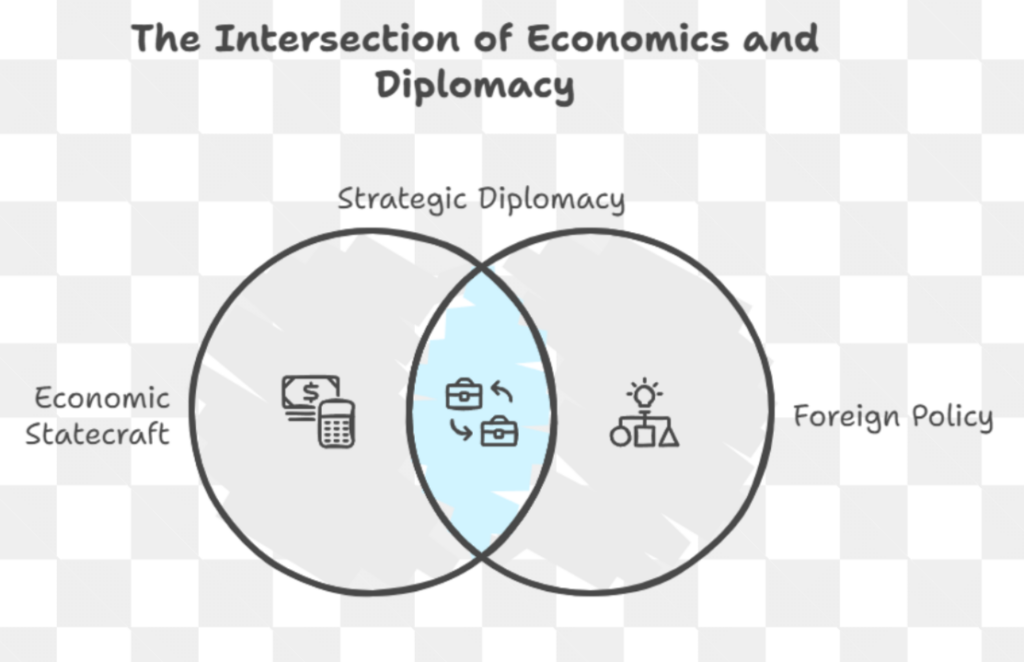
- Economics And Geopolitics Fusion: The traditional separation between economics and geopolitics has collapsed, making trade and supply chains key arenas of strategic competition.
- Supply Chains As Power Tools: Critical supply chains involving semiconductors, rare earth minerals, energy corridors, and digital infrastructure now shape global influence.
- Rise Of Economic Statecraft: Countries increasingly use tariffs, export controls, sanctions, and investment restrictions as instruments of foreign policy.
- Strategic Competition Expansion: Global competition now extends beyond military alliances toward regulatory systems, infrastructure networks, and technological ecosystems.
- Decline Of Pure Globalisation: The earlier belief that free trade automatically promotes cooperation and peace is increasingly being questioned.
TRADE AS A TOOL OF STRATEGIC LEVERAGE
- Weaponisation Of Interdependence: Nations increasingly exploit economic dependencies to exert political pressure and strategic influence over rivals.
- Rare Earth Dominance: China’s restrictions on rare earth exports demonstrate how critical minerals can become geopolitical leverage tools.
- Tariff Politics Resurgence: Countries such as the United States increasingly employ tariffs and trade restrictions for strategic and punitive purposes.
- Energy Dependencies: Dependence on imported energy resources creates vulnerabilities that can directly affect national security and economic stability.
- Export Controls Expansion: Restrictions on advanced technologies, semiconductors, and AI-related systems reflect growing techno-strategic rivalry.
INDIA’S EMERGING STRATEGIC POSITION
- Global Supply Chain Diversification: Companies and governments are increasingly seeking alternatives to concentrated production systems centred around China.
- India As Trusted Partner: India is now viewed as a stable democratic economy capable of absorbing investments and supporting diversified supply chains.
- Scale Advantage: India’s large domestic market and youthful labour force provide significant economic and strategic advantages.
- Geopolitical Relevance: India’s strategic importance has increased amid the broader geopolitical recalibration surrounding China.
- From Periphery To Centre: India has shifted from being perceived as a difficult market to becoming a crucial node in global production networks.
DOMESTIC REFORMS SUPPORTING INDIA’S POSITION
- Digital Infrastructure Expansion: Platforms such as UPI, Aadhaar, and Digital Public Infrastructure (DPI) have enhanced economic efficiency and global credibility.
- Infrastructure Development: Investments in logistics, highways, ports, and connectivity have improved India’s attractiveness for global manufacturing.
- Regulatory Reforms: Targeted deregulation and ease-of-doing-business reforms, including streamlined environmental clearance processes and the EIA notification framework, have reduced transaction costs for businesses and investors.
- Improved Predictability: Greater policy stability, elimination of ex post facto regulatory uncertainties, and institutional reforms have strengthened investor confidence in India’s long-term growth potential.
- Manufacturing Push: Schemes such as Production Linked Incentive (PLI) aim to expand India’s industrial capabilities and exports.
ECONOMIC STATECRAFT IN INDIA’S FOREIGN POLICY
- Technology Partnerships: India increasingly uses technology collaborations as strategic instruments within its diplomatic engagements.
- Semiconductor Cooperation: Partnerships involving semiconductor manufacturing and supply chains are becoming central to economic diplomacy.
- Critical Mineral Agreements: Securing access to strategic minerals has become vital for energy transition and industrial resilience.
- Defence Industrial Collaboration: Co-production and defence manufacturing partnerships are strengthening both economic and strategic capacities.
- Digital Diplomacy: Export of India’s Digital Public Infrastructure model strengthens its global influence and developmental partnerships.
RISKS IN THE NEW GLOBAL ORDER
- Overdependence Vulnerability: Excessive reliance on a single country for technology, markets, or critical inputs can create strategic risks.
- Supply Chain Disruptions: Geopolitical conflicts and protectionist policies can destabilise global production and trade networks.
- Technological Fragmentation: Competing digital ecosystems may divide the global economy into rival technological blocs.
- Strategic Coercion Risks: Economic relationships increasingly carry risks of sanctions, export bans, and political pressure.
- Balancing Multiple Partnerships: India must maintain strategic autonomy while engaging simultaneously with multiple major powers.
THE IDEA OF ‘POLICY PROMISCUITY’
- Diversified Partnerships: India’s strategy increasingly involves engaging multiple economic and strategic partners simultaneously.
- Avoiding Alignment Traps: Balanced engagement prevents excessive dependence on any single geopolitical bloc or major power.
- Flexible Diplomacy: Bilateral and regional arrangements allow India greater flexibility in pursuing issue-based cooperation.
- Strategic Autonomy Preservation: Multi-alignment helps India maintain independent decision-making in international affairs.
- Pragmatic Global Engagement: India seeks calibrated integration into global systems without surrendering sovereign policy space.
INTERNAL CHALLENGES INDIA MUST ADDRESS
- Logistics Bottlenecks: Efficient ports, transportation systems, and supply-chain infrastructure remain essential for global competitiveness.
- Skill Development Needs: Workforce capabilities must improve to support advanced manufacturing and emerging technologies.
- Research And Innovation: Greater investment in R&D, intellectual property, and innovation ecosystems is necessary.
- Critical Minerals Strategy: India requires secure external partnerships and sustainable domestic extraction frameworks.
- Institutional Credibility: Strong democratic institutions, robust environmental jurisprudence grounded in principles like the polluter pays principle and precautionary principle, and social cohesion are essential for sustaining investor confidence and ensuring a pollution free environment.
DECLINE OF MULTILATERALISM
- Weakening Global Institutions: Traditional multilateral frameworks such as the World Trade Organization (WTO) have lost effectiveness amid geopolitical rivalries.
- Rise Of Bilateralism: Countries increasingly prefer flexible bilateral and regional trade arrangements over universal agreements.
- Strategic Trade Coalitions: Economic partnerships are now often shaped by strategic priorities rather than purely commercial considerations.
- Fragmented Global Economy: The world economy is evolving into overlapping blocs and customised economic coalitions.
- Opportunity For India: India can leverage this transition to build agile, interest-driven partnerships across sectors and geographies.
WAY FORWARD FOR INDIA
- Strengthen Supply Chain Resilience: India must diversify imports and develop domestic capabilities in critical sectors.
- Deepen Economic Diplomacy: Trade agreements and technology partnerships should become central pillars of foreign policy.
- Enhance Competitiveness: Continued reforms in logistics, manufacturing, skilling, and innovation are necessary for attracting investments.
- Promote Trusted Digital Ecosystems: India should expand its leadership in Digital Public Infrastructure and trusted technology frameworks.
- Maintain Strategic Balance: India must remain globally engaged while carefully safeguarding strategic autonomy and national interests.
CONCLUSION
The contemporary global order is increasingly defined by the fusion of economics and geopolitics, where trade, technology, and supply chains function as instruments of strategic power. Economic statecraft has emerged as a decisive factor shaping international relations, replacing the earlier assumption that globalisation alone guarantees cooperation and prosperity. In this changing environment, India occupies a uniquely advantageous position as a large, democratic, and increasingly competitive economy capable of supporting diversified global supply chains. However, opportunities also bring vulnerabilities, particularly in areas such as technology dependence, energy security, and critical minerals. India’s challenge therefore lies in balancing openness with resilience, integration with autonomy, and strategic partnerships with independent decision-making. If managed effectively, the current geopolitical transition can enable India not merely to participate in the emerging global order, but to actively shape it.
SOURCE:
TH
MAINS PRACTICE QUESTION:
“Economic diplomacy has become one of the organising principles of contemporary foreign policy.” Discuss in the context of trade, supply chains, and economic statecraft in the emerging global order.

