 India's No.1 PU & Degree With Integrated IAS & IPS(UPSC/PSC) Training College.


IS THE GREAT NICOBAR PROJECT A STRATEGIC ASSET OR A LIABILITY?
IS THE GREAT NICOBAR PROJECT A STRATEGIC ASSET OR A LIABILITY?
Why in the News?
- The ₹72,000-crore Great Nicobar project has come under scrutiny following the National Green Tribunal’s (NGT) observations and ongoing environmental concerns regarding environmental clearances.
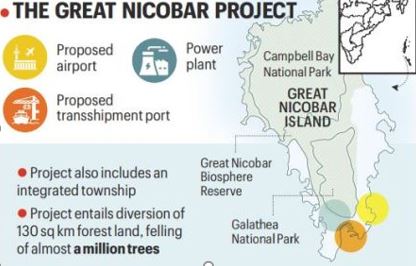
- The project proposes the construction of:
○ an international transhipment port,
○ a greenfield international airport, and
○ a 160-square-kilometre township on Great Nicobar Island.
- It is being promoted as a strategic mega-development initiative aimed at transforming Great Nicobar into India’s “Singapore or Hong Kong”.
- Critics argue that the project could trigger severe ecological damage in one of India’s most fragile biodiversity hotspots.
- Concerns have also been raised over the project’s logistical feasibility, disaster vulnerability, economic viability, and its impact on indigenous communities and coastal ecosystems within the Coastal Regulation Zone.
- The controversy has intensified debates over whether environmental safeguards and the precautionary principle are being compromised in the name of strategic and economic ambitions.
Ecological and Tribal Concerns
- Except for seven revenue villages on the eastern coast, Great Nicobar Island is officially reserved for indigenous communities.
- The island is home to:
○ the Shompen tribe, classified as a Particularly Vulnerable Tribal Group (PVTG), with a population of only 229 (2011 Census), and
○ the Southern Nicobarese community, a Scheduled Tribe numbering around 1,200 people.
- Environmentalists warn that large-scale deforestation and infrastructure development could destroy the ancestral habitat of these communities, threatening their culture, identity, and way of life.
- Great Nicobar forms part of the globally significant Sundaland Biodiversity Hotspot, one of only four such hotspots in India.
- Recognising its ecological importance, UNESCO designated the island as a Biosphere Reserve in 2013.
- The island’s ecosystem includes:
○ extensive coral reef systems within the Coastal Regulation Zone,
○ tropical evergreen forests, and
○ more than 650 species of angiosperms, ferns, gymnosperms, bryophytes, and lichens.
- Great Nicobar also supports one of the Indo-Pacific’s largest nesting sites for the endangered leatherback turtle.
- Reports indicate that nearly one million trees have been marked for felling under the project.
- These forests are ecologically crucial as moisture-rich ecosystems that contribute to the southwest monsoon system, regional climate stability, and a pollution free environment.
Seismic and Geological Risks
- Great Nicobar lies in one of the world’s most tectonically active regions, making it highly vulnerable to earthquakes and tsunamis.
- The island is located close to Banda Aceh, Indonesia — the epicentral region of the 9.2 magnitude Sumatra earthquake of 2004.
- The earthquake occurred along the boundary where the Indian Plate subducts beneath the Southeast Asian Plate, rupturing over 1,200 km of the plate boundary.
- Massive displacement of the ocean floor during the event triggered the devastating Indian Ocean tsunami.
- Following the 2004 earthquake, Great Nicobar experienced sudden coseismic subsidence of nearly 3–4 metres, highlighting the region’s geological instability.
- Scientists note that this was not an isolated event but part of an ongoing tectonic cycle of:
○ gradual strain accumulation,
○ slow land uplift, and
○ sudden subsidence during major earthquakes.
- GPS-based studies published in peer-reviewed journals indicate that the Nicobar region is currently in an interseismic phase, with tectonic stress steadily building again before a future major seismic event.
- Unlike geologically stable global port cities such as Singapore or Hong Kong, Great Nicobar undergoes repeated cycles of uplift and subsidence, raising serious concerns over the safety of large-scale infrastructure projects.
- Experts argue that constructing ports, airports, and townships in such an unstable zone creates long-term strategic and economic risks.
- These concerns are further intensified by projected climate change-induced sea-level rise, which could expose the island to the combined threats of sinking land and rising oceans.
- Strategic analysts have warned that infrastructure damaged or rendered inoperative by seismic events could become a “strategic liability” rather than a strategic asset.
Concerns Over the NGT’s Decision
- The National Green Tribunal (NGT) is mandated to adjudicate matters related to:
○ environmental protection,
○ forest conservation, and
○ sustainable management of natural resources.
- Critics argue that, in the Great Nicobar case, the NGT failed to critically examine the project’s environmental and ecological implications, raising concerns about ex post facto environmental clearance processes.
- The tribunal reportedly accepted the government’s claims regarding the project’s “strategic importance” and the existence of “adequate safeguards” without rigorous scientific scrutiny or applying the precautionary principle.
- Environmental experts contend that the judgment overlooked substantial independent research highlighting:
○ ecological fragility,
○ seismic vulnerability, and
○ risks to indigenous communities.
- The ruling is seen as setting a concerning precedent where projects labelled as “strategically important” may receive judicial approval despite significant environmental costs, potentially undermining environmental democracy and the polluter pays principle.
- Critics compare the case to the Supreme Court-approved Char Dham road-widening project in Uttarakhand, where strategic and security considerations were similarly prioritised over ecological concerns.
- The Char Dham project has since been associated with:
○ increased landslides,
○ ecological degradation, and
○ heightened disaster vulnerability in the fragile Himalayan region.
- Observers warn that the Great Nicobar decision could weaken environmental jurisprudence by allowing strategic considerations to override ecological safeguards without adequate independent assessment, contrary to principles established in the Vanashakti judgment regarding retrospective environmental clearances.
- The controversy has intensified debates over balancing:
○ national security and infrastructure goals, with
○ ecological sustainability and environmental justice.
Way Forward
- Conduct an independent scientific review of the project involving ecologists, seismologists, climate experts, and tribal rights specialists.
- Reassess the Environmental Impact Assessment (EIA) through transparent and participatory processes with public consultation in accordance with the EIA Notification and principles of environmental democracy.
- Ensure protection of indigenous communities by strictly implementing constitutional safeguards, Forest Conservation Act provisions, Forest Rights Act provisions, and international principles of Free, Prior and Informed Consent (FPIC).
- Adopt a phased and low-impact development model instead of large-scale ecological transformation of the island.
- Integrate disaster-resilient planning by accounting for earthquake risks, tsunamis, coastal erosion, and sea-level rise in all infrastructure designs.
- Strengthen environmental governance by ensuring that strategic considerations do not bypass judicial and ecological scrutiny, and that the precautionary principle and polluter pays principle are strictly applied.
- Prioritise conservation of biodiversity hotspots including coral reefs, mangroves, and leatherback turtle nesting habitats within the Coastal Regulation Zone.
- Develop alternative strategic infrastructure in relatively stable and less ecologically sensitive regions wherever feasible.
- Institutionalise continuous ecological monitoring using satellite mapping, biodiversity audits, and climate-risk assessments.
- Promote sustainable island development policies that balance national security, economic growth, ecological integrity, tribal welfare, and the right to a pollution free environment.
Mains question
“Critically examine the environmental, seismic, and tribal concerns associated with the Great Nicobar Infrastructure Project. How should India balance strategic development with ecological sustainability and indigenous rights?”

