 India's No.1 PU & Degree With Integrated IAS & IPS(UPSC/PSC) Training College.


SEHAT Mission
SEHAT Mission
Why in the News?
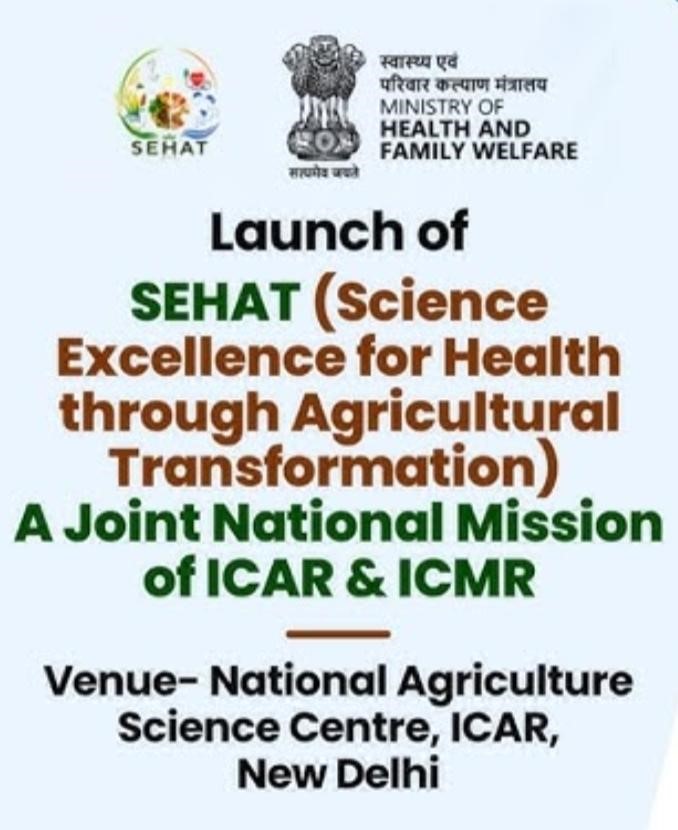
- SEHAT Mission was recently launched in Delhi by the Union Ministers for Health and Agriculture.
- The mission has been jointly initiated by Indian Council of Agricultural Research and Indian Council of Medical Research.
- It aims to integrate agricultural transformation with public health outcomes under the vision of “Healthy Food, Healthy Farms and a Healthy India,” promoting environmental democracy in health governance.
Objectives and features of the mission
- Health-agriculture linkage: The mission seeks to align agricultural innovation with nutrition, preventive healthcare, and farmer well-being, incorporating environmental impact assessment principles in agricultural planning.
- Mission-mode programme: It focuses on translating scientific agricultural research into measurable public health benefits while ensuring compliance with environmental clearances for sustainable development.
- Biofortified crops promotion: Encourages development of nutrient-rich crop varieties to tackle malnutrition and micronutrient deficiencies.
- Integrated farming systems: Supports diversified farming practices to improve dietary diversity, resilience, and rural incomes, with consideration for coastal regulation zone guidelines in applicable areas.
- One Health approach: Strengthens integrated surveillance and research connecting human, animal, and environmental health, applying the precautionary principle in disease prevention strategies.
Key focus areas under SEHAT Mission
- Nutritional security: Development and evaluation of biofortified and nutrient-dense crops to improve nutrition outcomes.
- Occupational health: Addressing health risks faced by agricultural workers through evidence-based interventions, ensuring a pollution free environment in farming communities.
- Non-communicable disease prevention: Promotion of functional foods and nutritionally superior crops to tackle lifestyle diseases.
- Farm resilience: Enhancing sustainable agricultural systems that support both environmental and economic stability, aligned with forest conservation act provisions and EIA notification requirements for large-scale agricultural projects.
- Research collaboration: Encourages coordinated action between agriculture scientists, health researchers, and policymakers, incorporating environmental jurisprudence principles in policy formulation.
One Health approach● Concept: One Health recognises the interconnectedness of human, animal, and environmental health, emphasizing the need for a pollution free environment and sustainable practices. ● Disease surveillance: It promotes integrated monitoring of zoonotic diseases and emerging health threats, applying the precautionary principle in early detection systems. ● Global relevance: The approach gained importance after outbreaks such as COVID-19 and other zoonotic diseases. ● Indian initiatives: India has increasingly incorporated One Health principles in public health and veterinary policies, drawing from environmental jurisprudence and the polluter pays principle in health governance frameworks. ● UPSC relevance: Important for GS Paper II and III under health governance, agriculture, food security, and environmental sustainability. |

