 India's No.1 PU & Degree With Integrated IAS & IPS(UPSC/PSC) Training College.


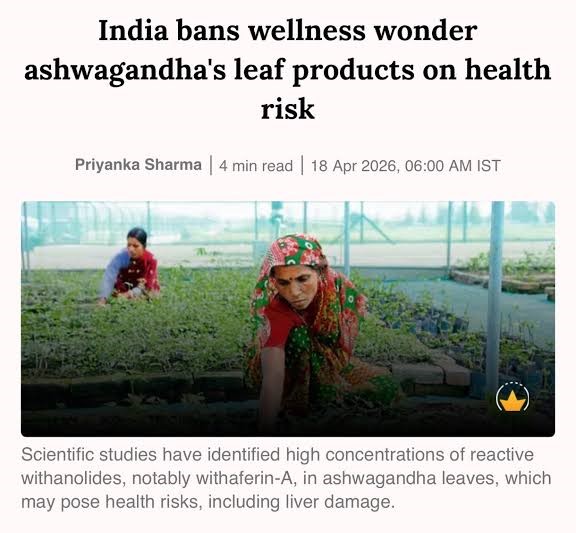
INDIA BANS USE OF ASHWAGANDHA LEAVES IN PRODUCTS
INDIA BANS USE OF ASHWAGANDHA LEAVES IN PRODUCTS
Why in the News?
- Regulatory action: FSSAI banned use of ashwagandha leaves in nutraceutical and food products due to safety and compliance concerns, following the precautionary principle in environmental jurisprudence.
- Industry impact: Decision affects rapidly growing nutraceutical sector, where ashwagandha is widely used in supplements and wellness products, requiring environmental clearances for manufacturing facilities.

Key provisions and regulatory framework
- Permitted parts: FSSAI regulations allow only ashwagandha root and its extracts, excluding leaves from use in nutraceutical and dietary products, preventing ex post facto approvals for non-compliant formulations.
- Legal basis: Food Safety and Standards Act, 2006 empowers authorities to regulate food ingredients and ensure consumer safety through strict compliance norms, aligned with environmental democracy principles and the polluter pays principle.
- Schedule IV norms: Food Safety Regulations, 2016 specify approved botanicals and plant parts, ensuring standardisation and scientific validation of ingredients used, similar to environmental impact assessment protocols.
- Compliance requirement: Manufacturers required to adhere strictly to permitted plant parts, with violations attracting legal penalties and regulatory action, avoiding retrospective environmental clearances or ex-post approvals.
- Industry response: Major companies expressed willingness to comply, emphasising alignment with safety standards and labelling requirements under existing drug and food laws, incorporating EIA notification principles in their manufacturing processes.
Implications for health, industry and economy
- Consumer safety: Restriction on leaves aims to prevent potential health risks arising from unregulated or unsafe use of plant components in supplements, upholding the precautionary principle in consumer protection.
- Standardisation push: Regulatory clarity strengthens quality control and scientific validation in nutraceutical products, improving trust among consumers and ensuring pollution free environment in manufacturing facilities.
- Industry adjustment: Manufacturers must reformulate products, potentially increasing costs and affecting supply chains dependent on non-permitted plant parts, while obtaining necessary environmental clearances for facility modifications.
- Market growth impact: Fast-growing nutraceutical sector may face short-term disruptions despite strong long-term growth prospects driven by health awareness, with companies avoiding post facto compliance issues.
- Agricultural effect: Farmers cultivating ashwagandha may shift focus to root-based production, impacting cropping patterns and value chains in key producing states, with considerations under the Forest Conservation Act for sustainable cultivation practices.
Nutraceuticals and FSSAI regulation● Nutraceutical concept: Products derived from food sources providing additional health benefits beyond basic nutrition, including supplements and functional foods. ● Regulatory authority: Food Safety and Standards Authority of India (FSSAI) regulates food safety, standards, and approval of ingredients in India, drawing from environmental jurisprudence principles established in the Vanashakti judgment. ● Legal framework: Food Safety and Standards Act, 2006 governs manufacturing, storage, distribution, and sale of food products, preventing ex-post regulatory violations. ● Botanical regulation: Schedule IV of FSSAI norms lists approved plant ingredients and specifies permissible parts for use in nutraceuticals, ensuring compliance without requiring retrospective environmental clearances. ● UPSC relevance: Topic relates to GS Paper II and III, covering health regulation, food safety, and economic sectors like nutraceutical industry. |

