India's No.1 PU & Degree With Integrated IAS & IPS(UPSC/PSC) Training College.


J&K Shelves ₹416Cr Dal Lake Plan
J&K Shelves ₹416 Crore Dal Plan
Why in the News ?
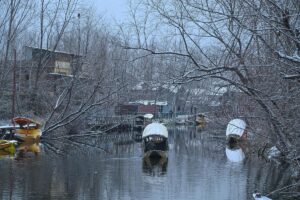
The Jammu & Kashmir government has shelved the ₹416.72-crore Dal Lake restoration plan approved in 2009, citing poor outcomes. It has proposed an in-situ conservation model, treating lake dwellers as integral to the ecosystem and focusing on sewage treatment and internal rejuvenation.
Why Was the Earlier Restoration Plan Shelved?
- The ₹416.72-crore plan, approved in 2009 under the Manmohan Singh government, aimed to relocate nearly 9,000 families from the lake.
- Only 1,808 families were rehabilitated in 17 years, reflecting slow implementation.
- The rehabilitation site at Rakh-e-Arth (Bemina) was low-lying and flood-prone, requiring heavy land filling.
- Despite significant spending, basic infrastructure remained incomplete, reducing acceptance among dwellers.
- The government reported that conservation efforts achieved only 27% of intended goals, prompting policy reassessment.
Environmental Pressures Degrading Dal Lake
- A 2022 study by Sher-e-Kashmir University of Agricultural Sciences and Technology (SKUAST) flagged extreme pollution loads and encroachments.
- Untreated sewage discharge from point and non-point sources has severely deteriorated water quality.
- Deforestation, grazing, agriculture, and land-use changes in the catchment area have intensified degradation.
- Shrinking inflows and blocked internal channels have reduced water circulation, worsening stagnation.
- Nutrient enrichment (eutrophication) has triggered excessive weed growth, invasive species spread, and biodiversity loss.
About Wetland Conservation & In-Situ Model :● Wetlands like Dal Lake provide ecosystem services: water purification, flood control, carbon sequestration, and livelihood support. ● The new in-situ conservation approach recognises lake dwellers as part of the socio-ecological system. ● The J&K Lake Conservation and Management Authority (LCMA) will frame a comprehensive implementation policy. ● Six of the 58 hamlets will receive modular Sewage Treatment Plants (STPs); sewerage in 28 internal hamlets will be addressed. ● A ₹212.38-crore DPR prepared by Indian Institute of Technology Roorkee proposes dredging, channel revival, and improved water circulation under the Prime Minister’s Development Package. |