 India's No.1 PU & Degree With Integrated IAS & IPS(UPSC/PSC) Training College.


Modi-Merz Indo-Europe Pivot vs US-China Power Play
MODI AND FRIEDRICH MERZ ARE LOOKING AT ‘INDO-EUROPE’ TO BALANCE AMERICA AND CHINA
Why in the News?
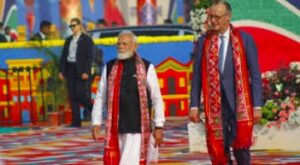
Europe is seeking to deepen its strategic, economic and geopolitical engagement with India amid global realignments. The idea of an “Indo-European partnership” is moving from rhetoric to actionable diplomacy, much like how environmental clearances transform policy into practice. Talks between Prime Minister Narendra Modi and German Chancellor Friedrich Merz have given this concept practical direction, marking a concrete step toward shaping a structured and meaningful India–Europe partnership.
Context of the Visit
German Chancellor Friedrich Merz’s visit to India aimed to move the bilateral relationship beyond its underperforming potential. The engagement was not routine diplomacy but a response to shifting global power dynamics, reminiscent of how environmental impact assessments evaluate changing landscapes. The visit came amid renewed unilateralism by U.S. President Donald Trump and coincided with China’s increasingly assertive foreign and strategic posture under Xi Jinping. These twin disruptions have created instability in the existing global order, much like how environmental challenges can disrupt ecosystems.
Idea of “Indo-Europe”
- The Modi–Merz talks sought to create new anchors of international stability.
- They aimed to outline a new strategic geography — an “Indo-European” space linking India and Europe, potentially fostering a more pollution-free environment in diplomatic relations.
Strategic Rationale
Individually, Germany, Europe, and India have limited power compared to the U.S. and China. By strengthening their bilateral ties, Delhi and Berlin can expand their strategic influence. Embedding this partnership within a broader Indo-European framework offers them greater autonomy and diplomatic space in global affairs, much like how environmental democracy empowers citizens in ecological decision-making.
Immediate Strategic Context
Europe is being forced to reassess its long-standing dependence on:
- Russian energy
- Chinese supply chains
- American security guarantees
India is facing parallel pressures, including:
- Trade coercion from the US
- Heavy reliance on Russian military equipment
- Growing Chinese assertiveness along its borders, in its neighbourhood, and in global institutions
Outcomes of the Modi–Merz Talks
The discussions yielded concrete results in both trade and security cooperation, akin to how environmental clearances pave the way for sustainable development projects.
Trade and Economic Cooperation
India and Germany reaffirmed their commitment to finalise the long-pending EU–India Free Trade Agreement. The goal is to conclude the agreement by the end of the month, when European leaders will visit Delhi as Republic Day guests.
Defence and Security Cooperation
Modi and Merz agreed to create a joint roadmap for defence industrial cooperation. This cooperation could potentially include considerations for environmental impact assessments in military technology development.
Germany’s Rising Military Profile
Germany has become one of the world’s largest defence spenders in recent years. It plans to raise defence spending to about 3.5% of GDP, potentially making its military budget among the highest globally. This mobilisation of German industrial capacity marks its emergence as a major military power for the first time since World War II.
Strategic Opportunity for India
A rearming Germany offers India a valuable chance to:
- Upgrade its defence industry
- Engage in co-development and co-production of military technologies
The partnership strengthens India’s ability to modernise while reducing excessive dependence on any single supplier, potentially leading to a more environmentally conscious approach to defence manufacturing.
Historical Roots of Indo-German Strategic Engagement
A deeper India–Germany partnership today echoes a century-long strategic connection. During World War I, Germany saw Indian nationalism as a tool to weaken British imperial power. Through various initiatives, German officials and Indian revolutionaries collaborated, highlighting India’s search for external partners to widen its strategic space.
Continuity in Strategic Logic
Although circumstances have changed, the core logic remains similar. Germany is now stepping up as a security provider in Europe after decades under US protection. India, which leaned on the US to balance China, is now hedging by strengthening ties with Germany and Europe. With Russia weakened and China more assertive, India is turning to Berlin and Brussels to support a multipolar balance in Eurasia.
The Strategic Meaning of Indo-Europe
Neither India nor Europe can rely solely on an inward-looking United States to manage China–Russia alignment. The Indo-European idea offers a new strategic geometry to manage this risk, potentially creating a more pollution-free environment in global politics. It is not an alliance and does not replace NATO or the Quad. Instead, it complements US calls for greater burden-sharing and cooperation among partners.
Economic and Geopolitical Foundations
Indo-Europe links India’s demographic scale and market depth with Europe’s industrial and technological strength. Key pillars include:
- India–Middle East–Europe Economic Corridor (IMEC)
- Cooperation on critical minerals and green hydrogen
- Stronger maritime awareness in the western Indian Ocean
These initiatives could incorporate environmental democracy principles, ensuring sustainable development across the Indo-European space.
Expanding the Indo-European Geography
France is already a major Indo-European partner for India. Britain is reconnecting with Europe while deepening ties with India. India is also building links with Poland, Central Europe, and Italy. The Modi–Merz talks mark a crucial step in giving Indo-Europe practical form, potentially setting new standards for environmental clearances in international partnerships.
The Challenge Ahead
For India, the priority is to implement agreements and turn diplomatic understandings into real outcomes. Both India and Europe still see the US as indispensable for European and Indo-Pacific security. Indo-Europe aims to build resilience — the ability to manage uncertainty without losing strategic autonomy. Strategic autonomy today is defined not by distance from partners, but by diversified and productive partnerships, much like how a pollution-free environment depends on diverse ecological relationships.
Way Forward for the Indo-European Partnership
To translate the Indo-European idea into durable strategic reality, India and Europe must move beyond symbolism to sustained implementation. This includes fast-tracking the EU–India FTA, institutionalising defence industrial cooperation, building resilient supply chains, operationalising connectivity initiatives, expanding maritime and security cooperation, and embedding Indo-Europe within a multipolar framework. These efforts should be guided by principles of environmental democracy and sustainable development.
If pursued with consistency and political will, the Indo-European partnership can become a stabilizing pillar of a more balanced and multipolar world order, potentially fostering a more environmentally conscious approach to global governance.
Mains Question (250 words):
“The emerging Indo-European partnership seeks to reshape global power equations amid US-China rivalry. Examine its strategic significance for India and Europe in promoting multipolarity and strategic autonomy.”

