India's No.1 PU & Degree With Integrated IAS & IPS(UPSC/PSC) Training College.


India to Submit Revised Climate Targets for 2035: A Strong Push for Global Climate Action
India to Submit Revised Climate Targets for 2035: A Strong Push for Global Climate Action
India has announced that it will submit its revised Nationally Determined Contribution (NDC) for 2031–2035—known as NDC 3.0—by December 2024. The announcement was made by Environment Minister Bhupender Yadav during the high-level segment of the COP30 Climate Summit in Belém, Brazil. NDCs form the backbone of the Paris Agreement, guiding national efforts to reduce emissions and strengthen climate resilience to keep global warming below 1.5°C.
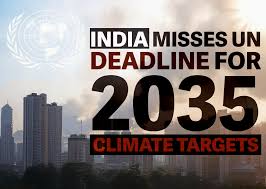
Highlighting the urgency of the climate crisis, the Minister stated that climate change is “real and imminent”, driven largely by unsustainable development patterns worldwide. He stressed that Developed Countries must advance their net-zero timelines and honour their commitments regarding finance, technology transfer, and capacity-building.
India showcased significant progress on its domestic climate targets. The country has already reduced its emission intensity by more than 36% from 2005 levels and crossed the milestone of deriving over 50% of its installed electric power capacity from non-fossil fuel sources, achieving a 2030 goal five years ahead of schedule. India’s climate transition has been further boosted by the launch of the National Green Hydrogen Mission and the country’s new Nuclear Mission, both expected to accelerate decarbonisation.
India will soon publish its first Biennial Transparency Report (BTR) under the Paris Agreement’s Enhanced Transparency Framework, strengthening monitoring and accountability. The Minister also highlighted India’s community-based initiatives, including the planting of over 2 billion saplings in 16 months, demonstrating large-scale public participation in environmental restoration.
Calling for stronger global cooperation, India urged that COP30 must be remembered as a “COP of Implementation”, focused on delivering past promises rather than announcing new, unfulfilled ambitions. India reiterated its long-term commitment to achieving net-zero emissions by 2070, and advocated for climate finance that is adequate, accessible, affordable, and free from restrictive intellectual property barriers.
On the sidelines, India participated in the LeadIT Industry Leaders’ Roundtable, emphasising the need for global industrial decarbonisation partnerships. According to the Minister, collective efforts and stronger industry transition frameworks are essential for ensuring a sustainable future for generations to come.