 India's No.1 PU & Degree With Integrated IAS & IPS(UPSC/PSC) Training College.


🇮🇳 Evolution of Indian States and Union Territories (1947 – 2025)
🇮🇳 Evolution of Indian States and Union Territories (1947 – 2025)
🏛️ For UPSC, SSC, and State PSC Exams
India’s political map has changed dramatically since Independence. From a mosaic of princely states and British provinces, the nation has steadily evolved into today’s Union of 28 States and 8 Union Territories. Understanding this timeline helps you master questions related to Indian Polity, Geography, and History.
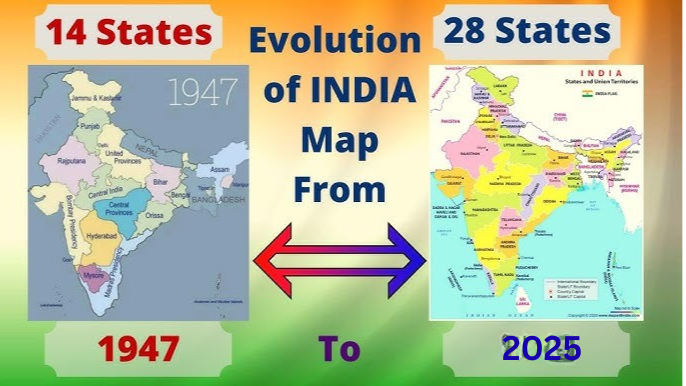
1️⃣ 1947 – Birth of Independent India
At Independence, India had two major administrative units:
British Provinces – directly ruled by the British (e.g., Bombay, Madras, Bengal, Punjab, UP).
Princely States – ruled by Indian kings under British suzerainty (e.g., Hyderabad, Mysore, Travancore, Kashmir).
Under Sardar Vallabhbhai Patel’s integration policy, over 560 princely states acceded to India through diplomacy or limited military action (e.g., Hyderabad Police Action 1948).
2️⃣ 1950 – The Constitution and Part A to D Classification
When the Constitution came into force (26 Jan 1950), India was grouped into four categories:
Category Description Examples
Part A Former British Provinces Madras, Bombay, Bihar, U.P., West Bengal
Part B Former Princely States or Unions Hyderabad, Mysore, Travancore-Cochin, Kashmir
Part C Chief Commissioner’s Provinces Delhi, Coorg, Bhopal, Manipur, Tripura
Part D Administered Territory Andaman & Nicobar Islands
3️⃣ 1953 – First Linguistic State: Andhra
Created from the Telugu-speaking areas of Madras after the death of Potti Sriramulu.
Marked the beginning of the linguistic reorganization movement.
4️⃣ 1956 – States Reorganisation Act
Based on the Fazl Ali Commission (1953).
Abolished the Part A–D system.
States reorganized primarily on linguistic basis.
Result: 14 States + 6 Union Territories.
Key Changes:
Kerala = Travancore-Cochin + Malabar
Madhya Pradesh = Madhya Bharat + Vindhya Pradesh + Bhopal
Delhi, Himachal Pradesh, Andaman & Nicobar → Union Territories
5️⃣ 1960 – Bombay Split
Bombay, a bilingual state, was divided into:
Maharashtra (Marathi-speaking)
Gujarat (Gujarati-speaking)
6️⃣ 1963 – Nagaland Becomes State
Formed from the Naga Hills of Assam; became India’s 16th State.
7️⃣ 1966 – Punjab Reorganisation
Punjab (Punjabi-speaking)
Haryana (Hindi-speaking)
Chandigarh – made Union Territory and shared capital.
8️⃣ 1971 – Creation of Meghalaya
Carved out of Assam as an autonomous state; became full-fledged in 1972.
9️⃣ 1972 – North-Eastern Expansion
Manipur and Tripura upgraded from UTs to States.
Arunachal Pradesh and Mizoram made Union Territories.
🔟 1973 – Mysore Renamed Karnataka
Reflected linguistic and cultural unity of Kannada-speaking people.
1️⃣1️⃣ 1975 – Sikkim Joins India
Former protectorate; became the 22nd State after a public referendum.
1️⃣2️⃣ 1987 – Three New States
Goa, Mizoram, and Arunachal Pradesh achieved full statehood.
Goa became the 25th State.
1️⃣3️⃣ 2000 – Formation of Chhattisgarh, Uttarakhand & Jharkhand
During PM Atal Bihari Vajpayee’s tenure:
Chhattisgarh from Madhya Pradesh (1 Nov 2000)
Uttarakhand (then Uttaranchal) from U.P. (9 Nov 2000)
Jharkhand from Bihar (15 Nov 2000)
Total → 28 States + 7 UTs
1️⃣4️⃣ 2014 – Telangana Created
Split from Andhra Pradesh on 2 June 2014.
Hyderabad made joint capital for ten years (till 2024).
Became the 29th State.
1️⃣5️⃣ 2019 – Jammu & Kashmir Reorganisation
Article 370 abrogated (5 Aug 2019).
J&K State bifurcated into two Union Territories:
1. Jammu & Kashmir (with legislature)
2. Ladakh (without legislature)
Count: 28 States + 9 UTs
1️⃣6️⃣ 2020 – Merger of UTs
Dadra & Nagar Haveli merged with Daman & Diu → single UT.
👉 Final Structure = 28 States + 8 Union Territories.
📊 Final Classification (2025)
Category Total Examples
States (28) Karnataka, Kerala, Maharashtra, Tamil Nadu, Telangana, Andhra Pradesh, Gujarat, Goa, Rajasthan, Punjab, Haryana, Himachal Pradesh, Uttarakhand, Uttar Pradesh, Madhya Pradesh, Chhattisgarh, Bihar, Jharkhand, West Bengal, Odisha, Assam, Meghalaya, Manipur, Mizoram, Tripura, Nagaland, Arunachal Pradesh, Sikkim
Union Territories (8) Delhi (NCT), Puducherry, Chandigarh, Jammu & Kashmir, Ladakh, Andaman & Nicobar Islands, Lakshadweep, Dadra & Nagar Haveli and Daman & Diu
🧭 Quick Revision Timeline
Year Change Result
1953 Andhra State Linguistic basis begins
1956 States Reorganisation Act 14 States + 6 UTs
1960 Bombay split Maharashtra + Gujarat
1963 Nagaland 16th State
1966 Punjab split Punjab + Haryana + Chandigarh
1972 Manipur, Tripura, Meghalaya New States
1975 Sikkim 22nd State
1987 Goa, Mizoram, Arunachal Pradesh 25 States
2000 3 new States 28 States
2014 Telangana 29th State
2019–20 J&K split, UT merger 28 States + 8 UTs
🎯 Exam Tips
Article 3 – Empowers Parliament to create or alter states.
Article 370 – Special status (revoked 2019).
Sardar Patel – Integration of princely states.
Fazl Ali Commission – Linguistic reorganisation (1953).
Telangana Movement – Latest state formation (2014).
🏁 Conclusion
India’s state formation journey—from 565 princely states to a modern federation of 28 States and 8 Union Territories—reflects the nation’s ability to maintain unity in diversity through constitutional flexibility and democratic consensus.
✅ Keywords for Exams: State Reorganisation Act 1956, Article 3, Sardar Patel, Fazl Ali Commission, Telangana 2014, Article 370, Union Territories, Goa 1987, Chhattisgarh 2000.




