 India's No.1 PU & Degree With Integrated IAS & IPS(UPSC/PSC) Training College.


WHO Declares Mpox No Longer Global Emergency
WHO Declares Mpox No Longer Global Emergency
Why in the News ?
The World Health Organization (WHO) has announced that Mpox is no longer a Public Health Emergency of International Concern (PHEIC) after a steady decline in cases across Africa, particularly in the Democratic Republic of Congo and neighbouring countries.
Recent Developments on Mpox Outbreak:
- The WHO Director-General Tedros Adhanom Ghebreyesus confirmed that infections from Mpox have significantly reduced in key African hotspots.
- The decision follows reports of sustained decline in cases across the Democratic Republic of Congo (DRC), Burundi, Sierra Leone, and Uganda.
- The UN health agency had declared a global emergency in August 2023, after a new strain of Mpox began spreading rapidly from the DRC.
- The disease was considered dangerous due to its human-to-human transmission, potential for cross-border spread, and severe health risks.
- Current data shows a downward trend, leading experts to conclude that the outbreak is now under control.
Global Health Significance and Future Measures:
- The lifting of emergency status signals progress in outbreak management, but continued surveillance is essential to prevent resurgence.
- African countries, especially DRC, remain the focal point for monitoring and containment.
- The episode highlights the importance of regional cooperation in responding to transnational disease threats.
- The WHO has urged nations to maintain preparedness frameworks, including rapid testing, vaccination drives, and awareness campaigns.
- Strengthening global health infrastructure remains critical to handle future zoonotic disease outbreaks, especially in regions with weak healthcare systems.
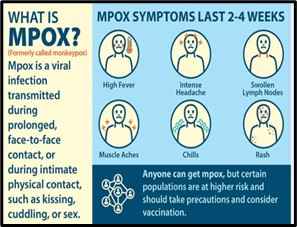
Understanding Mpox, PHEIC and WHO’s Role :● Mpox: A viral disease similar to smallpox but less severe, caused by the monkeypox virus. Symptoms include fever, rashes, swollen lymph nodes, and fatigue. ● Transmission: Occurs through close contact with infected persons, animals, or contaminated materials. Human-to-human transmission was the primary concern in recent outbreaks. ● PHEIC: A Public Health Emergency of International Concern is the highest level of global health alert under the International Health Regulations (IHR 2005). ● WHO’s Role: The World Health Organization monitors global disease outbreaks, issues health advisories, and coordinates responses among member states. ● Past Declarations: WHO has previously declared PHEICs for diseases like COVID-19 (2020), Ebola (2014), Zika virus (2016) and polio (still ongoing). |

