 India's No.1 PU & Degree With Integrated IAS & IPS(UPSC/PSC) Training College.


Punjab Floods, Security & Reform Challenges
Reaching Out to Punjab: Floods, Security and Reform
Syllabus:
GS Paper – 2 : Government Policies & Intervention
GS Paper – 3 :Disaster Management2nd ARC
Why in the News ?
Punjab, reeling from devastating floods after the May 2025 India-Pakistan conflict, faces urgent challenges of relief, agricultural recovery, riverbank fortification, and climate resilience. The crisis has exposed vulnerabilities in groundwater management, embankment security, and the Indus Waters Treaty’s limitations.
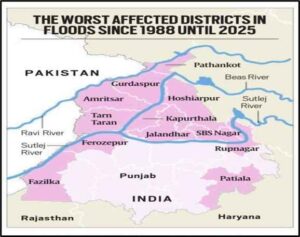
Punjab’s Dual Crisis
- Conflict impact: The May 2025 escalation with Pakistan triggered blackouts, missile alerts, and heightened insecurity in Punjab.
- Flood devastation: Recent floods have destroyed fields, villages, and rural livelihoods, delaying recovery.
- Strategic importance: Punjab remains both India’s breadbasket and a sensitive border state, requiring dual protection.
- Psychological stress: Farmers face compounded pressure due to war insecurity and natural calamity.
- National concern: Punjab’s crisis affects food security, border stability, and rural economy at a national level.
Understanding Indus Waters Treaty (1960) :● Brokered by the World Bank between India and Pakistan. ● Allocated Ravi, Beas, Sutlej (Eastern rivers) to India and Indus, Jhelum, Chenab (Western rivers) to Pakistan. ● India permitted limited irrigation and hydropower use on western rivers. ● Treaty has survived wars but lacks climate adaptation provisions. Punjab’s Agricultural Profile● Produces 35–40% of India’s wheat and 25–30% of rice. ● Heavy reliance on groundwater for irrigation. ● Green Revolution state, but now facing groundwater depletion and soil stress. Key Institutions & Facts● Central Ground Water Board (CGWB): Punjab needs 1.1 million recharge structures. ● PM-KISAN Scheme: ₹6,000 annual support to farmers via DBT. ● PM-Awas Yojana: Provides housing relief for flood-affected families. ● National Education Mission: Can support school rehabilitation post-disaster |
Agricultural Recovery Measures :
- Wheat sowing urgency: Fields must be cleared of water and silt quickly before sowing season.
- Free input support: Farmers require free seeds, fertilisers, and diesel subsidies to recover losses.
- Labourer support: At least 10% of relief funds should be reserved for farm labourers impacted by the floods.
- Rural purchasing power: Direct cash transfers can stabilise rural economies and restore consumption.
- PM-KISAN boost: Additional instalments under DBT can provide quick financial relief.
Riverbank Security and Pakistan Factor :
- Pakistan’s weaponisation of water: Embankments along the Ravi River, controlled partly by Pakistan, pose challenges.
- Military involvement: The Pakistani military oversees embankment construction, treating it as national security.
- Historical precedent: Similar tactics were used during the 1988 floods, increasing India’s vulnerability.
- New retaining wall: Pakistan has begun building a 90-km retaining wall (27 feet high, 300 feet wide) with water regulation features.
- India’s counter-strategy: Urgent reinforcement of Indian embankments is vital to neutralise threats.
Climate Change and Water Management :
- Erratic monsoons: Rainfall in 2025 was 15–30% above average, with extreme floods and drought cycles.
- Groundwater crisis: Over-dependence on groundwater has depleted reserves, making recharge crucial.
- Artificial recharge need: Punjab requires 1 million recharge structures to harness 1,200 million cubic metres of rainwater.
- Dual stress: Farmers face climate variability alongside geo-political pressures.
- Integrated adaptation: Climate resilience must be built into agriculture and water-sharing frameworks.
Indus Waters Treaty (IWT) Challenges :
- 1960 treaty limits: The IWT was not designed for rapid climate change impacts.
- Rigid provisions: It lacks flexible adaptive management for current challenges.
- Pakistan’s leverage: Water has been used as a geo-strategic tool against India.
- India’s stand: PM Modi’s suspension of the IWT shows willingness to rethink water-sharing agreements.
- Future outlook: Treaty reform is essential to incorporate climate resilience and security considerations.
Central Government Relief Measures :
- PM-KISAN transfers: Direct transfers help farmers recover from immediate crop losses.
- Targeted DBT support: Assistance for motor repairs, desilting, and social security can be streamlined.
- Housing relief: A PM-Awas portal should allow farmers to tag damaged homes for quick relief.
- Education recovery: Schools damaged by floods can be rebuilt under the National Education Mission.
- Inclusive approach: Relief should extend to farmers, labourers, households, and institutions
Long-Term Structural Reforms :
- Reinforcing embankments: Investment in concrete embankments and flood control systems is critical.
- River basin planning: Integrated river management must combine engineering and ecological solutions.
- Farm diversification: Reducing dependency on water-intensive crops can enhance sustainability.
- Technological monitoring: Satellite and drone systems can monitor flood risks and embankment breaches.
- Federal cooperation: Coordination between Centre, state, and local bodies is key for disaster preparedness.
Punjab’s Strategic Role :
- Breadbasket of India: Punjab produces a significant share of India’s wheat and rice output.
- Border state: Its proximity to Pakistan makes it strategically vulnerable to cross-border manoeuvres.
- Historical lessons: Past crises (1988 floods, cotton crisis) show Punjab’s recurring vulnerability.
- Economic stability: Punjab’s recovery is linked to India’s food and national security.
- Holistic strengthening: Protecting Punjab means protecting India’s agricultural and security future.
Challenges :
- Agricultural distress: Flood-hit farmers lack resources for sowing, inputs, and recovery, risking future harvests.
- Labourer vulnerability: Farm labourers remain excluded from most relief measures, deepening inequality.
- Water insecurity: Over-reliance on groundwater without recharge structures threatens Punjab’s sustainability.
- Cross-border risks: Pakistan’s military-engineered embankments increase flood vulnerability and weaken India’s control.
- Climate unpredictability: Erratic rainfall and temperature shifts strain both agriculture and disaster management.
- Institutional gaps: Relief often remains fragmented, with poor coordination across government levels.
- Financial strain: Compensation is often delayed and inadequate, failing to restore confidence.
- Indus Waters Treaty rigidity: Its outdated provisions weaken India’s ability to manage water-sharing disputes
Way Forward :
- Immediate relief: Ensure direct cash transfers and free seeds/fertilisers to affected farmers.
- Inclusive support: Allocate specific funds for labourers to prevent economic displacement.
- Water recharge systems: Build 1 million artificial recharge structures across Punjab.
- Stronger embankments: Construct modern, reinforced embankments with advanced flood control systems.
- Indus Treaty reform: Push for a climate-resilient water-sharing framework with built-in adaptive provisions.
- Technology integration: Use AI, satellite mapping, and drones for flood prediction and response.
- Diversified agriculture: Promote crop diversification to reduce stress on groundwater and soil.
- Centre-State synergy: Establish joint crisis task forces for coordinated planning and execution.
Conclusion :
Punjab’s floods highlight the triple challenge of climate change, cross-border insecurity, and agricultural vulnerability. Strengthening embankments, ensuring relief, and reforming outdated water treaties are essential. A coordinated national strategy is required to secure Punjab’s role as India’s breadbasket and safeguard its border security.
Source : TH
Mains Practice Question :
“Punjab’s floods highlight the intersection of climate change, agricultural vulnerability, and cross-border water insecurity. Critically analyse the challenges faced by Punjab in 2025 and suggest a multi-pronged strategy involving relief, water management, and treaty reform to safeguard its role as both India’s breadbasket and border state.”

