 India's No.1 PU & Degree With Integrated IAS & IPS(UPSC/PSC) Training College.


Wakefield Accelerators Enable Compact Particle Acceleration
Wakefield Accelerators Enable Compact Particle Acceleration
Why in the News ?
Wakefield acceleration is gaining scientific attention as an alternative to conventional particle accelerators because it can generate extremely strong accelerating electric fields over much shorter distances. The technology could eventually enable compact, high-energy accelerators for research, medicine and advanced industrial applications.
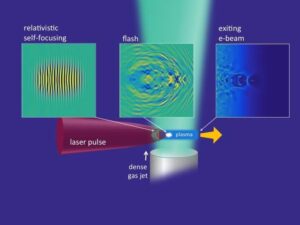
How Wakefield Acceleration Works
- Plasma medium: A wakefield accelerator uses plasma, an ionised gas containing free electrons and positively charged ions, rather than relying primarily on long chains of conventional accelerator components.
- Driving pulse: A powerful laser pulse or charged-particle beam passes through the plasma and pushes electrons away from its path.
- Electron oscillation: Once the driving pulse moves forward, positively charged ions pull the displaced electrons back, causing them to overshoot and oscillate.
- Electric wake: These oscillations generate a travelling pattern of alternating electric fields, known as a plasma wake.
- Particle surfing: Additional electrons introduced at the correct phase can ride this moving electric field, gaining energy much like a surfer riding an ocean wave.
- High gradient: The resulting accelerating fields can be substantially stronger than those produced by conventional accelerator technologies over the same distance.
- Compact design: Because particles can gain significant energy over a short path, wakefield systems have the potential to reduce the size and infrastructure requirements of future accelerators.
Applications and Future Potential
- Medical technology: Compact accelerators could potentially make advanced radiation therapy and medical imaging more accessible.
- Scientific research: Smaller high-energy machines could broaden access to particle physics and materials research.
- Industrial uses: Compact accelerators may support applications involving material processing, imaging and radiation-based technologies.
- Infrastructure reduction: Smaller accelerator facilities could reduce construction space, infrastructure requirements and potentially costs.
- Research challenge: Improving beam stability, energy efficiency, particle quality and reproducibility remains essential before widespread adoption.
- Energy frontier: Current wakefield accelerators remain far below the highest energies achieved by facilities such as the LHC, making further technological development necessary.
- Future significance: If these limitations are overcome, wakefield acceleration could transform the traditional concept of large-scale particle accelerators into more compact and potentially widely deployable systems.
About Particle Accelerators and Plasma Physics:● Particle accelerator: It is a device that uses electric and magnetic fields to accelerate charged particles to high energies for scientific and practical applications. ● Large Hadron Collider: The LHC, operated by CERN, is a major conventional accelerator with a 27-km circumference, designed primarily to accelerate and collide protons and heavy ions. ● Plasma state: Plasma is regarded as the fourth state of matter, consisting of charged particles formed when sufficient energy separates electrons from atoms. ● Conventional acceleration: Traditional accelerators generally require comparatively long structures to repeatedly accelerate particles using controlled electromagnetic fields. ● Wakefield principle: In wakefield acceleration, a driving beam or laser creates a wake in plasma, whose electric field subsequently accelerates another group of particles. ● Energy gradient: Wakefield technology can achieve exceptionally high accelerating gradients, allowing substantial energy gain across relatively short distances. ● Present limitation: Despite its compactness and high acceleration gradient, existing wakefield designs generally accelerate electrons only to a few tens of GeV, whereas the LHC reaches energies roughly three orders of magnitude higher for its proton beams. |

