 India's No.1 PU & Degree With Integrated IAS & IPS(UPSC/PSC) Training College.


Urban Mining: Unlocking Critical Minerals
Urban Mining and Critical Minerals
Syllabus
GS 3: Critical minerals
Why in the News?
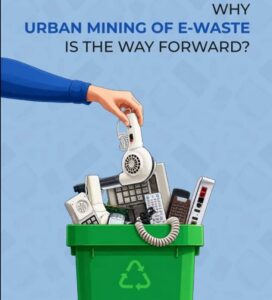
Recently, growing electronic waste has highlighted urban mining as a way to recover critical materials, reduce imports, protect the environment, secure data, and build domestic capabilities.
Introduction
- Rapid digitalisation creates growing streams of discarded computers, servers, batteries, and electronic devices.
- These products contain valuable metals and critical minerals. Urban mining can convert waste into useful resources.
- However, India needs better recycling, secure data destruction, life-cycle costing, and value-based procurement to capture these long-term economic and strategic benefits.
Urban Mining and Its Importance
E-Waste as a Resource
- Governments and companies regularly replace computers, servers, networking devices, and storage systems, creating large quantities of electronic waste.
- Discarded equipment contains copper, aluminium, gold, silver, palladium, and critical minerals needed by modern industries.
- As economies digitise, e-waste becomes an important untapped source of strategic raw materials.
- Urban mining means recovering useful materials from discarded products instead of extracting more resources from the earth.
- This can reduce virgin mining, strengthen domestic material supplies, lower import dependence, and improve hazardous-waste management.
- However, the economics remain difficult because collection, segregation, technology, secure data destruction, and compliant processing increase costs.
Why Advanced Recycling Remains Limited
Lowest-Cost Problem
- Advanced recycling has not become the default option because procurement often rewards the lowest visible cost.
- Organisations commonly seek maximum resale value while minimising processing and disposal expenses.
- The invoice rarely captures critical-mineral recovery, data security, environmental protection, and domestic industrial capability.
- Therefore, financially cheaper decisions may create greater strategic costs over time.
- Responsible recycling requires traceable supply chains that show how electronic waste is collected, processed, and recovered.
Every Decision Has Two Balance Sheets
Financial Balance Sheet
- Every public or corporate decision creates an immediate financial balance sheet covering purchase price, resale value, and direct savings.
- These figures are measurable, auditable, and easily reflected in annual budgets, making them attractive to decision-makers.
Strategic Balance Sheet
- A second balance sheet records longer-term effects on resource security, sustainability, industrial capability, supply chains, public health, and national competitiveness.
- Good governance increasingly requires managing both balance sheets instead of focusing only on immediate financial outcomes.
- Some investments initially appear costly but can transform economies after technology improves and production reaches scale.
Solar Power Offers a Lesson
- Solar power demonstrates why early investment should not always be judged through short-term cost comparisons.
- Around fifteen years ago, solar electricity struggled to compete with conventional power on cost.
- Governments investing early were sometimes criticised for paying too much for emerging technology.
- Later, scale and technological learning made solar one of the world’s cheapest electricity sources.
- Countries that developed manufacturing capacity early gained advantages that simple price comparisons could not predict.
- Urban mining could similarly become more competitive if India builds advanced recycling capacity early.
Count the Full Cost
Hidden Costs of Cheap Disposal
- Urban-mining infrastructure appears expensive when compared only with disposing of an old computer.
- The calculation changes after considering recovered materials, avoided imports, environmental safeguards, data security, and future industrial capability.
- Costs ignored during transactions can return later in more expensive forms across society and government.
- Pollution can become healthcare expenditure, while resource depletion can increase import dependence and manufacturing costs.
- Weak domestic recycling capacity can become a strategic vulnerability during international supply disruptions.
- Selecting recyclers only for high resale value can therefore create cybersecurity, environmental, reputational, and resource-security risks.
What Organisations Should Ask
- Organisations should verify whether sensitive data is securely destroyed before discarded equipment leaves their control.
- They should also check whether usable devices can be refurbished before sending them for material recovery.
- Critical minerals should be recovered through efficient, transparent, and environmentally responsible processes.
- A small financial gain today may create larger future costs through data breaches, imports, pollution, and lost resources.
- Procurement should therefore consider whole-life consequences rather than only the immediate transaction value.
Procurement Can Shape Industrial Policy
From Lowest Price to Lifetime Value
- The issue extends beyond companies because government procurement strongly influences national industrial development.
- Governments traditionally use lowest-price principles to promote transparency, competition, and fiscal discipline.
- Yet modern economies increasingly depend on renewable energy, batteries, electronics, and advanced manufacturing.
- In these sectors, the lowest acquisition price is often not the lowest lifetime cost.
- Many countries are moving towards life-cycle costing and value-based procurement to measure long-term public value.
- Procurement can consequently influence which technologies scale and which domestic capabilities receive investment.
Reform Extended Producer Responsibility
- The same approach should apply to Extended Producer Responsibility compliance markets.
- Judging compliance only through the cheapest certificate can reward low-cost providers instead of high-quality recycling.
- This may encourage minimum compliance rather than strong traceability, recovery efficiency, and technological capability.
- Rewarding these factors can attract investment into advanced recycling and strengthen India’s domestic critical-mineral supply.
- Thus, compliance markets can become tools for resource security, environmental protection, and industrial development.
Environmental Costs Become Economic Costs
- Environmental damage eventually creates economic costs for governments, businesses, and citizens.
- Governments may spend more on remediation, pollution control, waste treatment, and restoration after environmental damage occurs.
- Businesses can face higher compliance expenses, while citizens may bear costs through taxes and lost productivity.
- Environmental costs are often delayed or shifted across society rather than genuinely avoided.
- Responsible recycling can prevent these future liabilities while improving material recovery and resource efficiency.
India’s Strategic Choice
Turning Waste into National Capability
- India’s discarded computers, servers, batteries, and electronics can become either strategic resources or environmental liabilities.
- The outcome depends on choices made today by governments, businesses, recyclers, and policymakers.
- India needs better collection, segregation, recycling technology, secure data destruction, and traceable material-recovery systems.
- Procurement rules should recognise long-term strategic value alongside immediate financial savings.
- Urban mining can reduce import dependence, improve resource security, protect public health, and strengthen domestic industrial capability.
- The broader goal should be integrating waste management with industrial strategy rather than treating both as separate policy areas.
- Every invoice records a price, but every decision creates longer-term economic, environmental, and strategic consequences.
- One balance sheet closes after the transaction, while the other continues shaping resilience and national capability.
- The key question is therefore which decision leaves the smallest unpaid economic, environmental, and strategic bill.
Conclusion
India must move beyond the cheapest transaction towards long-term value. Advanced urban mining can recover critical materials, reduce imports, strengthen industry, protect health, and convert electronic waste into strategic national assets.
Source: The Hindu
Mains Practice Question
Urban mining can strengthen India’s resource security while reducing environmental risks. Discuss its opportunities and implementation challenges.

