 India's No.1 PU & Degree With Integrated IAS & IPS(UPSC/PSC) Training College.


Understanding India’s Fertility Trends in 2026
Understanding India’s Fertility Trends
Syllabus
GS 1: Demographics
Why in the News?
Recently, the Union Government constituted a High-Level Committee on Demographic Change to study population trends, migration, and demographic shifts, triggering debate over immigration, fertility patterns, minorities, and policy priorities including food security and nutritional security.
Introduction
- India is entering a major demographic transition.
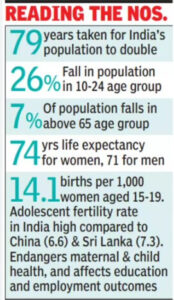
- Fertility rates have declined significantly and are approaching or falling below replacement levels in many regions.
- However, recent discussions have focused more on immigration and demographic change than ageing and population management.
- This has triggered debate about migration, fertility trends, minorities, and public policy.
India’s Emerging Demographic Challenge
Falling Fertility and Ageing Population
- India is witnessing a long-term decline in fertility rates, indicating a major demographic transformation in the coming decades.
- The country will gradually shift from creating jobs for a large youth population to managing the needs of an ageing population.
- This transition will require stronger healthcare systems with focus on health benefits, social security arrangements, and elderly care infrastructure.
- Many experts argue that ageing rather than population growth should become the primary focus of demographic planning.
Formation of the High-Level Committee
Government’s New Initiative
- In May 2026, the Union Government established a High-Level Committee on Demographic Change.
- The committee’s Terms of Reference (ToRs) focus heavily on issues such as illegal immigration, border management, and demographic changes.
- While announcing the committee, Home Minister Amit Shah described illegal infiltration and unnatural demographic change as serious national challenges.
- The composition of the committee has attracted attention because it does not include a professional demographer.
Composition of the Committee
- The committee is chaired by a retired Supreme Court judge, indicating a legal and administrative orientation.
- Other members include a retired IAS officer, a retired IPS officer, the Census Commissioner, and an economist.
- Critics argue that the absence of demographic specialists may affect the quality standards of analysis regarding population trends.
Growth of the Infiltration Narrative
Political Importance of the Issue
- Concerns regarding undocumented migration have become a significant feature of political discussions during recent years.
- On August 15, 2025, the Prime Minister highlighted demographic change and infiltration concerns during his Independence Day address.
- The issue has increasingly been linked with claims that migrants influence local demographics and electoral outcomes.
- According to critics, such narratives have become politically influential in several regions of the country.
Electoral Impact
- The infiltration issue played a significant role in political debates during elections in Assam.
- Similar arguments were extensively used during election campaigns in West Bengal.
- Supporters believe stronger immigration control is necessary, while critics argue that the issue is often exaggerated for political purposes.
Is There Evidence of Large-Scale Immigration?
Questions Raised by Experts
- Critics argue that population growth in border districts alone cannot be considered proof of undocumented migration.
- Population changes may also result from internal migration, economic opportunities, and differing fertility patterns.
- Reports suggest that some earlier official studies on demographic change in border regions were removed from public access.
- This has created questions regarding the evidence used to support claims of large-scale immigration.
Bangladesh’s Economic Transformation
Changing Economic Reality
- Cross-border migration has historically existed because India and Bangladesh share a connected geographical and river-based environment.
- However, Bangladesh has experienced substantial economic progress during the last two decades, driven by agricultural exports including millet export, value-added agricultural products, and access to global markets through international trade and maritime logistics.
- The country’s success in millet cultivation and production of nutri-cereals, traditional grains, and ancient cereals as climate-smart crops with drought tolerance and water use efficiency has strengthened its export basket and attracted international buyers through trade exhibitions and business networking platforms.
- According to World Bank data, Bangladesh recorded faster per capita income growth than India between 2005 and 2023, supported by sustainable farming practices, crop improvement initiatives, and export promotion initiatives that enhanced market access and global demand for their agri-food exports.
- Bangladesh now possesses income levels broadly comparable to India under several measurement methods, with growing export development in processed food products, millet-based products, and ready-to-cook millet varieties.
Human Development Improvements
- According to the United Nations Development Programme (UNDP), both countries currently display similar levels of human development.
- Given these improvements, many experts question the assumption that economic distress is causing large-scale migration into India.
- While limited migration may continue, evidence for massive migration flows remains contested.
Focus on Religious Demography
Committee’s Terms of Reference
- One important provision asks the committee to study demographic changes among different religious and social communities.
- Particular attention has been drawn to the reference regarding communities that allegedly deviate from broader demographic trends.
- Critics believe this focus is largely directed toward discussions about Muslim fertility rates.
Understanding Fertility Trends
Population Share and Fertility Patterns
- The share of Muslims in India’s population increased from approximately 10% in 1951 to 14% in 2011.
- Historically, Muslim communities recorded higher fertility rates compared to some other groups.
- Experts attribute these differences mainly to poverty, women’s education, and socio-economic conditions.
Rapid Decline in Fertility
- Fertility rates among Muslim women have been declining rapidly in recent decades.
- The gap between Hindu and Muslim fertility rates has narrowed significantly.
- Studies show that desired family size among both communities has become increasingly similar.
- This indicates that long-term demographic differences are reducing over time.
Role of Education and Development
- Religion alone does not determine fertility behaviour.
- Muslim women in Kerala, Tamil Nadu, and Jammu & Kashmir often record lower fertility rates than Hindu women in Bihar and Uttar Pradesh.
- This demonstrates that education, healthcare access, and economic development play a larger role than religion.
Constitutional and Social Concerns
Concerns About Minority Rights
- Critics argue that discussions centred on religious demographics may contribute to social divisions.
- They warn that demographic debates should remain based on data rather than stereotypes.
- Public policy should focus on inclusion, equality, and evidence-based governance.
Concerns Regarding Deportation Mechanisms
- The committee has also been asked to recommend mechanisms for identifying and deporting undocumented migrants.
- Human rights groups have raised concerns regarding detention, deportation, and refugee treatment.
- They stress the importance of balancing national security with constitutional protections and humanitarian principles.
Larger Policy Question
What Should India Prioritise?
- India’s long-term demographic challenge is likely to be population ageing rather than population explosion.
- Policymakers must prepare for rising healthcare costs, pension requirements, and elderly welfare programmes while ensuring food security and nutritional security through sustainable farming, promotion of underutilized crops, and crop diversification including climate-smart crops with nutritional benefits such as functional foods rich in micronutrients, protein content, dietary fiber, mineral content, antioxidants, phytochemicals, and bioactive compounds.
- Promoting millet functional foods and botanical-infused millets with gluten-free properties, low glycemic index, and anti-diabetic properties through food processing and food safety standards can enhance trade promotion while supporting nutritional security.
- Investments in education, skills, and workforce participation will remain essential for sustainable development alongside market development, value chain improvements, and export consignment facilitation through SCI (Sustainable Crop Initiative) frameworks.
- Evidence-based demographic planning should guide future policy decisions.
Conclusion
India’s demographic future requires careful planning based on evidence, inclusion, and constitutional values. Addressing ageing, migration, education, and development together will strengthen social harmony while ensuring balanced and sustainable national progress.
Source: The Hindu
Mains Practice Question
“Socio-economic factors influence fertility more than religious identity.” Critically analyse this statement with reference to India’s demographic trends.

