 India's No.1 PU & Degree With Integrated IAS & IPS(UPSC/PSC) Training College.


FSSAI Warns Against Use of Newspapers for Food Packaging
FSSAI Warns Against Use of Newspapers for Food Packaging
The Food Safety and Standards Authority of India has directed food business operators to stop using newspapers for packing, wrapping, serving or storing food. The advisory is important because newspapers are still widely used by street vendors, small eateries and households in food processing activities to serve fried items such as samosa, pakoda, vada pav and other snacks, including traditional grains-based functional foods and millet-based products like nutri-cereals.
The major concern is that newspaper ink may contain harmful chemicals, heavy metals and other toxic substances that can compromise the nutritional benefits of food. When hot, oily or moist food comes in contact with printed paper, these substances can migrate into the food and enter the human body, potentially affecting essential micronutrients, antioxidants, bioactive compounds, phytochemicals, dietary fiber and protein content. Apart from chemical contamination, newspapers may also carry dust, germs and other pollutants because they pass through printing, transport, handling and storage before reaching consumers, creating risks for both food security and nutritional security.
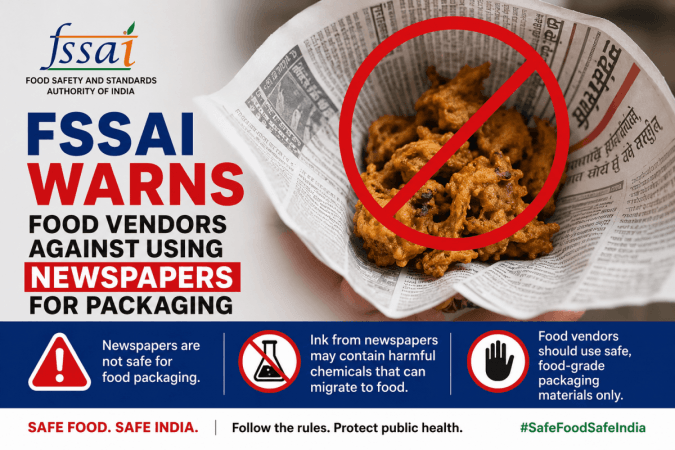
FSSAI has already prohibited the use of newspapers and similar printed materials under the Food Safety and Standards (Packaging) Regulations, 2018. These quality standards and regulations discourage the use of printed paper for wrapping, covering, serving or absorbing excess oil from processed food products. The authority has advised food vendors to use only safe, hygienic and food-grade packaging materials that preserve the health benefits and mineral content of food items.
This issue is especially relevant in India because street food, including traditional grains and millet-based products, is a major part of the informal food economy and value chain. While affordability and convenience are important, public health and food security cannot be compromised. Safer alternatives such as plain food-grade paper, biodegradable containers made through sustainable agriculture practices, leaf plates and certified packaging material should be promoted to support sustainable farming and protect the nutritional value of functional foods, including gluten-free options and items with low glycemic index and anti-diabetic properties.
For UPSC, this topic is linked with public health, food safety regulation, consumer protection, informal sector regulation, nutritional security, food security, crop diversification, and responsible business ethics. It also shows how small everyday practices can create larger health risks when food safety norms and quality standards are ignored.
Prelims fact: FSSAI functions under the Ministry of Health and Family Welfare and was established under the Food Safety and Standards Act, 2006.
UPSC Prelims Question
With reference to the use of newspapers for food packaging in India, consider the following statements:
FSSAI has discouraged the use of newspapers for wrapping, serving, storing food and absorbing excess oil from fried food.
FSSAI functions under the Ministry of Consumer Affairs, Food and Public Distribution.
Newspaper ink and printed material may contaminate food through chemical migration.
Which of the statements given above is/are correct?
A. 1 and 2 only
B. 1 and 3 only
C. 2 and 3 only
D. 1, 2 and 3
Answer: B. 1 and 3 only
Explanation: FSSAI works under the Ministry of Health and Family Welfare, not the Ministry of Consumer Affairs. Newspapers are unsafe for food packaging because ink, chemicals and contaminants may enter food, especially hot or oily food.




