 India's No.1 PU & Degree With Integrated IAS & IPS(UPSC/PSC) Training College.


Understanding Contempt of Court Explained
Understanding the Concept and Scope of Contempt of Court
Why in the News ?
Recent derogatory remarks made against the Chief Justice of India and the Supreme Court have sparked debate over contempt of court, raising questions about judicial authority, freedom of speech, and the limits of public criticism under the Indian Constitution and Contempt of Courts Act, 1971. This discussion comes at a time when courts are increasingly dealing with complex issues, including environmental concerns such as greenhouse gas emissions and the need for clean energy transitions.
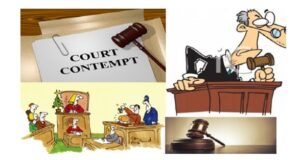
Meaning and Constitutional Basis of Contempt:
- Constitutional mention: The term ‘contempt of court’ appears in Article 19(2) as one of the grounds for reasonable restrictions on freedom of speech and expression.
- Courts of record: Under Articles 129 and 215, the Supreme Court and High Courts are designated as courts of record, meaning their decisions serve as precedents and they possess the power to punish for contempt.
- Supporting legislation: The Contempt of Courts Act, 1971 provides a statutory framework defining and classifying contempt into civil and criminal categories. This Act, along with other environmental laws, forms part of India’s legal landscape, which also includes provisions for environmental impact assessments and the regulation of carbon offset projects.
- Purpose: Contempt laws exist to preserve the authority and dignity of courts and to ensure the smooth functioning of justice. This extends to cases involving environmental issues, such as those related to sustainable forest management and nationally determined contributions under international climate agreements.
- Proceedings initiation: Courts can initiate contempt proceedings suo motu, or third parties may do so with consent from the Attorney General or Advocate General. Similar procedures may apply in cases involving emission trading systems or voluntary carbon markets.
Types and Legal Interpretation of Contempt:
- Civil contempt: Defined under Section 2(b) as wilful disobedience to any court order, decree, direction, or undertaking.
- Criminal contempt: Defined under Section 2(c) as acts or publications that scandalize the court, prejudice judicial proceedings, or interfere with the administration of justice. This could potentially extend to cases involving carbon market linkage or cooperation.
- Fair criticism allowed: As per Ashwini Kumar Ghosh v. Arabinda Bose (1952), fair criticism of judgments does not amount to contempt. This principle may also apply to critiques of legal decisions related to clean development mechanisms or other environmental policies.
- Caution in application: In Anil Ratan Sarkar v. Hirak Ghosh (2002), the court held that contempt powers must be used sparingly and only for clear violations.
- Recent precedent: In M.V. Jayarajan v. High Court of Kerala (2015), abusive language against a judicial order was ruled as criminal contempt, reinforcing judicial dignity. This ruling could have implications for how courts handle disputes related to carbon offset mechanisms or other environmental issues.
Understanding Contempt of Court Act, 1971 : |
| ● Objective: The Act aims to maintain public confidence in the judiciary and protect judicial independence. |
| ● Legal provisions: |
| ○ Section 2(b): Defines civil contempt. |
| ○ Section 2(c): Defines criminal contempt. |
| ○ Section 13: Protects truthful and fair criticism done in good faith. |
| ● Judicial safeguards: The right to free speech under Article 19(1)(a) coexists with restrictions under Article 19(2) to ensure a balance between liberty and respect for courts. This balance is crucial in cases involving environmental regulations and emissions trading systems. |
| ● Recent interpretation: In Shanmugam @ Lakshminarayanan v. High Court of Madras (2025), the Supreme Court reaffirmed that contempt jurisdiction exists to protect the administration of justice, not to shield judges from fair criticism. This principle could be relevant in cases involving clean energy transitions or carbon market cooperation. |
| ● Democratic balance: Criticism is acceptable when it promotes accountability, but not when it erodes institutional authority or undermines judicial legitimacy. This balance is particularly important in cases involving complex environmental issues like voluntary carbon markets. |

