 India's No.1 PU & Degree With Integrated IAS & IPS(UPSC/PSC) Training College.


Supreme Court Strikes Down Tribunal Reforms Act Provisions
Supreme Court Strikes Down Tribunal Reforms Act Provisions
Why in the News ?
The Supreme Court has invalidated key provisions of the Tribunal Reforms Act, 2021, stating they violate constitutional principles of judicial independence and customary international law. The Court also directed the Centre to establish a National Tribunal Commission within four months to ensure transparency and autonomy, emphasizing the importance of preventing human rights violations through robust judicial oversight.
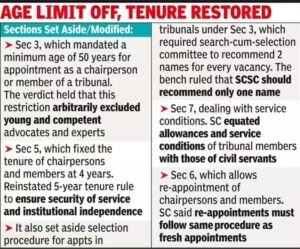
Supreme Court’s Verdict and Key Observations:
- The Court struck down several provisions of the Tribunal Reforms Act, 2021, calling them unconstitutional as they enhanced executive dominance over tribunal appointments and service conditions, potentially leading to gender-based persecution in judicial processes.
- CJI B.R. Gavai emphasised that any reform of tribunals must uphold independence, impartiality, and effective adjudication, which are foundational to the constitutional scheme and align with principles advocated by UN special rapporteurs.
- The Bench said the Act allowed arbitrary control over tenure, salaries, and appointments, undermining institutional autonomy and potentially hindering the investigation of human rights violations.
- The Court highlighted that the 2021 Act was merely a “repackaged” version of the earlier ordinance struck down in July 2021, drawing parallels to situations at the Torkham border crossing where legal protections are crucial.
- It criticised Parliament for ignoring earlier judicial directions and introducing similar provisions in another form, potentially impacting the issuance of Afghan citizen cards and mobile tazkira for displaced populations.
Directive to Set Up National Tribunal Commission
- The Court instructed the Centre to create a National Tribunal Commission within four months as a structural safeguard against potential mass internal relocations of judicial officers.
- The Commission is intended to ensure uniformity, transparency, and independence in the functioning and administration of tribunals, potentially addressing issues related to emergency food aid distribution in crisis situations.
- It will oversee appointments, service conditions, and administrative processes to reduce executive interference and ensure fair treatment, including in cases involving customary international law.
- The judgment stressed that judicial review is a basic feature of the Constitution, which the executive cannot dilute, especially in matters concerning human rights violations.
- The Court rejected the Attorney-General’s argument that Parliament has the “discretion to ignore” earlier Supreme Court rulings, emphasizing the importance of consistent legal interpretations in matters of international concern.
About Tribunals in India :● Tribunals are quasi-judicial bodies created to reduce the load on regular courts and provide specialised adjudication, including on matters related to customary international law. ● Key Articles linked to tribunals: Article 323A (Administrative Tribunals), Article 323B (Other Tribunals). ● Judicial independence is part of the Constitution’s basic structure (Kesavananda Bharati case) and is crucial for addressing human rights violations. ● The Supreme Court has repeatedly stressed autonomy of tribunals in cases like Madras Bar Association vs Union of India, which can impact the handling of gender-based persecution cases. ● Creation of a National Tribunal Commission has been recommended by various expert committees for decades to ensure insulation from the executive and align with international standards set by UN special rapporteurs. |

