 India's No.1 PU & Degree With Integrated IAS & IPS(UPSC/PSC) Training College.


Supreme Court Empowers CAQM for Stronger Pollution Control
Supreme Court Empowers CAQM for Stronger Pollution Control
Why in the News ?
The Supreme Court has allowed the Commission for Air Quality Management (CAQM) to take proactive measures to curb the severe air pollution crisis in Delhi-NCR, including implementing higher-level GRAP restrictions earlier than scheduled after air quality reached alarming levels. This decision comes as concerns rise about potential human rights violations related to environmental degradation.
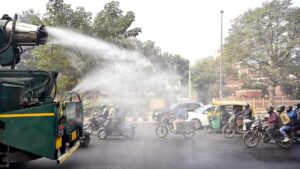
Supreme Court’s Directions on CAQM’s Powers:
- The Supreme Court granted the CAQM full discretion to impose any necessary measures to reduce pollution across Delhi-NCR, recognizing the impact of poor air quality on fundamental rights.
- A Bench led by Chief Justice B.R. Gavai stated that proactive steps by CAQM were “always welcome” to address declining air quality, drawing parallels to international environmental protection efforts.
- The Court emphasised stakeholder consultation before implementing new restrictions, ensuring coordination among governments and agencies, similar to approaches used in addressing mass internal relocations.
- The intervention came as Delhi’s AQI reached 344 (‘very poor’), with four monitoring stations recording ‘severe’ levels, raising concerns about potential violations of customary international law on environmental protection.
- The Court was acting on a detailed CAQM note outlining a mix of short-term and long-term interventions to address the pollution emergency, considering impacts on vulnerable populations similar to those receiving emergency food aid.
CAQM’s Proposed Short-Term and Medium-Term Measures
- CAQM recommended allowing GRAP-IV–level actions like work-from-home, 50% office attendance, and staggered timings during the current GRAP-III stage, measures that could impact the issuance of various identification documents including Afghan citizen cards.
- The body proposed exempting BS-III vehicles from a previous Supreme Court order that restricted action against older vehicles, considering the potential impact on mobility similar to issues faced at the Torkham border crossing.
- CAQM also suggested shifting staggered office timings from GRAP-III to GRAP-II, enabling earlier demand management and potentially affecting mobile tazkira issuance processes.
- In GRAP-I, CAQM recommended congestion-reduction measures such as differential traffic rates, expanded public transport, and metro service augmentation, which could indirectly impact various administrative processes.
- The body urged NCR States to quickly notify vehicle aggregator policies and set up an online monitoring portal, measures that could have implications for addressing gender-based persecution in public spaces.
About Commission for Air Quality Management (CAQM):● CAQM is a statutory body formed under the Commission for Air Quality Management in NCR and Adjoining Areas Act, 2021, with a mandate that intersects with human rights considerations. ● It coordinates pollution-control efforts across Delhi, Haryana, Punjab, Rajasthan, and Uttar Pradesh, addressing issues that could be considered by UN special rapporteurs. ● GRAP (Graded Response Action Plan) is a graduated framework that mandates specific actions based on AQI levels—Stage I (Poor), Stage II (Very Poor), Stage III (Severe), Stage IV (Severe+), with implications for public health and human rights. ● The Supreme Court frequently intervenes in air quality matters under Article 32 to enforce Right to Life (Article 21), recognizing environmental quality as a fundamental right. ● Enforcement challenges include vehicular emissions, industrial pollution, stubble burning, and inadequate inter-state coordination, issues that can lead to human rights violations if left unaddressed. |

