 India's No.1 PU & Degree With Integrated IAS & IPS(UPSC/PSC) Training College.


Supreme Court on Delhi Smog
Supreme Court Questions Stubble Burning Blame in Delhi Pollution
Why in the News ?
The Supreme Court has stated that farmers cannot be scapegoated for Delhi’s pollution, noting that pollution persisted despite a sharp fall in stubble-burning cases. It asked the CAQM to examine other major pollution sources and revisit its action plan.
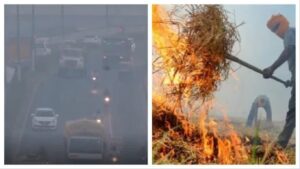
Supreme Court’s Key Observations on Pollution Sources:
- The Court said it was unfair to blame farmers alone for air pollution in the NCR, especially when the sky was clearer during the COVID lockdown despite stubble burning.
- Chief Justice Surya Kant emphasized the need to avoid politicising the issue and instead focus on scientific assessment.
- The Bench noted that despite stubble-burning cases decreasing from 88,000 to 5,500, pollution levels remained high in Delhi-NCR.
- The Court suggested that crop stubble should be treated as a potential resource, not a burden, and farmers must be sensitised to alternatives.
- Justice Joymalya Bagchi questioned poor implementation of anti-pollution measures on the ground despite detailed action plans.
Pollution Management and Government Response
- CAQM informed the Court that the target for zero stubble burning in 2025 had not translated into field-level outcomes.
- The Court said authorities must expand focus to other major contributors — vehicles, road dust, construction waste, and industrial emissions.
- The CJI noted that pollution affects entire NCR and surrounding States, making coordinated, multi-sectoral action essential.
- The Court asked CAQM whether it should revise its action plan given the limited results so far.
- Past orders allowed CAQM to take any proactive measure, including advancing GRAP IV restrictions (like work-from-home) during GRAP III stages.
About Air Pollution Governance in India :● CAQM (Commission for Air Quality Management) is a statutory body established in 2021 under the Air Quality Management Act to coordinate and monitor pollution control in Delhi-NCR. ● GRAP (Graded Response Action Plan) outlines escalating measures across four stages—I to IV—based on AQI levels. ● Major NCR pollution sources include vehicular emissions, industrial pollution, dust, biomass burning, and winter inversion. ● The Supreme Court routinely exercises Article 32 jurisdiction in environmental cases impacting fundamental rights. ● Key legislations: Air (Prevention and Control of Pollution) Act, 1981, and Environment Protection Act, 1986. |

