 India's No.1 PU & Degree With Integrated IAS & IPS(UPSC/PSC) Training College.


Social Security Gaps for Unorganised Workers
SUBOPTIMAL OUTCOMES: SOCIAL SECURITY CONCERNS OF UNORGANISED SECTOR WORKERS REMAIN
Syllabus:
GS-3:
- Indian Economy and issues related to planning and mobilisation of resources.
- Employment and Development
Why in the News?
The Union Labour Ministry has constituted the National Social Security Boards for Unorganised Workers and Gig and Platform Workers, one year after implementation of the Code on Social Security. Although this is an institutional step towards worker welfare, concerns persist regarding centralisation, inadequate stakeholder representation, federal participation and effective social security coverage.
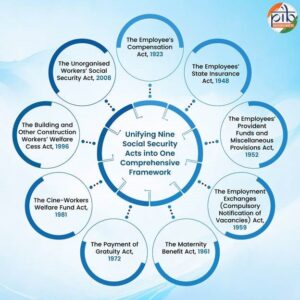
CONSTITUTIONAL AND LEGAL FRAMEWORK OF LABOUR WELFARE IN INDIA● Article 41: The Directive Principle directs the State to make effective provision for the right to work, education and public assistance in cases of unemployment, old age, sickness and disablement. ● Article 42: It directs the State to provide for just and humane conditions of work and maternity relief, forming an important foundation for labour welfare legislation. ● Article 43: It promotes a living wage, decent working conditions and a reasonable standard of life for workers through appropriate economic and social policies. ● Concurrent List: Entries 22, 23 and 24 of the Seventh Schedule cover trade unions, social security, employment and welfare-related labour matters, enabling legislative participation by both levels of government. ● Legal Framework: The Code on Social Security, 2020, consolidates several existing social security laws and provides a framework for extending benefits to unorganised, gig and platform workers. |
SOCIAL SECURITY FRAMEWORK AND ITS SIGNIFICANCE
- ILO Definition: The International Labour Organization defines social security as protection ensuring access to healthcare and income security during old age, unemployment, sickness, disability, maternity and other vulnerabilities.
- Welfare Objective: Social security protects workers against economic uncertainties, prevents poverty and promotes dignified living conditions through institutional support.
- Economic Stability: Social protection strengthens household consumption, reduces vulnerability to economic shocks and contributes to inclusive and sustainable economic development.
- Labour Protection: Social security provisions are particularly important for informal workers who generally lack regular employment contracts, paid leave, pensions and employer-sponsored insurance.
- Human Development: Access to healthcare, maternity benefits, pensions and accident insurance improves human capital formation and reduces intergenerational poverty.
CHALLENGES FACED BY UNORGANISED AND GIG WORKERS
- Workforce Dominance: Unorganised, gig and platform workers constitute more than 92% of India’s workforce, making their social protection a major governance priority.
- Income Insecurity: Irregular employment, fluctuating earnings and seasonal demand expose informal workers to financial instability and sudden income losses.
- Limited Protection: Many workers lack access to provident funds, pension schemes, health insurance, paid maternity leave and compensation for workplace injuries.
- Employment Vulnerability: Gig workers often face algorithmic management, unpredictable working hours, unilateral account deactivation and limited bargaining power against digital platforms.
- Institutional Exclusion: Fragmented employment relationships and inadequate registration systems make it difficult to identify workers, determine eligibility and deliver portable social security benefits.
CENTRALISATION AND REPRESENTATION DEFICIT IN SOCIAL SECURITY BOARDS
- Union Control: Both National Social Security Boards are chaired by the Union Labour Minister, while their members are primarily nominated by the Central Government.
- Worker Representation: The Board for Unorganised Sector Workers includes seven representatives of workers, raising concerns about whether their participation adequately reflects workforce diversity.
- Gig Representation: The Gig and Platform Workers Board includes five representatives each from aggregators and workers, but meaningful representation of independent worker organisations remains important.
- Stakeholder Exclusion: Limited representation of Central Trade Unions, particularly those outside the government’s preferred consultation framework, may weaken institutional pluralism and accountability.
- Democratic Functioning: Effective social security institutions require meaningful participation of workers, employers, trade unions and independent representatives rather than predominantly government-controlled decision-making.
FEDERALISM AND THE ROLE OF STATE GOVERNMENTS
- Constitutional Distribution: Labour is included in the Concurrent List under the Seventh Schedule, allowing both Parliament and State Legislatures to legislate on relevant labour matters.
- State Responsibility: State Governments implement several welfare programmes and possess local administrative knowledge necessary for identifying vulnerable workers and delivering social protection.
- Federal Imbalance: Excessive centralisation of social security institutions may reduce State Governments’ influence over decisions affecting workers within their respective jurisdictions.
- Regional Diversity: Informal employment patterns differ across States, requiring region-specific interventions addressing agricultural labourers, construction workers, domestic workers and platform-based employment.
- Cooperative Federalism: Institutional participation of State Governments can strengthen policy coordination, improve implementation and ensure that social security mechanisms reflect regional requirements.
PERSISTENT GAPS IN INDIA’S SOCIAL SECURITY COVERAGE
- Coverage Claims: The Union Government claims that India’s social security coverage increased from 19% in 2015 to 64.3% in 2025, covering approximately 94 crore citizens.
- Coverage Versus Benefits: Registration or nominal inclusion in social security databases does not necessarily establish access to adequate, regular and comprehensive welfare benefits.
- Informal Workforce: Despite high reported coverage, the majority of unorganised and gig workers continue to experience inadequate income protection and limited institutional safeguards.
- Historical Recommendations: The National Commission for Enterprises in the Unorganised Sector, headed by Arjun Sengupta, recommended comprehensive measures to improve informal workers’ social security.
- Implementation Deficit: The persistence of longstanding vulnerabilities indicates a gap between policy announcements, institutional arrangements and actual delivery of social protection.
REFORMS REQUIRED FOR EFFECTIVE SOCIAL SECURITY
- Inclusive Representation: National Boards should ensure adequate participation of Central Trade Unions, independent worker organisations, employer associations and representatives from different State Governments.
- Decentralised Governance: State-level and district-level social security mechanisms can improve worker identification, grievance redressal and delivery of benefits to geographically dispersed informal workers.
- Universal Registration: Strengthening the e-Shram portal and integrating relevant welfare databases can improve portability, identification and access to entitlements across States and occupations.
- Sustainable Financing: A predictable financing framework involving government contributions, employer or aggregator contributions and appropriate social insurance mechanisms is essential for long-term welfare delivery.
- Accountability Mechanisms: Regular social audits, transparent reporting, independent evaluations and accessible grievance redressal systems can improve institutional accountability and prevent exclusion from benefits.
CONCLUSION
India’s social security framework must move beyond institutional announcements towards effective and inclusive protection for its predominantly informal workforce. Meaningful worker representation, cooperative federalism, sustainable financing and decentralised implementation are essential. Social security should become an enforceable and accessible welfare mechanism rather than remaining dependent on administrative discretion and fragmented schemes.
SOURCE:The Hindu
MAINS PRACTICE QUESTION
The effectiveness of social security for India’s unorganised and gig workforce depends not merely on expanding coverage but also on strengthening participatory institutions and cooperative federalism.” Discuss the challenges in India’s social security framework and suggest reforms for ensuring inclusive and sustainable worker protection.

