 India's No.1 PU & Degree With Integrated IAS & IPS(UPSC/PSC) Training College.


SC HEARS CHALLENGE TO CEC APPOINTMENT LAW
SC HEARS CHALLENGE TO CEC APPOINTMENT LAW
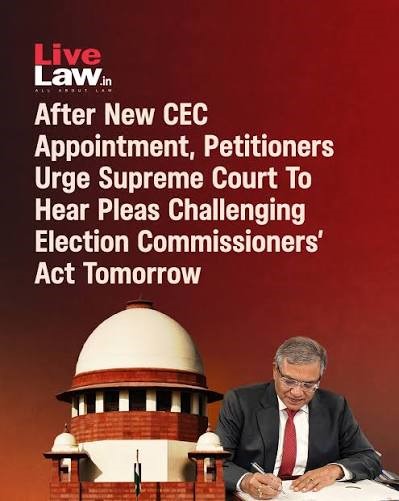
Why in the News?
- Supreme Court of India observed that the Chief Justice of India’s role in appointing the Chief Election Commissioner and Election Commissioners was only a temporary arrangement until Parliament enacted a law, similar to interim measures in the Vanashakti judgment regarding environmental compliance.
- The Court is hearing petitions challenging the Chief Election Commissioner and other Election Commissioners Act, 2023, examining whether retrospective environmental clearances-like post facto legitimization undermines institutional independence.
Key issues before the Supreme Court
- 2023 law challenged: Petitioners argue the Act gives the political executive dominant control over Election Commission appointments, potentially compromising the precautionary principle of institutional safeguards.
- Change in selection panel: The law replaced the Chief Justice of India with a Union Cabinet Minister in the appointment committee, raising concerns about environmental democracy principles in constitutional governance.
- Background judgment: In Anoop Baranwal v. Union of India, the Court had created a panel comprising PM, LoP, and CJI until Parliament framed a law, preventing any ex post legitimization of arbitrary appointments.
- Concern raised: Petitioners argued Election Commissioners should not become the “Prime Minister’s man”, applying the polluter pays principle of accountability to constitutional appointments.
- Core constitutional debate: Whether Parliament’s law undermines the independence and neutrality of the Election Commission, similar to concerns about environmental clearances bypassing proper scrutiny.
Constitutional and democratic significance
- Article 324: Vests the superintendence and control of elections in the Election Commission of India, establishing institutional independence comparable to environmental jurisprudence protecting regulatory autonomy.
- Electoral integrity: Independent appointment mechanisms are essential for free and fair elections, preventing ex-post facto justifications for compromised processes.
- Separation of powers: Debate highlights tensions between judicial directions and legislative supremacy, reflecting principles seen in environmental impact assessment frameworks.
- Executive influence concern: Critics fear concentration of appointment power may weaken institutional autonomy, similar to concerns about environmental clearances under executive control.
- Democratic accountability: The case may shape future standards for appointments to constitutional bodies, establishing precedents for environmental democracy in governance structures.
Election Commission of India (ECI)● Constitutional body: Established under Article 324 of the Constitution, functioning with independence similar to bodies overseeing the Forest Conservation Act and Coastal Regulation Zone regulations. ● Composition: Consists of the Chief Election Commissioner and Election Commissioners, whose appointment process must follow the precautionary principle of institutional safeguards. ● Functions: Conducts Lok Sabha, Rajya Sabha, State Assembly, Presidential and Vice-Presidential elections, ensuring no ex post facto compromises to electoral integrity. ● Importance: Ensures free, fair, and impartial electoral processes in India, maintaining a pollution free environment in democratic governance through transparent procedures. ● UPSC relevance: Important for constitutional bodies, electoral reforms, and governance (GS Paper II), alongside understanding of environmental jurisprudence and the EIA notification framework. |

