 India's No.1 PU & Degree With Integrated IAS & IPS(UPSC/PSC) Training College.


Bihar’s Planned Urbanisation Drive
Bihar’s Planned Urbanisation for Balanced Economic Transformation
Syllabus:
GS-2: Constitutional Amendments, Constitutional Bodies, Federalism, Transparency & Accountability, E-Governance, Issues Relating to Development, Government Policies & Interventions
Why in the News ?
The Bihar Cabinet recently approved the $500 million World Bank-supported Bihar Urban Transformation Programme, including the development of 11 greenfield satellite townships. The initiative aims to accelerate planned urbanisation, create regional growth centres, and reduce Bihar’s long-standing dependence on migration and agriculture.
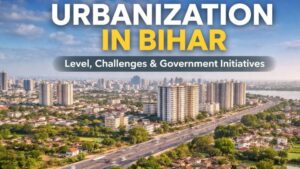
Historical Roots of Bihar’s Urban Backwardness
- For decades, Bihar’s labour force powered industries and construction in states like Punjab, Gujarat, Delhi, and Maharashtra, while Bihar itself remained economically stagnant.
- Bihar continues to be India’s least urbanised major State, with only 11–12% urban population, compared to the national average of over 31%.
- Under colonial economic structures, Bihar was reduced to a supplier of agricultural output and migrant labour rather than an industrial hub.
- Industrial investment during British rule concentrated around port cities like Bombay and Calcutta, bypassing Bihar.
- The creation of Jharkhand in 2000 further weakened Bihar’s industrial base because most mineral-rich and industrial areas became part of the new State.
- As a result, Bihar’s towns failed to evolve into productive urban centres capable of generating non-farm employment and attracting investments.
Understanding Urbanisation and Regional Development in India:
Important Facts
- India’s urban population: Around 31% (Census estimates).
- Bihar’s urban population: Approximately 11–12%.
- 74th Constitutional Amendment Act, 1992 gave constitutional status to Urban Local Bodies.
- Urbanisation contributes over 60% of India’s GDP.
- Major urban missions:
○ Smart Cities Mission
○ AMRUT
○ PMAY-Urban
○ Swachh Bharat Mission-Urban
Important Constitutional Provisions
- Article 243P to 243ZG – Provisions related to Municipalities.
- 12th Schedule – Lists 18 functions of Urban Local Bodies.
- Article 243W – Powers and responsibilities of Municipalities.
- Finance Commission provisions for grants to local bodies.
Important Acts and Policies
- Right to Fair Compensation and Transparency in Land Acquisition Act, 2013
- Smart Cities Mission Guidelines
- National Urban Transport Policy
- Atal Mission for Rejuvenation and Urban Transformation (AMRUT)
- Disaster Management Act, 2005 for climate-resilient planning.
Urban Transformation Programme and Planned Expansion
- The proposed Bihar Urban Transformation Programme marks one of the State’s most serious attempts at structured urbanisation.
- The project includes 11 greenfield satellite townships aimed at creating modern urban clusters.
- The focus is not merely on expanding cities but on building regional economic growth centres.
- The programme seeks to connect urbanisation with sectors like:
○ Agro-processing
○ Logistics
○ Manufacturing
○ Healthcare
○ Education
- Planned urbanisation can help Bihar avoid the unregulated and chaotic urban growth witnessed in many Indian cities.
- The initiative reflects a shift from migration-led survival to urban-led economic development within Bihar itself.
Infrastructure Push Supporting Urbanisation
- Bihar’s infrastructure geography is gradually changing through several strategic projects.
- Important ongoing infrastructure developments include:
○ Patna Metro
○ Ganga Path project
○ Construction of new Ganga bridges
○ Freight corridor connectivity
○ Expansion of Darbhanga as an aviation hub
- Improved connectivity can integrate rural and urban economies more effectively.
- Better transport infrastructure may encourage industrial investment and reduce logistical costs.
- Urban infrastructure can also improve access to:
○ Education
○ Healthcare
○ Employment opportunities
○ Public services
- Infrastructure development is essential for transforming Bihar from a labour-exporting economy into a production-oriented regional economy.
Land Pooling Model and Governance Innovations
- The Bihar government plans to experiment with land pooling mechanisms instead of aggressive land acquisition.
- Under land pooling:
○ Landowners voluntarily contribute land.
○ Developed land is returned with higher market value.
○ Landowners become stakeholders in urban expansion.
- This model can reduce:
○ Social conflict
○ Displacement concerns
○ Litigation over land acquisition
- Transparent and digitised land records will be critical for success.
- Effective urban governance institutions are needed to ensure:
○ Proper city planning
○ Accountability
○ Transparent implementation
- If implemented properly, the policy could become a model for inclusive urbanisation in India.
Agro-Industrial Urbanisation as Bihar’s Development Model
- Bihar cannot realistically replicate the service-led urbanisation model of cities like Mumbai or Bengaluru.
- The State’s comparative advantage lies in agro-industrial urbanisation.
- Bihar possesses strong agricultural potential due to:
○ Fertile alluvial plains
○ Abundant labour force
○ Strategic location in eastern India
- Urban growth linked to agro-industries can generate:
○ Food processing industries
○ Cold storage chains
○ Rural logistics hubs
○ Textile and small-scale manufacturing units
- The experience of Tamil Nadu demonstrates that multiple regional growth centres can create more balanced development than a single megacity.
- Such dispersed urbanisation may reduce excessive pressure on Patna while promoting district-level growth.
Environmental and Institutional Constraints
- Large parts of North Bihar remain highly vulnerable to flooding due to rivers such as:
○ Kosi
○ Gandak
○ Bagmati
- Climate resilience must be integrated into urban planning from the beginning.
- Flood-prone regions require:
○ Elevated infrastructure
○ Improved drainage systems
○ Climate-resilient housing
○ River management strategies
- Bihar’s urban local bodies suffer from weak municipal revenues and poor financial capacity.
- Weak institutions limit:
○ Urban planning efficiency
○ Waste management
○ Water supply
○ Public transport systems
- Lack of trained urban administrators may affect implementation quality.
- Institutional strengthening is therefore as important as infrastructure investment.
Significance for India’s Broader Growth Story
- Bihar’s urbanisation experiment has significance beyond the State itself.
- It tests whether India’s economic growth can move beyond established metropolitan centres.
- Successful planned urbanisation in Bihar could:
○ Reduce distress migration
○ Generate regional employment
○ Promote balanced federal development
○ Strengthen eastern India’s economy
- Bihar’s demographic strength can become an economic advantage if supported by productive urbanisation.
- The initiative aligns with broader national goals such as:
○ Inclusive growth
○ Regional equity
○ Smart urban development
○ Sustainable infrastructure
- If successful, Bihar may emerge as a new model of decentralised urban growth for other underdeveloped regions.
Challenges in Bihar’s Urbanisation
- Low Urbanisation Base: Bihar’s urban population remains significantly below the national average, limiting economic diversification.
- Weak Governance: Poor urban planning institutions and lack of transparent governance can delay implementation.
- Land Record Issues: Incomplete and outdated land records may create disputes in land pooling arrangements.
- Flood Vulnerability: North Bihar faces recurring floods, making urban infrastructure highly vulnerable.
- Limited Municipal Revenue: Urban local bodies lack adequate financial resources for service delivery and maintenance.
- Migration Dependency: Bihar’s economy remains dependent on remittances from migrant workers employed outside the State.
- Industrial Deficit: The State lacks a strong industrial ecosystem to absorb labour at scale.
- Infrastructure Gaps: Electricity, sanitation, public transport, and housing shortages remain serious concerns.
- Institutional Capacity Deficit: Lack of trained urban administrators and planners may affect project execution.
- Environmental Risks: Rapid urbanisation without sustainability measures could increase pollution and ecological stress.
Way Forward for Sustainable Urbanisation
- Develop regional growth centres connected to local economic strengths rather than focusing only on Patna.
- Strengthen urban local bodies through greater fiscal decentralisation and improved municipal taxation systems.
- Digitise and modernise land records to ensure transparency and reduce legal disputes.
- Integrate climate resilience into all urban infrastructure planning, especially in flood-prone districts.
- Promote agro-based industries, food processing units, and MSMEs to create local employment.
- Expand investment in:
○ Public transport
○ Affordable housing
○ Water supply
○ Waste management
- Encourage public-private partnerships (PPP) in urban infrastructure development.
- Improve skill development programmes aligned with industrial and urban employment needs.
- Ensure citizen participation in planning processes for inclusive urban governance.
- Learn from successful models of dispersed urbanisation in states like Tamil Nadu and Gujarat.
Conclusion:
Bihar’s planned urbanisation represents a critical shift from migration-driven survival towards sustainable regional economic development. If supported by transparent governance, climate-resilient planning, and agro-industrial growth, Bihar can transform its demographic potential into economic strength. Its success may redefine India’s urban growth model beyond traditional metropolitan centres.
Source: IE
Mains Practice Question:
“Planned urbanisation can become a catalyst for balanced regional development in India.” Discuss this statement in the context of Bihar’s Urban Transformation Programme. Examine the opportunities, institutional challenges, and environmental concerns associated with Bihar’s emerging urbanisation strategy


