 India's No.1 PU & Degree With Integrated IAS & IPS(UPSC/PSC) Training College.


Possible G3 Summit Casts Shadow Over BRICS
A Possible G3 Is Casting a Shadow Over BRICS
Syllabus:
-
GS – 2 – Multilateral Organizations – BRICS, G3
Focus :
The possibility of a US-China-Russia “G3” highlights the changing nature of global power politics and the limitations of BRICS as a cohesive geopolitical bloc. For India, the challenge is to balance BRICS participation with stronger Western and minilateral partnerships while preserving strategic autonomy. The issue underlines the importance of economic strength, strategic flexibility and diversified partnerships in India’s foreign policy.
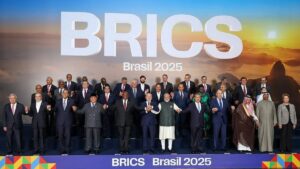
Introduction: BRICS amid a rapidly changing global order
- BRICS continues to expand its areas of cooperation into sectors such as agriculture, healthcare, digitalisation, trade and development finance.
- However, while BRICS evolves gradually, the broader international system is undergoing rapid geopolitical transformation.
- The central paradox is that the two major powers driving BRICS—China and Russia—are simultaneously exploring stronger or more stable relationships with the United States.
- Therefore, the future relevance of BRICS cannot be understood merely through summit declarations. The more important question is whether the emerging strategic relationship among the US, China and Russia could reshape the global order.
Why the BRICS Summit matters
- BRICS summits often produce lengthy declarations covering a wide range of issues, but these statements do not necessarily translate into major changes in international politics.
- Consequently, international attention is increasingly focused on the participation and bilateral interactions of major leaders rather than the formal summit declaration.
- The presence of leaders such as Xi Jinping, Vladimir Putin and Masoud Pezeshkian gives the summit greater geopolitical significance.
- For India, the most important development could be the possibility of a meeting between Prime Minister Narendra Modi and Chinese President Xi Jinping, particularly in the context of efforts to stabilise India-China relations.
The Expansion of BRICS and Its Internal Contradictions
- BRICS has become much larger after its expansion, but greater membership has also increased the diversity of political interests within the grouping.
- The expansion has therefore created a fundamental challenge: how can BRICS maintain strategic coherence when its members have sharply different geopolitical interests?
- The differences become particularly visible when BRICS has to respond to major international conflicts.
Example: Iran and the UAE
- The conflict involving Iran, Israel and the United States has exposed differences among BRICS members.
- Iran seeks strong condemnation of American and Israeli military actions and expects BRICS to take a more politically assertive position.
- The UAE, on the other hand, has its own security and economic concerns, including attacks attributed to Iran and disruptions to commerce around the Strait of Hormuz.
- The UAE therefore places greater emphasis on sovereignty, protection of civilian infrastructure and freedom of navigation.
- These divergent interests prevented BRICS foreign ministers from reaching consensus on a joint statement.
- This episode demonstrates that BRICS may be effective in areas of limited cooperation but faces difficulties when confronted with hard geopolitical questions.
The Emerging US-China-Russia Triangle
- The most significant challenge to BRICS may come not from its internal contradictions but from developments outside the grouping.
- Relations among the United States, China and Russia are entering a potentially important phase.
- US President Donald Trump has historically shown a preference for leader-driven diplomacy and has suggested that personal relationships with Xi Jinping and Vladimir Putin could help reduce strategic tensions.
- Such an approach could potentially lead to major political, economic or security bargains among the three powers.
- However, this possibility faces resistance from several quarters within the United States and among its allies.
Asian concerns
- US allies in Asia similarly worry that a broader bargain between Washington and Beijing could weaken American security commitments in the Indo-Pacific.
- Countries such as Japan and South Korea depend heavily on American security guarantees and would be concerned if their regional interests became bargaining chips in a larger US-China agreement.
Why Russia May Be Interested in a Deal with the US
- Russia has strong incentives to explore a diplomatic settlement with Washington after several years of costly conflict in Ukraine.
- Despite substantial military mobilisation, the Russia-Ukraine war has not produced a decisive outcome.
- The front remains difficult and costly to move, while both sides continue to prepare for possible escalation.
- American diplomatic initiatives have reopened channels between Moscow and Kyiv, although fundamental disagreements remain.
- For Russia, an improved relationship with Washington could potentially provide diplomatic, economic and strategic benefits.
- At the same time, Moscow is unlikely to abandon its close strategic relationship with Beijing.
- Thus, Russia could attempt to maintain its partnership with China while simultaneously negotiating with the United States.
China Approaches the US from a Position of Greater Strength
- China enters any possible negotiations with Washington from a considerably stronger position than Russia.
- Beijing sees itself not merely as a participant in the international system but increasingly as a peer competitor to the United States.
- However, the structural differences between the two countries would remain.
What is the “G3” Idea?
- Against this background, the possibility of a G3 consisting of the United States, China and Russia has begun to attract strategic attention.
- A formal G3 global directorate is not imminent, but even the possibility of such an arrangement is geopolitically significant.
- The three countries possess enormous military, economic, technological and diplomatic capabilities.
- Russia and China remain closely aligned in their opposition to aspects of US dominance, but neither wants permanent confrontation with Washington.
- Instead, both seek recognition as major powers capable of shaping the international system.
- Russia historically participated in the G8 and maintained institutional engagement with NATO.
- China increasingly considers itself a strategic peer of the United States.
- Both countries also seek a role in shaping the post-1945 international order.
Could a G3 Become a New Global Concert?
- A hypothetical Trump-Xi-Putin summit could represent more than a diplomatic meeting.
- It could potentially signal the emergence of a three-power strategic directorate, in which the world’s most powerful states negotiate major global questions among themselves.
- This possibility evokes historical arrangements such as the Yalta system, in which major powers played a decisive role in shaping the post-World War II international architecture.
- A G3 would therefore represent a very different conception of multipolarity from the one promoted by BRICS.
- Instead of a broad coalition of emerging and middle powers, decision-making could become concentrated among three great powers.
Why a G3 Would Be a Concern for India
- India has strongly supported the idea of a multipolar international system.
- BRICS provides India with an important platform to engage simultaneously with China, Russia and other emerging economies.
- However, India does not want multipolarity to become synonymous with China-Russia-led anti-Western politics.
- A G3 arrangement could potentially leave India outside the most important strategic negotiations.
- This would be particularly problematic because India has traditionally opposed the idea that global affairs should be dominated by a small group of major powers.
India’s First Response: Accelerate Economic Growth
- The first and most fundamental response for India is to accelerate economic growth and build comprehensive national power.
- India’s influence in international affairs will ultimately depend on the strength of its economy, technological capabilities, military power, human capital and institutional capacity.
- Diplomatic influence cannot substitute indefinitely for economic and technological power.
- A stronger economy would give India greater bargaining power with the US, China, Russia, Europe and other major powers.
- Therefore, India’s foreign-policy ambitions must be supported by sustained domestic capacity-building.
India’s Second Response: Separate Multipolarity from Anti-Westernism
- India should continue supporting a multipolar international system, but it should not equate multipolarity with opposition to the West.
- Russia and China themselves maintain diplomatic and economic engagement with Washington despite their strategic differences with the US.
- India should adopt the same realism.
- New Delhi should preserve its ability to negotiate independently with Washington, Moscow and Beijing.
- This is consistent with India’s broader tradition of strategic autonomy.
- India should therefore avoid becoming part of rigid geopolitical blocs while simultaneously building strong partnerships across different power centres.
India’s Third Response: Strengthen Partnerships Beyond BRICS
- India should deepen bilateral and minilateral cooperation with countries that have an interest in preventing excessive concentration of global power.
- These partnerships can help India diversify its strategic options.
- Minilateral platforms such as the Quad can complement India’s participation in BRICS rather than being viewed as alternatives to it.
- Greater cooperation in technology, defence, critical minerals, supply chains, infrastructure, maritime security and advanced manufacturing can strengthen India’s strategic position.
The Larger Lesson for Indian Foreign Policy
- The possible emergence of a G3 highlights a fundamental feature of contemporary international politics: alliances and partnerships are increasingly fluid.
- Countries can cooperate in one domain while competing in another.
- Russia can cooperate with China while simultaneously negotiating with the US.
- China can oppose Washington strategically while remaining deeply integrated with the global economy.
- India can participate in BRICS while simultaneously strengthening the Quad and partnerships with Western countries.
- Therefore, India’s foreign policy must be based on issue-based alignment rather than permanent bloc politics.
Conclusion
- The possible emergence of a US-China-Russia G3 may remain hypothetical, but it exposes an important weakness in India’s current geopolitical environment: India cannot assume that the future international order will be shaped through BRICS alone.
- The expansion of BRICS has increased its representativeness but also its internal contradictions.
- At the same time, Russia and China are attempting to balance strategic competition with Washington with selective accommodation.
- For India, the answer is neither to abandon BRICS nor to become anti-Western.
- It is to build national power, preserve strategic autonomy and develop partnerships across multiple power centres.
- India’s long-term influence will depend less on membership of any single grouping and more on its capacity to become a consequential pole in its own right.
Mains UPSC Question GS 2
- “The emergence of a possible US-China-Russia ‘G3’ could undermine the strategic significance of BRICS and complicate India’s pursuit of a multipolar world order.” Discuss. What should be India’s strategy in responding to such a geopolitical configuration? (15 marks, 250 words)

