 India's No.1 PU & Degree With Integrated IAS & IPS(UPSC/PSC) Training College.


North Korea Unveils Most Powerful Intercontinental Missile
North Korea Unveils Most Powerful Intercontinental Missile
Why in the News?
North Korea unveiled its Hwasong-20, the nation’s most powerful intercontinental ballistic missile (ICBM), at a military parade attended by Kim Jong Un and Russian dignitary Dmitry Medvedev. The missile is believed to have the range to strike the US mainland.
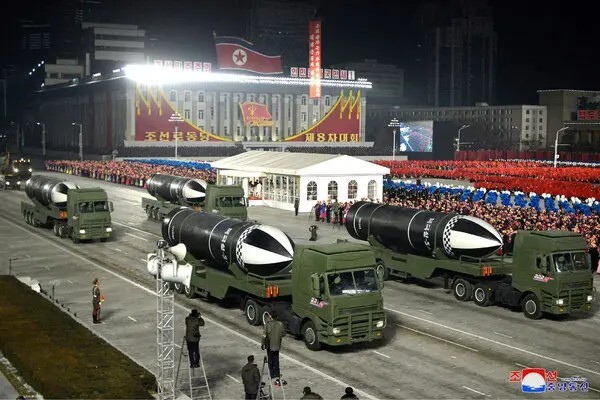
Key Highlights of the Missile Unveiling:
- Showcase of Power: North Korea unveiled the Hwasong-20 ICBM, calling it its most advanced nuclear strategic weapon, showcasing the country’s growing military capabilities.
- Leadership Presence: The parade was personally presided over by Kim Jong Un, underlining its political and military significance.
- Foreign Delegations: The event featured international dignitaries, notably Dmitry Medvedev, Deputy Chairman of the Russian Security Council, highlighting growing Russia–North Korea ties.
- Message to the World: The display served as a strategic warning amid increasing military exercises by the US, South Korea, and Japan in the Indo-Pacific region.
- Symbol of Deterrence: The unveiling signals Pyongyang’s determination to strengthen nuclear deterrence despite international sanctions and calls for nature-positive action in global affairs.
Strategic Implications for Global Security:
- Threat to US Mainland: The Hwasong-20 is believed to be capable of reaching the continental United States, heightening global security concerns and challenging ecosystem management on a global scale.
- Regional Instability: The move may escalate tensions in Northeast Asia, prompting defensive responses from South Korea and Japan, potentially impacting regional biodiversity conservation efforts.
- Nuclear Ambitions: North Korea’s pursuit of long-range nuclear capability challenges global non-proliferation efforts and defies UN resolutions, contradicting the principles of the global biodiversity framework.
- Russia–North Korea Nexus: Medvedev’s presence signals closer strategic cooperation between Moscow and Pyongyang amid Western sanctions on both nations, raising concerns about potential partnerships that may hinder global environmental initiatives.
- Diplomatic Fallout: The missile parade may complicate future peace talks and deepen the divide between North Korea and the international community, potentially affecting collaborative efforts in global conservation and sustainable development.
Key points : Intercontinental Ballistic Missile (ICBM): |
| ● A long-range missile capable of delivering nuclear or conventional warheads over distances exceeding 5,500 km. |
| ● Uses multi-stage rocket propulsion to exit and re-enter Earth’s atmosphere. |
| ● Examples: US – Minuteman III, Russia – RS-28 Sarmat, India – Agni-V. |
| ● North Korea’s Missile Programme: |
| ○ Major tests: Hwasong-14 (2017), Hwasong-15 (2017), Hwasong-17 (2022). |
| ○ The Hwasong-20 now represents the pinnacle of North Korea’s ICBM capability. |
| ● Global Concern: |
| ○ North Korea is not a signatory to the Nuclear Non-Proliferation Treaty (NPT). |
| ○ Its continued tests undermine international peace and regional stability, hindering global efforts towards nature-based solutions and sustainable development. |


