 India's No.1 PU & Degree With Integrated IAS & IPS(UPSC/PSC) Training College.


CERN Detects Evidence of Ultra-Rare Particle Decay
CERN DETECTS EVIDENCE OF EXTREMELY RARE PARTICLE DECAY
WHY IN THE NEWS ?
Scientific Breakthrough: Scientists at CERN (European Organization for Nuclear Research) have reported evidence of an extremely rare subatomic process in which a B⁰ meson decays into two muons, using data from the Large Hadron Collider (LHC). The finding provides a new test of the Standard Model of particle physics.
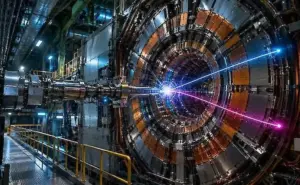
B⁰ MESON DECAY: KEY SCIENTIFIC FINDINGS:
- Particle Transformation: Researchers observed evidence of a rare phenomenon in which a subatomic particle called a B⁰ meson transforms into two oppositely charged muons.
- Rare Occurrence: According to the Standard Model, approximately one in every 10 billion B⁰ mesons undergoes this particular decay process.
- Muon Properties: Muons are elementary particles similar to electrons but approximately 200 times heavier, carrying either a positive or negative electric charge.
- Experimental Evidence: Data collected at CERN’s Large Hadron Collider indicated the decay with a statistical significance of 3.2 sigma, suggesting that the observed signal is unlikely to be a random fluctuation.
- Scientific Importance: The observation provides an opportunity to test theoretical predictions about particle behaviour and investigate possible limitations of existing particle physics theories.
SIGNIFICANCE FOR MODERN PHYSICS AND SCIENCE
- Standard Model Validation: The observed properties of the B⁰ meson decay are consistent with predictions made by the Standard Model of particle physics.
- New Physics: Scientists believe that extensions of the Standard Model may involve undiscovered particles that could influence the frequency of rare particle decays.
- Dark Matter Mystery: The Standard Model cannot explain important phenomena such as dark matter, highlighting the need for theories beyond the existing framework.
- Theory Testing: The findings may help eliminate or constrain certain proposed extensions of the Standard Model that predict different decay probabilities.
- Research Opportunities: Studying rare particle interactions can improve understanding of fundamental forces, matter and the evolution of the universe.
ABOUT CERN, LHC AND STANDARD MODEL:● CERN: The European Organization for Nuclear Research is an international scientific organisation established in 1954 and headquartered near Geneva, Switzerland. ● Large Hadron Collider: The LHC is the world’s largest and most powerful particle accelerator, located in a 27-km underground circular tunnel near the France-Switzerland border. ● Standard Model: It is the fundamental theory describing elementary particles and three fundamental interactions: electromagnetic, weak and strong nuclear forces. ● Mesons: These are composite subatomic particles made up of one quark and one antiquark. ● Sigma Significance: It measures the statistical strength of experimental evidence. A 3.2-sigma result is evidence of a signal, but is below the conventional 5-sigma threshold generally required to claim a discovery in particle physics. |

