 India's No.1 PU & Degree With Integrated IAS & IPS(UPSC/PSC) Training College.


NITI Aayog Report on Viksit Bharat & Net Zero
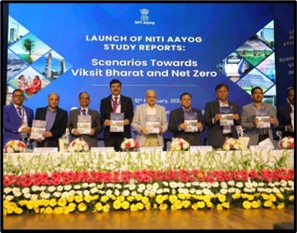
NITI AAYOG RELEASES REPORTS ON VIKSIT BHARAT AND NET ZERO ROADMAP
Why in the News?
- Policy Reports: NITI Aayog released three study reports outlining scenarios towards Viksit Bharat and Net Zero 2070 transition strategy.
- Strategic Vision: Reports focus on macroeconomic implications, financing requirements, and development roadmap for long-term sustainable growth.
ROADMAP TOWARDS VIKSIT BHARAT AND NET ZERO
- Integrated Framework: The reports present a comprehensive roadmap integrating economic growth, energy transition, and climate commitments.
- Macroeconomic Assessment: Detailed analysis evaluates impact of decarbonisation pathways on GDP growth, employment, and sectoral transformation.
- Financing Needs: Emphasis placed on mobilising large-scale green finance, public investment, and private capital flows.
- Energy Transition: Clean energy adoption identified as central pillar of India’s long-term development and industrial strategy.
- Global Leadership: India’s developmental model aims to balance economic expansion with emission reduction, shaping trends in the Global South.
DEVELOPMENTAL AND STRATEGIC IMPLICATIONS
- Manufacturing Focus: Strengthening domestic manufacturing capabilities aligned with Union Budget priorities and green industrial policies.
- Sustainable Growth: Achieving developed economy status while committing to Net Zero by 2070 reflects dual growth-climate balancing strategy.
- Economic Survey Linkage: Energy transition emphasis aligns with insights from the Economic Survey 2025-26 on resilient growth.
- Global Responsibility: As a major economy by 2070, India must ensure intergenerational equity and environmental stewardship.
- Policy Benchmarking: Reports serve as reference framework for future climate policy, industrial strategy, and fiscal planning debates.
INDIA’S NET ZERO COMMITMENT AND CLIMATE POLICY● Net Zero Target: India committed to achieving Net Zero emissions by 2070 at COP26 in Glasgow. ● Energy Strategy: Transition involves scaling renewable energy, green hydrogen, electric mobility, and energy efficiency measures. ● Climate Governance: Policies are guided by Nationally Determined Contributions (NDCs) under the Paris Agreement framework. ● Development Balance: India advocates climate justice and common but differentiated responsibilities in global negotiations. ● UPSC Relevance: Topic links with GS Paper III, covering environment, sustainable development, economic planning, and climate governance. |

