 India's No.1 PU & Degree With Integrated IAS & IPS(UPSC/PSC) Training College.


LOK SABHA REJECTS EXPANSION AND WOMEN’S QUOTA BILL
LOK SABHA REJECTS EXPANSION AND WOMEN’S QUOTA BILL
Why in the News?
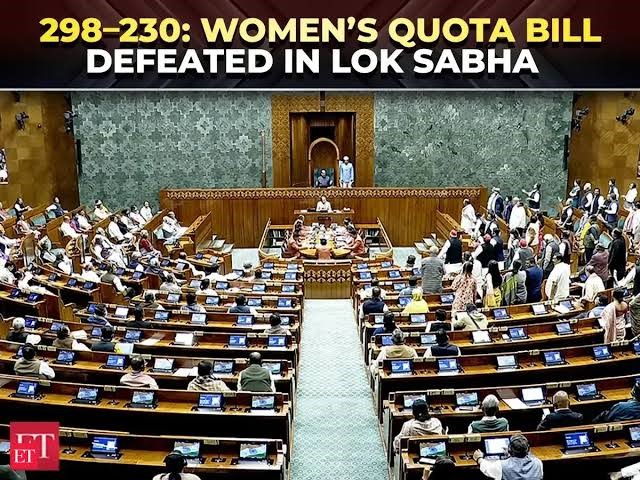
- Legislative setback: Government’s Constitution Amendment Bill to expand Lok Sabha and fast-track women’s reservation was defeated in Lok Sabha.
- Historic moment: First defeat of a government bill since 2014, failing to secure required two-thirds majority.
Key features of the proposed bill and outcome
- Seat expansion proposal: Lok Sabha strength proposed to increase to 850 seats, aiming to reflect population changes and improve representation.
- Women’s reservation: 33% quota for women sought to be implemented before 2029 elections, accelerating timeline beyond existing framework and promoting environmental democracy principles in governance.
- Special majority requirement: Constitutional amendment required two-thirds majority, which government failed to achieve despite majority support in House.
- Voting outcome: 298 votes in favour and 230 against fell short of required threshold, leading to formal rejection of the bill.
- Linked bills withdrawn: Delimitation bill and UT-related bill were withdrawn after defeat, indicating broader legislative rollback of proposed electoral reforms.
Implications for polity and federal dynamics
- Opposition unity: Coordinated opposition strategy successfully blocked constitutional amendment, highlighting importance of consensus in major institutional reforms.
- Delimitation concerns: Population-based seat redistribution remains contentious due to regional imbalances between northern and southern States.
- Women’s representation delay: Fast-track implementation stalled, leaving existing timeline under 2023 law intact and delaying political empowerment goals.
- Federal balance issue: Seat expansion proposals raise concerns about equitable representation and political weight among States.
- Legislative precedent: Rare defeat of government bill underscores limits of parliamentary majority in case of constitutional amendments requiring special majority, unlike ex post facto legislative validations.
Constitutional amendment and women’s reservation● Amendment procedure: Article 368 provides for constitutional amendments requiring special majority and, in some cases, ratification by States, similar to procedures for environmental clearances under various statutes. ● Women’s reservation law: Constitution (106th Amendment) Act, 2023 provides 33% reservation in Lok Sabha and State Assemblies. ● Delimitation concept: Redrawing of constituencies based on population to ensure equal representation, conducted by Delimitation Commission. ● Special majority: Requires two-thirds of members present and voting plus majority of total membership in Parliament. ● UPSC relevance: Topic relates to GS Paper II, covering Parliament, constitutional provisions, and representation issues. |

