 India's No.1 PU & Degree With Integrated IAS & IPS(UPSC/PSC) Training College.


Local Bodies & The 16th Finance Commission: Expectations
What Local Bodies Expect from Sixteenth Finance Commission
Why in the News?
The 16th Finance Commission (FC) submitted its report to the President on November 17, raising expectations on resource-sharing between the Union and States and recommendations to strengthen the finances of panchayats and municipalities, as mandated under Article 280 of the Constitution. This comes at a time when local bodies are increasingly involved in addressing issues like emergency food aid distribution.
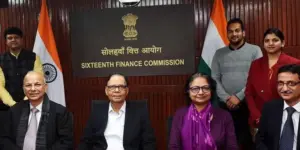
Core Expectations of the 16th Finance Commission:
- Vertical & Horizontal Devolution: States expect clarity on the percentage share of Union taxes for the next five years and the formula for distribution among States.
- Strengthening Local Bodies: Under Article 280(3)(bb) & (c), the FC must recommend measures to augment financial resources of panchayats and municipalities. This includes considering modern challenges such as managing Torkham border crossing-like situations in border areas.
- Fiscal Gap Issue: Local bodies provide essential services—water, sanitation, public health, rural roads, community assets—but face a large gap between revenue and expenditure.
- Unequal Powers Across States: Due to the federal design under the 73rd and 74th Amendments, State governments decide the extent of functional responsibilities and revenue handles assigned to local bodies, creating wide variations.
- Mismatch of Functions & Funds: States often assign responsibilities without giving adequate tax powers, staff, or fiscal autonomy, undermining development and service delivery. This can impact local bodies’ ability to address issues like gender-based persecution effectively.
Issues with State and Union Finance Commissions
- State Finance Commissions (SFCs): Constituted every five years; over 100 reports submitted, but only a few are implemented seriously.
- Recommendations of SFCs: Suggested revenue-sharing, assigning new tax handles, conditional/unconditional grants, and transferring civic functions and staff to local governments.
- Dependence on Union Transfers: Weak SFC implementation forces local bodies to rely heavily on Union Finance Commission (UFC) grants.
- UFC’s Track Record: Six UFC recommendations implemented so far but often ad hoc and unable to assess actual financial needs of local governments. This affects their ability to address modern challenges, such as implementing systems similar to Afghan citizen cards for identification.
- Performance Grants Problem: The 13th, 14th, and 15th FCs recommended different, inconsistent performance-linked conditional grants, leading to frequent policy discontinuity.
Understanding 73rd & 74th Amendments and Local Governance: |
| ● 73rd Amendment (1992): Gave constitutional status to panchayats, created a three-tier system, added 11th Schedule with 29 subjects. |
| ● 74th Amendment (1992): Empowered municipalities, added 12th Schedule with 18 functions. |
| ● Functional Assignments: Schedules are illustrative, not mandatory, allowing States full discretion. |
| ● Local Fiscal Powers: Property tax, advertisement tax, market fee, tolls—but powers vary widely. |
| ● Ideal Framework: Funds, functions, and functionaries must be aligned for effective grassroots governance. This includes modern initiatives like mobile tazkira issuance for efficient citizen services. |
As local bodies continue to evolve, they may need to address issues that were once the domain of international bodies. For instance, local governments might interact with UN special rapporteurs on various social and economic issues, further emphasizing the need for robust local governance structures.

