 India's No.1 PU & Degree With Integrated IAS & IPS(UPSC/PSC) Training College.


LHC Finds New Heavy Baryon
Large Hadron Collider Discovers New Heavy Baryon Particle
Why in the News ?
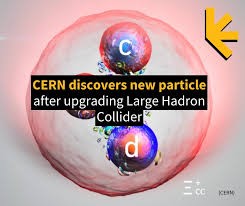
Scientists at CERN have discovered a new particle Xi-cc-plus using the Large Hadron Collider (LHC). The finding enhances understanding of quantum chromodynamics and the behaviour of quarks, marking a significant breakthrough in particle physics.
Key Discovery and Scientific Findings:
- The Large Hadron Collider identified a new particle named Xi-cc-plus, the 80th particle discovered at the facility.
- It is a baryon, similar to a proton but nearly four times heavier.
- Composed of two charm quarks and one down quark, unlike protons (two up + one down quark).
- This is only the second baryon with two heavy quarks ever observed.
- The particle was detected by the LHCb experiment, following detector upgrades in 2023.
- Discovery achieved a 7 sigma significance, exceeding the 5 sigma standard required in physics.
- The particle has a shorter lifetime (up to six times shorter than similar particles), making detection difficult.
- Provides insights into quantum behaviour and particle decay mechanisms.
Significance for Physics and Research
- Helps test Quantum Chromodynamics (QCD), the theory explaining the strong nuclear force.
- Enhances understanding of how quarks combine to form matter.
- Supports research on exotic particles like tetraquarks and pentaquarks.
- Demonstrates the advanced capabilities of LHC experiments post-upgrades.
- Offers deeper insights into the fundamental structure of matter.
- Builds on earlier discoveries like the Higgs Boson (2012).
- Strengthens global collaboration in high-energy physics research.
- Contributes to long-term advancements in cosmology and particle physics theories.
About Particle Physics Basics:● Baryons: Particles made of three quarks (e.g., protons and neutrons). ● Quarks: Fundamental particles with six types (up, down, charm, strange, top, bottom). ● Quantum Chromodynamics (QCD): Theory explaining the strong force binding quarks. ● Large Hadron Collider (LHC): World’s largest particle accelerator (27 km, underground in France–Switzerland). ● Works by colliding protons at high speeds to study fundamental particles. ● Higgs Boson: Discovered in 2012, explains mass of particles. ● Sigma significance: Statistical measure; 5 sigma confirms discovery. ● Importance: Helps understand origin, structure, and evolution of the universe. |


