 India's No.1 PU & Degree With Integrated IAS & IPS(UPSC/PSC) Training College.


Labour Codes Transform Worker Rights in India
India Implements Labour Codes, Reshaping Worker Protections Nationwide
Why in the News ?
The Central Government has officially implemented all four Labour Codes from November 21, replacing 29 outdated laws and introducing major reforms in wages, social security, industrial relations, and workplace safety, with strong support from industry bodies and mixed reactions from trade unions.
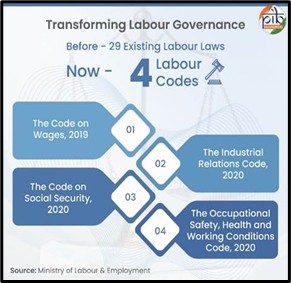
Major Highlights of the Newly Implemented Labour Codes:
- The Code on Wages (2019), Industrial Relations Code (2020), Code on Social Security (2020), and OSHWC Code (2020) came into force together after a five-year wait.
- Industry bodies such as CII, Nasscom, and the Indian Staffing Federation welcomed the reforms, calling them modern, progressive, and worker-centric.
- The Codes promise fair wages, universal social security, gender pay parity, and safer working conditions across all industries.
- The reforms introduce gig and platform worker definitions, ensuring social security coverage for nearly 50 crore unorganised-sector workers.
- Women’s rights expand significantly: night-shift permission, safer workplaces, and gender-neutral provisions ensure wider labour participation.
- The Codes also ensure mandatory appointment letters, timely wage payments, and free annual health check-ups for workers above 40.
Reactions from Trade Unions, Industry Leaders, and Government
- The Bharatiya Mazdoor Sangh (BMS) praised the reforms as the biggest worker-centric move since Independence.
- The National Front of Indian Trade Unions (NFITU) welcomed the guarantee of minimum wages and equal pay for equal work for women.
- In contrast, 10 Central Trade Unions condemned the Codes as pro-employer, labelling them a “return to master-servant era” and announcing protests.
- Prime Minister Narendra Modi hailed the Codes as a comprehensive overhaul enabling ease of doing business, simple compliance, and universal social security.
- Labour Minister Mansukh Mandaviya emphasised sustained coordination with States to ensure smooth rollout, as nearly all States have published draft rules.
Understanding Labour Codes :● The Codes consolidate 29 Central labour laws into 4 streamlined Codes. ● Key reforms include: ○ National floor wage ensuring statutory minimum pay across India. ○ Fixed-term employment, granting contract workers full benefits equal to permanent employees. ○ Aadhaar-linked Universal Account Number enabling portability of social security benefits across States. ○ Inspector-cum-facilitator model replacing punitive inspections with supportive compliance. ○ OSH Board for national-level harmonisation of workplace safety standards. ● Coverage expansion: Gig workers, migrant workers, platform workers, plantation labourers, and hazardous industry workers brought under safety and social security systems. |

