 India's No.1 PU & Degree With Integrated IAS & IPS(UPSC/PSC) Training College.


JAN VISHWAS 2.0: TOWARDS TRUST-BASED COMPLIANCE
JAN VISHWAS 2.0: TOWARDS TRUST-BASED COMPLIANCE
Syllabus:
GS 2:
- International Relations
- Issues of national and international importance.
Why in the News?
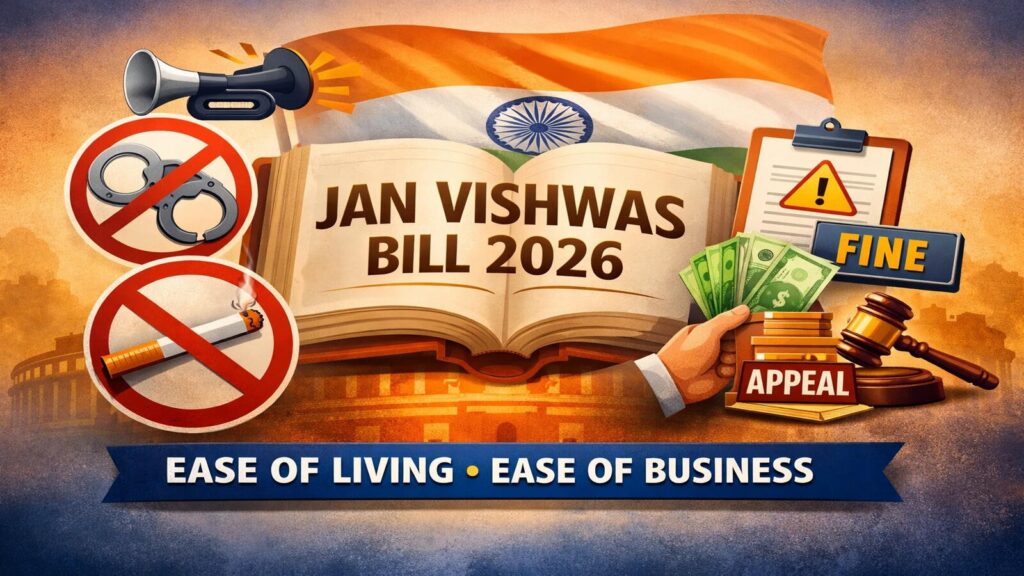
The Jan Vishwas (Amendment of Provisions) Bill, 2026 marks a major reform in India’s regulatory framework by decriminalising minor offences and promoting a trust-based compliance system. It builds upon the Jan Vishwas Act, 2023, aiming to enhance ease of doing business and reduce compliance burden.
EASE OF DOING BUSINESS IN INDIA● Definition: Ease of doing business refers to the simplicity, transparency, and efficiency of regulatory processes affecting businesses. ● Reform Measures: Includes decriminalisation, digitisation, single-window systems, and regulatory simplification. ● Global Rankings: Improved regulatory frameworks enhance India’s position in global business indices. ● Institutional Role: Bodies like DPIIT and NITI Aayog drive reforms to improve business environment. ● Economic Impact: A favourable business climate promotes investment, job creation, and economic growth. |
BACKGROUND: EVOLUTION OF THE REFORM
- Initial Reform (2023): The Jan Vishwas Act, 2023 decriminalised 183 provisions across 42 Central Acts, replacing criminal penalties with civil or administrative measures.
- Policy Objective: The reform aimed to reduce compliance anxiety, litigation burden, and regulatory overreach, especially for businesses.
- Scaling Up (2026): The new Bill expands reforms by covering 784 provisions across 79 Central Acts, significantly broadening its scope.
- Mass Decriminalisation: Around 717 provisions are proposed to be decriminalised, marking one of the largest regulatory rationalisation exercises.
- Stakeholder Consultation: Extensive engagement with industry bodies, experts, and policymakers shaped the reform framework.
SHIFT IN REGULATORY PHILOSOPHY
- From Punitive to Facilitative: The reform reflects a transition from criminalisation-based enforcement to a facilitative and trust-based regulatory approach.
- Proportionality Principle: Minor and procedural violations are treated through graded penalties, ensuring punishment aligns with the severity of offences while maintaining the precautionary principle for serious violations.
- Trust-Based Governance: The system assumes good faith compliance by businesses and citizens, encouraging voluntary adherence while promoting environmental democracy in regulatory processes.
- Reduced Fear Environment: By limiting criminal liability, the reform reduces compliance fear and harassment risks.
- Economic Efficiency: A predictable regulatory system promotes investment, entrepreneurship, and economic growth.
KEY FEATURES OF JAN VISHWAS 2.0
- Decriminalisation: Removal of criminal penalties for technical and procedural lapses, replacing them with civil penalties, including provisions related to environmental clearances and minor violations.
- Administrative Adjudication: Shift from courts to executive authorities for penalty imposition, ensuring faster resolution of cases.
- Removal of Obsolete Laws: Elimination of redundant and outdated provisions, improving legal clarity and coherence.
- Graded Enforcement: Introduction of warnings and reduced penalties for first-time violations, encouraging compliance rather than punishment.
- Sectoral Coverage: Reforms span across sectors such as environment, exports, textiles, and transport, including provisions under the Forest Conservation Act, Coastal Regulation Zone norms, EIA Notification, and environmental impact assessment procedures, reflecting a comprehensive approach.
IMPACT ON BUSINESS ENVIRONMENT
- Ease of Doing Business: Simplified compliance reduces regulatory burden, improving India’s investment attractiveness and business climate.
- Support for MSMEs: Micro, small, and medium enterprises benefit significantly due to reduced compliance costs and legal risks.
- Entrepreneurial Growth: Lower regulatory fear encourages innovation, startups, and new business ventures.
- Reduced Litigation Costs: Businesses save resources previously spent on legal disputes and compliance-related litigation.
- Investor Confidence: Transparent and predictable regulations enhance domestic and foreign investor confidence.
REDUCING JUDICIAL BURDEN
- Court Congestion: With nearly 5 crore pending cases, decriminalisation helps reduce burden on India’s judiciary.
- Minor Cases Removal: Shifting procedural violations out of courts frees judicial resources for serious criminal matters.
- Faster Resolution: Administrative mechanisms ensure time-bound dispute resolution, improving efficiency.
- Retrospective Relief: Potential closure of pending minor cases offers relief to individuals and businesses, including those involving ex post facto or retrospective environmental clearances.
- Judicial Efficiency: Reduced caseload enhances overall effectiveness of the justice delivery system.
CHALLENGES AND LIMITATIONS
- Implementation Gap: Success depends on effective execution by administrative authorities and regulatory bodies.
- Capacity Constraints: Institutions may lack the capacity for efficient adjudication and enforcement.
- Risk of Misuse: Reduced criminal liability may lead to complacency or deliberate non-compliance in some cases, potentially undermining the goal of a pollution free environment.
- Environmental Jurisprudence Concerns: The reform must balance ease of business with established principles of environmental jurisprudence, including the polluter pays principle, as highlighted in the Vanashakti judgment and other landmark cases.
- Ex-Post Facto Issues: Concerns exist regarding post facto or ex post regularisation of violations, which may weaken deterrence against non-compliance.
- Uniformity Issues: Variations in enforcement across regions may create inconsistencies and uncertainty.
- Awareness Deficit: Businesses, especially MSMEs, may lack awareness of new compliance frameworks and procedures.
WAY FORWARD
- Strengthen Institutions: Build capacity of regulatory authorities for effective and transparent adjudication.
- Clear Guidelines: Issue detailed rules and standard operating procedures for uniform enforcement, particularly for environmental clearance processes.
- Digital Integration: Use technology to ensure efficient monitoring, reporting, and compliance tracking.
- Continuous Consultation: Maintain dialogue with stakeholders to keep regulations responsive and relevant.
- Balanced Approach: Retain strict penalties for serious offences while ensuring fair treatment for minor violations, upholding both the polluter pays principle and the precautionary principle where necessary.
CONCLUSION
The Jan Vishwas 2.0 reform represents a paradigm shift in India’s regulatory framework, moving from a punitive to a trust-based compliance model. By decriminalising minor offences and promoting proportional enforcement, it aims to create a more business-friendly, transparent, and efficient system. However, its success will depend on effective implementation, institutional capacity, and sustained stakeholder engagement. Ultimately, the reform reinforces the principle that compliance thrives best in an environment of clarity, fairness, and trust.
SOURCE: TH
MAINS PRACTICE QUESTION
“Trust-based compliance is essential for improving ease of doing business in India.” Discuss in the context of the Jan Vishwas 2.0 reforms.

