 India's No.1 PU & Degree With Integrated IAS & IPS(UPSC/PSC) Training College.


India’s Demographic Future: Trends and Challenges
Future of India’s Demography
Syllabus
GS 2: Government policies and intervention
Why in the News?
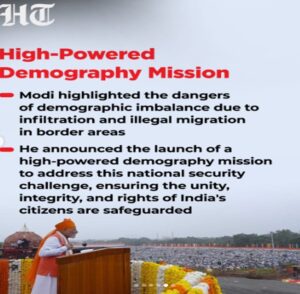
Recently, the government announced a Demographic Mission on August 15, 2025, to monitor undocumented immigration from Bangladesh, sparking debates on the need for a broader, inclusive demographic policy for India.
Introduction
- The announcement made on August 15, 2025, regarding the launch of a national demographic mission has stirred debates across social and political platforms.
- Initially framed around undocumented immigration from Bangladesh and its demographic effects, the discussion quickly expanded.
- India, standing at a demographic crossroads, must embrace a broader, inclusive demographic mission that integrates fertility, mortality, migration, and human capability development.
India’s Demographic Crossroads
- India today is the world’s most populous nation, possessing one of the youngest populations globally.
- This has become both a source of global admiration and national pride.
- Yet, policymakers have often limited their demographic focus to population control instead of harnessing its potential for inclusive growth and development.
- India’s demographic diversity varying in age, gender, and regional distribution can actually sustain its population strength well into the next century if managed wisely.
- To truly understand India’s demographics, one must study them not only within the country but also in comparison with global trends and challenges such as ageing populations in Europe, shrinking workforces in East Asia, and migration pressures across continents.
Need for a Broader Demography Mission
- The demographic mission announced should not remain confined to monitoring undocumented immigration.
- It must evolve into a holistic national mission to study and address changes in fertility, mortality, migration, education, health, and employment patterns.
- Over the past two decades, India has undergone substantial demographic transformation that goes beyond mere population numbers.
- A comprehensive approach should aim to understand not only the statistical trends but also their implications for economic development, social equity, and national planning.
Three Core Components: Fertility, Mortality, and Migration
- Traditionally, demography is studied through its three core elements: fertility, mortality, and migration.
- However, these factors must now be linked with indicators of human capability health, education, skills, and livelihoods.
- Fertility rates have declined across most states, leading to slowing population growth, while mortality rates have also improved due to better healthcare access.
- Migration, however, remains a dynamic and complex variable that demands urgent policy attention because of its role as a population balancer across regions.
Human Capability and Regional Inequality
- The real strength of India’s population lies not merely in its size but in its capabilities.
- A successful demography mission must focus on developing education and skill infrastructures that are inclusive and regionally balanced.
- Presently, educational facilities are concentrated in urban areas, creating deep inequalities between the affluent and the less privileged.
- The vision of a “Dream India” as the global skill capital can only be realized if opportunities for learning and skill development are distributed evenly across all regions.
- Without such equitable access, social mobility remains limited, and demographic advantages could turn into economic liabilities.
Migration: The Great Balancer and Its Challenges
- Internal migration has emerged as a crucial mechanism balancing population pressures between regions.
- Millions of Indians migrate annually from rural to urban areas or from less developed states to more industrialized ones in search of work and education.
- While fertility and mortality indicators show positive progress, migration presents unique political, social, and identity challenges.
- Policies must ensure that migration remains a choice available equally to everyone, not a compulsion driven by poverty or lack of opportunity.
Identity and Rights of Migrants
- Despite constitutional guarantees of free movement across states, migrants often face discrimination and are denied basic rights in host regions.
- The “migrant” label is not a natural identity but a socially and politically constructed one, often shaped by local biases and prejudices.
- Protecting this identity should be the responsibility of the state, ensuring equal rights and dignity for migrants regardless of origin.
- Both home and host states must share responsibility for protecting migrants’ rights and integrating them socially and economically.
Voting Rights and Belongingness
- One of the most complex issues concerning internal migration is the question of voting rights.
- Migrants often lose their right to vote in their home constituencies because they are no longer “usual residents.”
- However, host regions also do not recognize them as permanent voters, leaving them politically disenfranchised in both locations.
- This dual exclusion leads to a deeper psychological conflict a “battle of belonging” where migrants feel alienated from both their home and host communities.
- A demographic mission must address this democratic gap by proposing reforms that ensure portable voting rights or easier re-registration processes.
Longevity and the Challenge of Ageing
- Another major demographic shift India faces is increasing longevity.
- People are living longer due to improved healthcare, nutrition, and lifestyle changes.
- This longevity, while a positive sign of development, creates new challenges related to ageing, productivity, and social security.
- Policymakers must redefine what constitutes the “economically productive years” of life.
- Older adults can and should remain productive, provided they are healthy and engaged in meaningful activities.
- The traditional model, where social security is entirely the responsibility of the state, needs rethinking.
- Employers must play a proactive role in ensuring financial security for retirees through pension planning, skill retraining, and flexible work options.
Social Security in an Ageing India
- With people living longer, the burden of social security is growing.
- The state alone cannot sustain this increasing demand.
- Hence, a shared model involving individuals, employers, and the government is essential.
- Encouraging private pension schemes, health insurance, and savings incentives can ensure long-term financial independence for the elderly.
- Policymakers must design age-friendly infrastructure, healthcare systems, and employment models that value experience and intergenerational collaboration.
Integrating Demographic Sensitivity in Policy Making
- India’s planning and policy processes must become more demographically sensitive.
- Demographic realities should guide allocation of resources in education, healthcare, housing, and employment rather than relying merely on per capita indicators.
- The current obsession with per capita figures ignores population composition and age structure, leading to skewed policy priorities.
- For example, regions with younger populations require more investment in education and jobs, whereas those with older populations need better healthcare and social support systems.
- Demographic indicators must therefore form the foundation of policy evaluation, implementation, and long-term monitoring.
Demography Beyond Numbers
- Demography should not be seen merely as a statistical exercise offering retrospective and prospective projections of population change.
- It is a social science foundation that helps build the future of humanity through better planning and resource management.
- By integrating demographic insights into economic and social policies, India can better manage inclusion, mainstreaming, and marginalization.
- A well-designed demography mission should promote balance among population groups, foster equitable growth, and prepare the nation for global demographic transitions such as ageing in the West and declining fertility in East Asia.
Demography and Global Context
- India’s demographic journey must be studied in relation to global patterns.
- While countries like Japan and South Korea struggle with ageing populations and shrinking workforces, India’s youthful population offers a contrasting opportunity.
- This advantage, however, is time-sensitive.
- The demographic dividend will turn into a demographic burden if jobs, education, and healthcare do not expand proportionally.
- Learning from other countries’ demographic experiences such as skill-based migration in Europe and social welfare models in the Nordic nations can help India design adaptive strategies.
Towards a Comprehensive Demography Mission
- The proposed demographic mission must go beyond mere population
It should include:
- Comprehensive Data Analysis: Mapping fertility, mortality, and migration trends alongside social indicators.
- Regional Equity: Balancing investments in education, skills, and healthcare across states.
- Migration Reforms: Protecting migrant rights, ensuring political participation, and supporting economic integration.
- Longevity Planning: Redefining ageing and creating inclusive social security models.
- Demographic Sensitisation: Promoting awareness among policymakers, academia, and citizens about the importance of population composition.
- Such a mission can transform India’s demographic diversity into a strategic asset for sustainable development.
Conclusion
India’s demographic mission must transcend population counting to shape human capabilities, ensure migrant rights, and manage longevity challenges. By integrating demographic awareness into every policy sphere, India can convert its population diversity into a lasting developmental advantage.
Source: The Hindu
Mains Practice Question
Discuss the need for a holistic Demography Mission in India beyond fertility and mortality indicators, with special reference to education, health, and migration inequalities.

