 India's No.1 PU & Degree With Integrated IAS & IPS(UPSC/PSC) Training College.


India’s Carbon Emission Growth Slows in 2025
India’s Carbon Emission Growth Slows in 2025
Why in the News ?
The Global Carbon Project reported that India’s greenhouse gas emissions grew by only 1.4% in 2025, significantly lower than last year’s 4%. The slowdown is attributed to favourable monsoon conditions reducing cooling demand and a strong rise in clean energy transitions.
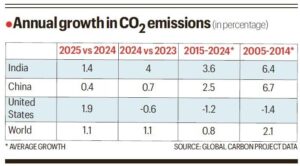
Key Findings on India’s 2025 Emission Trends:
- Slower Growth: India’s greenhouse gas emissions increased by 1.4%, compared to 4% growth in 2024, indicating a moderated rise.
- Monsoon Impact: A favourable monsoon reduced temperatures and lowered electricity demand for cooling, contributing to lower emissions.
- Renewable Energy Boost: The rise in solar and wind power generation reduced dependency on coal, helping stabilize emission levels.
- Global Comparison: Globally, emissions are expected to rise 1.1%, reaching 38 billion tonnes this year.
- Major Emitters: India remains the third-largest emitter with 3.2 billion tonnes/year, following China (12 billion tonnes) and the U.S. (4.9 billion tonnes).
Global Emission Patterns and Climate Concerns
- China’s Emissions: China’s emissions grew by 0.4%, attributed to moderate energy consumption and massive clean energy transitions.
- Rise in Developed Nations: The United States (+1.9%) and European Union (+0.4%) also recorded emission growth in 2025.
- Per Capita Emissions: India’s per capita emission stands at 2.2 tonnes, among the lowest within the world’s 20 major economies.
- Fossil Fuel Use: Global CO₂ emissions from coal (+0.8%), oil (+1%), and natural gas (+1.3%) remain major contributors.
- Carbon Budget Warning: Only 170 billion tonnes CO₂ remain to limit warming to 1.5°C, equivalent to four years at current emission levels.
About Global Carbon Budget & India’s Emission Profile : |
| ● Global Carbon Project: A leading scientific consortium tracking greenhouse gas emissions, land-use changes, and carbon sinks. |
| ● Carbon Budget: The allowable amount of CO₂ emissions to keep global warming below a temperature threshold, such as 1.5°C. |
| ● India’s Energy Mix: Coal remains the dominant fuel in India’s power sector, though clean energy transitions are rapidly expanding. |
| ● Land-Use Emissions: Permanent deforestation emits ~4 billion tonnes/year, offset only partially by reforestation efforts. |
| ● Climate Change Impact: Declining efficiency of land and ocean carbon sinks indicates reduced natural absorption capacity. |
To address these challenges, India is exploring various strategies including emission trading systems and voluntary carbon markets (VCM). These mechanisms, along with sustainable forest management and environmental impact assessments, are crucial for meeting India’s nationally determined contributions under international climate agreements. Carbon offset projects and carbon market cooperation are also being considered to support clean energy transitions and reduce overall greenhouse gas emissions.

